Web Development · Architecture Patterns
Idempotency Keys: How to Make API Endpoints Safe to Retry
Idempotency keys let a client retry a request that may have already succeeded, without double-charging a card. The pattern, in Postgres and in Redis.

Prathviraj Singh
6 min read
Sponsored
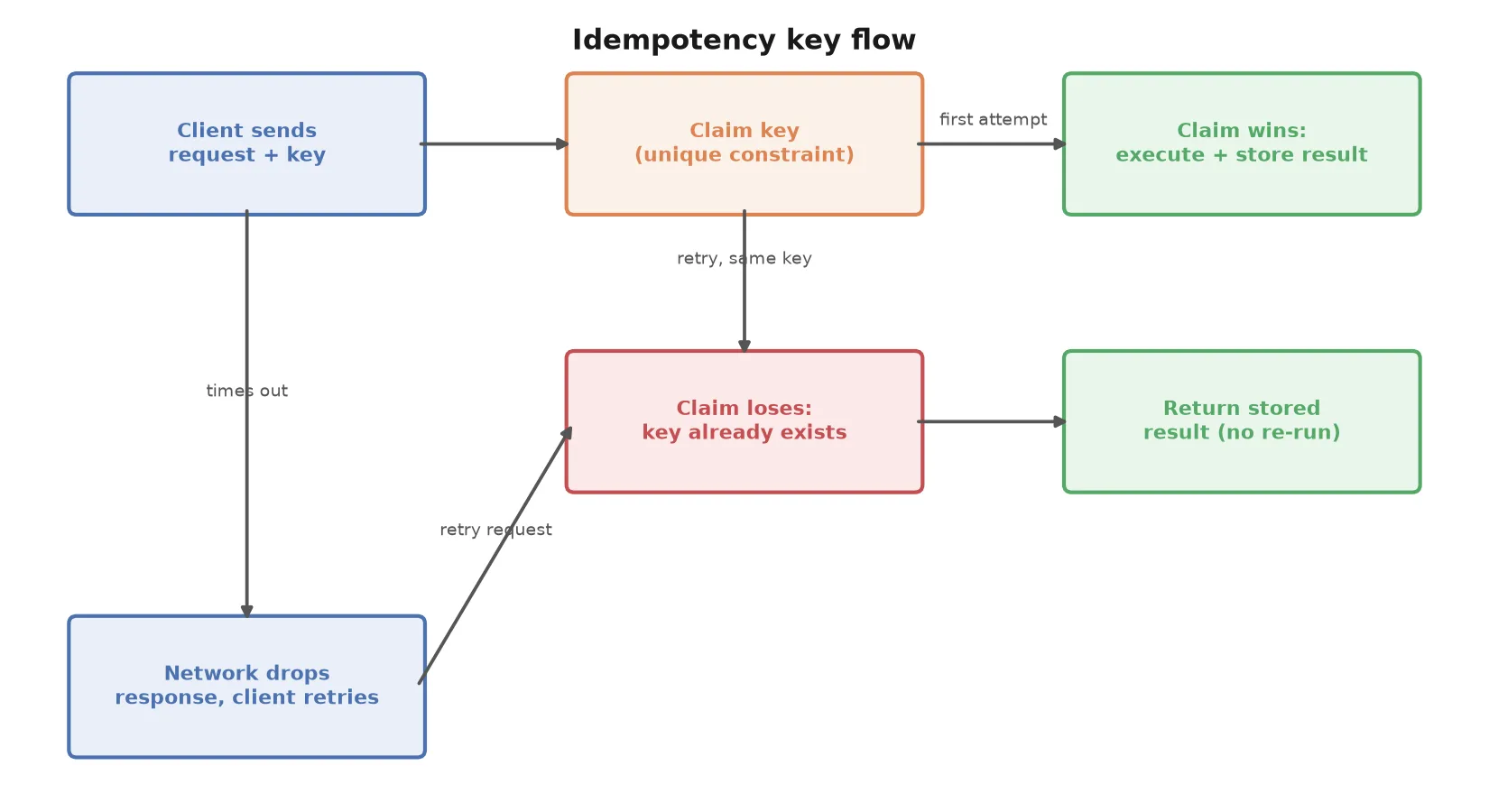
A payment request times out. The client doesn’t know if the card was charged or not, so it retries. Without protection against this exact scenario, that retry can charge the customer twice. Idempotency keys are the standard fix: a unique value the client attaches to a request so the server can recognize “I’ve already processed this” and return the original result instead of repeating the side effect.
The failure mode this actually fixes
The problem isn’t that clients retry, retrying is the correct behavior when you don’t know if a request succeeded. The problem is that a naive retry re-executes the operation, and for anything with a side effect (charging a card, creating an order, sending a notification, incrementing a counter) that means doing it twice.
Client                          Server
  |--- POST /charge ------------->|
  |                                | charges card, saves order
  |<---------- (timeout, no response)
  |
  |--- POST /charge (retry) ----->|   <- without idempotency protection,
  |                                |      this charges the card again
The client has no reliable way to distinguish “the server never got my request” from “the server processed it and the response got lost.” Both look identical from the client’s side: silence. An idempotency key moves the decision of “have I seen this exact logical request before” onto the server, where it can actually be answered.
How the pattern works
The client generates a unique key, typically a UUID, once per logical operation, and sends it on every attempt including retries.
POST /api/charges HTTP/1.1
Idempotency-Key: 8f14e45f-ceea-467e-bd3f-8e7cd377f123
Content-Type: application/json

{"amount": 4999, "currency": "usd", "customer_id": "cus_123"}
If the client has to retry, it sends the exact same key with the exact same request. The server’s job is to recognize the key, check whether it already has a stored outcome for it, and if so, return that outcome instead of executing the operation again.
A real implementation against Postgres
Here’s a working pattern, not pseudocode. It uses a dedicated table with a unique constraint on the key to close the race condition where two concurrent requests with the same key both try to proceed.
CREATE TABLE idempotency_keys (
    key             TEXT PRIMARY KEY,
    status          TEXT NOT NULL DEFAULT 'in_progress',
    response_body   JSONB,
    response_status INT,
    created_at      TIMESTAMPTZ NOT NULL DEFAULT now(),
    expires_at      TIMESTAMPTZ NOT NULL
);
import json
from datetime import datetime, timedelta, timezone
from psycopg2 import IntegrityError
IDEMPOTENCY_WINDOW = timedelta(hours=24)
def handle_charge_request(idempotency_key, request_body, db):
# Try to claim the key atomically. If another request already
# claimed it, this insert fails on the unique constraint.
try:
db.execute(
"""INSERT INTO idempotency_keys (key, status, expires_at)
VALUES (%s, 'in_progress', %s)""",
(idempotency_key, datetime.now(timezone.utc) + IDEMPOTENCY_WINDOW),
)
db.commit()
except IntegrityError:
db.rollback()
return get_existing_result(idempotency_key, db)
# This request won the race. Do the actual work.
try:
result = charge_card(request_body)
db.execute(
"""UPDATE idempotency_keys
SET status = 'completed', response_body = %s, response_status = %s
WHERE key = %s""",
(json.dumps(result), 200, idempotency_key),
)
db.commit()
return result, 200
except Exception as e:
db.execute("UPDATE idempotency_keys SET status = 'failed' WHERE key = %s", (idempotency_key,))
db.commit()
raise
def get_existing_result(idempotency_key, db):
row = db.execute(
"SELECT status, response_body, response_status FROM idempotency_keys WHERE key = %s",
(idempotency_key,),
).fetchone()
if row["status"] == "in_progress":
# Another request is still processing this key. A 409 tells the
# client to back off and retry, rather than racing further.
return {"error": "request already in progress"}, 409
return json.loads(row["response_body"]), row["response_status"]
The unique constraint on key is what actually closes the race. Two nearly-simultaneous requests with the same key both attempt the insert; the database guarantees only one succeeds, and the loser reads the winner’s eventual result instead of proceeding independently.
Why a Redis SETNX version is sometimes better
If your throughput or latency requirements make a database round-trip for key claiming too slow, Redis’s SETNX (set if not exists) gives you the same atomic claim semantics with lower latency:
import redis
r = redis.Redis()

def claim_key(idempotency_key, ttl_seconds=86400):
    # SETNX-style atomic claim: returns True only for the first caller
    claimed = r.set(f"idem:{idempotency_key}", "in_progress", nx=True, ex=ttl_seconds)
    return claimed is not None
The tradeoff is durability. Redis is fast but typically configured for performance over strict durability, so a Redis-only implementation risks losing a claimed-but-not-yet-persisted key on a crash. A common pattern is Redis for the fast claim path with the authoritative result still written to your primary database, giving you speed on the common path and durability on the record that matters.
What idempotency keys don’t do
They protect exactly the operation they’re scoped to, nothing more. A multi-step checkout flow, reserve inventory, charge the card, create the order, needs either a separate idempotency key per step or a higher-level orchestration pattern that tracks the whole workflow’s state, not one key wrapping the entire sequence. Treating one key as coverage for a multi-step process is a common design mistake; it protects the first step from duplication and does nothing for the rest.
They also don’t replace input validation or authorization checks. A replayed request with a stored idempotency key still needs to go through the same authorization checks on the way in, in case the key has expired or the requester’s permissions changed between the original request and the retry.
For workflows more complex than a single-step operation, the durable execution patterns discussed in our background jobs and workflow orchestration guide build on the same core idea, tracking state so a retry resumes correctly instead of restarting, just extended across multiple steps instead of one request.
Where to actually put this
Add idempotency key support to any endpoint with a side effect that a client might retry: payments, order creation, sending a notification, or any operation triggered by a webhook (webhooks are retried by design on many providers, which makes this pattern close to mandatory for webhook handlers). Skip it for genuinely read-only or naturally idempotent operations, adding the machinery there is complexity with nothing to show for it.
The pattern is small to implement and prevents a category of bug that’s expensive precisely because it tends to surface in production, under real network conditions, against a real customer’s payment method, not in a test suite where requests rarely time out.
Frequently asked questions
- What problem do idempotency keys actually solve?
- The specific failure mode is: a client sends a request that creates a side effect (charges a card, creates an order, sends an email), the server processes it successfully, but the response never reaches the client because of a network timeout, a dropped connection, or a proxy failure. The client has no way to distinguish 'the request failed' from 'the request succeeded but I didn't hear back,' so a naive retry can trigger the side effect twice. An idempotency key lets the server recognize 'I've already handled this exact logical request' and return the original result instead of repeating the side effect.
- Is idempotency the same as making an endpoint idempotent by HTTP method (like PUT)?
- No, and conflating them is a common mistake. HTTP defines GET, PUT, and DELETE as idempotent by convention, meaning calling them multiple times with the same input should produce the same end state. But POST, the method used for most operations with real side effects (charging a card, creating an order), is explicitly not idempotent by the HTTP spec. Idempotency keys are how you add idempotency semantics to an operation, typically a POST, that isn't naturally idempotent by method alone.
- Where should the idempotency key be stored on the server?
- In a datastore the request handler can check before doing any work with side effects, and update atomically once the operation completes: a dedicated table in your primary database, or a fast key-value store like Redis if you need lower latency and can tolerate the operational complexity of a second system. The record needs at minimum the key, a status (in-progress, completed, failed), the response to return on replay, and an expiry timestamp.
- What happens if two requests with the same idempotency key arrive at nearly the same time?
- This is the race condition the naive 'check then insert' implementation misses. If both requests check for the key, find nothing, and both proceed to execute the side effect, you've defeated the entire point. The fix is to make key registration atomic: use a unique constraint on the key column and let the second insert fail, or use an atomic check-and-set operation like Redis's SETNX, so only one request can claim the key and proceed while the other waits for or reads the first request's result.
- How long should an idempotency key stay valid?
- Long enough to cover realistic retry windows but not indefinitely. Stripe's API, one of the most widely referenced implementations of this pattern, uses a 24-hour window. After that, the same key can be reused for a new, unrelated request. Pick a window based on how long your client-side retry logic and any manual customer-support retries realistically need, then expire and clean up keys past that window so the table doesn't grow unbounded.
Sponsored
More from this category
More from Web Development
Sponsored
Discussion
Join the conversation.
Comments are powered by GitHub Discussions. Sign in with your GitHub account to leave a comment.
Sponsored