Cloud & Infrastructure · AI Infrastructure
Google's $12.2B Marvell Bet: What It Means If You Build on GCP's AI Stack
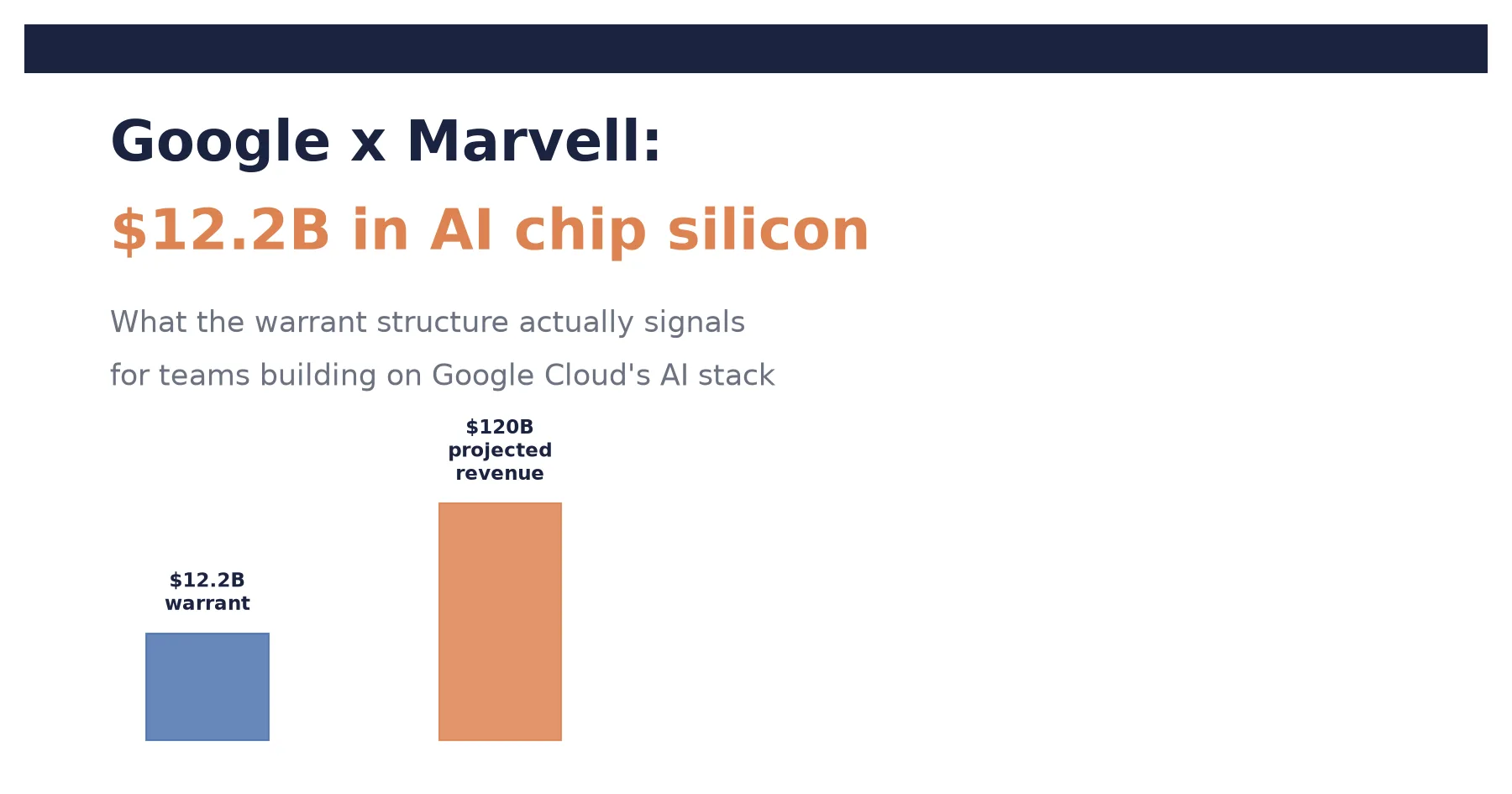
Marvell just gave Google a warrant to buy up to $12.2 billion in its shares, tied to Google's custom TPU silicon roadmap. Here's what the deal structure actually says about where Google Cloud's AI infrastructure is headed, and what it means for teams building on it.

Shashikant Gupta
4 min read
Sponsored
Marvell handed Google the right to buy up to $12.2 billion of its own stock this week, and the number that matters isn’t the size, it’s the structure. This isn’t Google writing a check for equity. It’s a warrant that vests as Google actually buys chips, which makes the deal a direct, dollar-denominated bet on how much custom AI silicon Google’s roadmap is going to consume through 2033.
If you build anything on Google Cloud’s AI infrastructure, that’s worth fifteen minutes of attention even though nothing about it changes your bill today.
What actually got announced
Marvell gave Google a warrant to purchase up to 58.97 million Marvell shares at $206.58 each, a stake worth roughly $12.18 billion if Google exercises the whole thing. Most of that warrant doesn’t just sit there vesting on a calendar, it becomes exercisable in proportion to Google hitting agreed chip-purchasing targets with Marvell through fiscal 2033. If Google buys less silicon than projected, less of the warrant vests. If the deal plays out as structured, Google could end up as Marvell’s fifth-largest shareholder, purely as a side effect of buying chips at the volume the agreement assumes.
That structure is the actual story. A straight equity purchase would just be Google parking cash. A purchase-linked warrant means Marvell is willing to hand over that much upside specifically to lock in Google as a long-term buyer, and Google is willing to accept the incentive because the purchasing commitment behind it is one they already intend to hit.
What Marvell is actually building
The partnership covers a broad range of chips and related technology designed to work with Google’s TPU ecosystem, the custom tensor processing units that run most of Google’s internal AI workloads and back a growing share of what Google Cloud rents out to customers as AI compute. Marvell isn’t a household name the way Nvidia is, but it’s one of a small number of companies with the fabrication and design relationships to help a hyperscaler build custom silicon at this scale, and Broadcom has historically held that same role for Google and other hyperscalers.
That’s what made the market reaction legible. Marvell’s stock jumped more than 11% in premarket trading on the news. Broadcom, the closest comparable supplier for this kind of work, fell more than 3% in the same session. Neither move is proof that Google is abandoning Broadcom, hyperscalers routinely run multiple custom-silicon partnerships in parallel to avoid single-supplier risk, but the market read the deal’s size as a real shift in how much of that work is going to Marvell specifically.
The number that actually signals something
The projection getting less attention than the $12.2 billion warrant is the revenue figure behind it: the deal could bring Marvell roughly $120 billion through fiscal 2033 if Google hits its purchasing targets. That’s not Marvell’s estimate of Google’s total AI spend, it’s Marvell’s estimate of just the portion of custom chip development it expects to capture from one hyperscaler over seven years.
Public statements about AI infrastructure investment tend to be big round numbers attached to a press release. A supplier’s internal revenue projection, backed by a purchasing commitment large enough to justify handing over a $12 billion equity incentive, is a harder number to inflate for headlines. It’s one of the more concrete signals available right now for how much custom silicon capacity Google actually expects to need, as opposed to how much capacity it’s announced.
What this means if you build on GCP
Nothing changes in your Google Cloud console this week. No pricing update, no new instance type, no capacity announcement tied to this specific deal. What it does tell you, if you’re making multi-year infrastructure decisions that assume continued TPU availability and pricing stability on Google Cloud, is that Google is backing that assumption with a supply commitment large enough to move Marvell’s stock double digits.
That’s a reasonable input if you’re weighing GCP against other clouds for a long-lived AI workload, the kind of decision that also shows up in comparing vector database and inference infrastructure choices where the underlying compute economics matter as much as the API surface. It doesn’t tell you anything about next quarter’s pricing, and it’s not a reason to make an infrastructure decision today that you wouldn’t otherwise make. It’s a data point for the multi-year column, not the this-sprint column, and treating it as anything bigger than that is reading more into a supplier warrant than the filing actually supports.
If your team is evaluating cloud AI infrastructure commitments at this scale, that’s exactly the kind of decision worth an architecture review before signing a multi-year contract on assumptions a single press release can’t actually verify.
Frequently asked questions
- Did Google just buy $12.2 billion of Marvell stock?
- No. Google received a warrant, an option to buy up to 58.97 million Marvell shares at $206.58 apiece, not the shares themselves. Most of that warrant only becomes exercisable if Google meets agreed chip-purchasing targets with Marvell through fiscal 2033. It's structured as an incentive tied to actual silicon purchases, not an upfront equity purchase.
- What does Marvell actually build for Google?
- Marvell helps develop the custom chips that support Google's TPU ecosystem, the tensor processing units that underpin most of Google's internal AI infrastructure, including the systems Google Cloud rents out to customers. The deal covers a broad range of chips and related technology built to work with that ecosystem, not a single product line.
- Why did Broadcom's stock fall on this news?
- Broadcom is the other major custom-chip design partner for hyperscale AI infrastructure, and investors read the size and structure of the Marvell deal as a signal that Google may be shifting more of its custom silicon work toward Marvell. Broadcom dropped more than 3% in the same trading session Marvell rose over 11%, though Broadcom still holds other major hyperscaler relationships this one deal doesn't erase.
- Does this affect Google Cloud TPU pricing or availability for customers?
- Not directly or immediately. This is a multi-year supply and incentive agreement about chip development and purchasing, not a pricing change. The practical read for teams building on GCP's AI stack is that Google is locking in custom silicon supply at a scale that suggests continued TPU capacity growth, which is a reasonable signal for planning long-term AI infrastructure commitments on Google Cloud, but it isn't something that changes your invoice this quarter.
Sources
Sponsored
More from this category
More from Cloud & Infrastructure
 R.01
R.01 Graceful Shutdown in Containers: SIGTERM, Draining, and the Errors Nobody Debugs
 R.02
R.02 Merkle Trees Explained: How Git, DynamoDB, and Bitcoin Verify Data Without Reading All of It
 R.03
R.03 Leader Election Explained: How a Cluster Picks Who's in Charge
Sponsored
Discussion
Join the conversation.
Comments are powered by GitHub Discussions. Sign in with your GitHub account to leave a comment.
Sponsored