AI Integration · AI Model Releases
GPT-6.1 Sol Cost Per Task: What It Means for Agents
GPT-6.1 Sol launched September 29 near Astra's scores at about a fifth of the cost per task. What the numbers mean for agent loops, and what to test first.

Shashikant Gupta
5 min read

Sponsored
OpenAI released GPT-6.1 Sol on September 29, 2026, one week after GPT-6 Sol, and the pitch is not a lower per-token price. List pricing is unchanged at $2 per million input tokens and $10 per million output. The pitch is that it reaches nearly the same scores as GPT-6 Astra while costing about a fifth as much to finish a task.
That distinction decides whether this release matters to your budget. Here is what has been reported, where to be careful, and how to test it. Figures below come from Vellum’s breakdown and TestingCatalog’s launch report. They are vendor-reported benchmarks relayed by third parties, so read them as claims to verify.
The specs
| Item | Value |
|---|---|
| Release date | September 29, 2026 (DevDay) |
| API model id | gpt-6.1-sol |
| Context window | 1,050,000 tokens |
| Input price | $2.00 per million tokens |
| Cached input | $0.10 per million tokens |
| Output price | $10.00 per million tokens |
Access: ChatGPT Work and Codex for Plus, Pro, Business, Enterprise and Edu users, plus the API. TestingCatalog notes it is not in the standard Chat product.
One detail to catch if you read our GPT-6 Sol and Luna pricing breakdown: that post cited a 90% discount on cached input. Cached input at $0.10 per million is a 95% discount off the $2.00 standard rate. For agents that resend a large system prompt and tool list on every step, that is the number to rerun your cost model with.
Cost per task is the real comparison
Agent workloads aren’t priced by tokens in a spreadsheet. They are priced by how many steps a task takes and how much context each step drags along. Reported per-task costs for Sol against Astra:
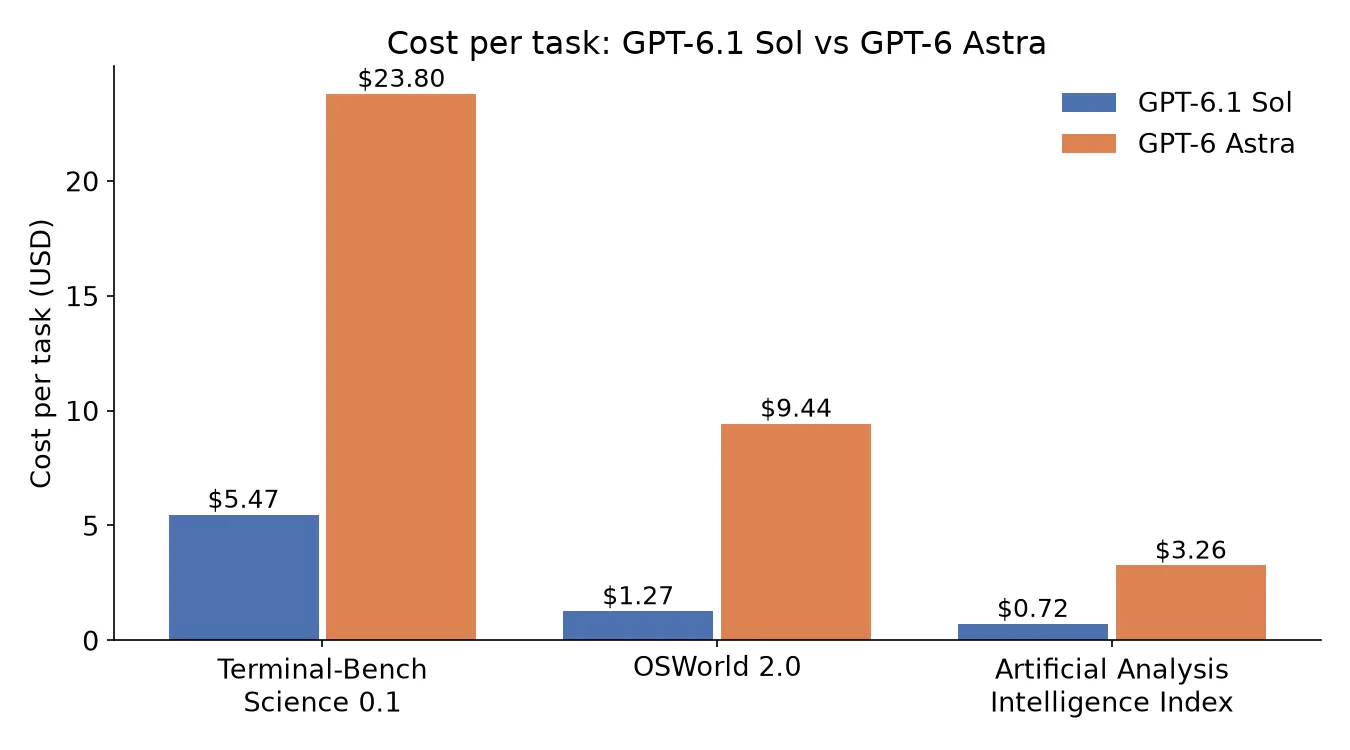
The figures behind the chart: $5.47 vs $23.80 per task on Terminal-Bench Science 0.1, $1.27 vs $9.44 on OSWorld 2.0, and $0.72 vs $3.26 on the Artificial Analysis Intelligence Index. The gap runs from roughly a fifth to a seventh, depending on the benchmark.
What you give up
Astra is not obsolete. On OSWorld 2.0, a benchmark of 108 long-horizon computer-use workflows, reported scores are 71.4% for Sol and 73.5% for Astra. That is a 2.1-point gap. On Terminal-Bench Science, Astra still leads at 68.1%, and Vellum’s guidance is to keep Astra for the hardest mathematical and laboratory-research work where maximum reasoning matters more than cost.
So the question for most product teams is whether 2 points of accuracy is worth 5 to 7 times the spend. For a support triage agent processing thousands of tickets a day, almost certainly not. For a task where a wrong answer costs you a customer or a regulatory finding, the math changes, and you should measure the failure rate on that task rather than trust a general benchmark.
Reported scores for Sol itself, per Vellum: 75.2% on DeepSWE v1.1, 71.4% on OSWorld 2.0, 32.0% on GDP.pdf (document analysis) and 36.0% on AutomationBench 1.0.6. Those numbers mean little in isolation. They are useful for ranking models, and not for predicting your own success rate.
Where Sol should help most
Three workload shapes benefit from this combination of price and caching:
- Long agent loops with a stable prefix. If your agent resends the same instructions and tool definitions on each step, cache hits at $0.10 per million tokens cut that fixed cost sharply. Check that your prompts keep the stable part first, since caching rewards identical prefixes.
- GUI and computer-use automation. Vellum points to per-step expense as the usual barrier here. At $1.27 per OSWorld task, workflows that were uneconomic at Astra’s $9.44 may now pencil out.
- Document and finance processing. High volume, moderate difficulty, and a clear accuracy metric you can check.
If you are already trimming agent spend, cutting AI agent token costs with MCP tool pruning stacks with this. A smaller tool list shrinks the prefix you are caching, and a cheaper model shrinks the rate you pay for it.
How to test it in a day
Don’t switch on a benchmark table. Do this:
- Pull 200 to 500 real, recent tasks from your logs, including the ones your current model got wrong.
- Run each through your current model and through
gpt-6.1-solwith the same prompt and tools. - Score success with the check you already use in production, not a new rubric.
- Record total cost per task, including retries and tool calls, plus the 95th percentile, since expensive outliers are where agent budgets go missing.
- Route by task type, not globally. Send the cheap, high-volume tasks to Sol and keep a stronger model as the fallback when a verifier fails.
If the success rates are within noise, take the cost savings. If they aren’t, you’ve learned which task types need the bigger model, which is the more useful result.
For help setting up an evaluation setup or a routing layer, our AI integration team builds these.
The takeaway: stop comparing price per million tokens and start comparing cost per successfully completed task. On that measure, GPT-6.1 Sol is worth a serious test this week.
Frequently asked questions
- How much does GPT-6.1 Sol cost?
- Standard API pricing is $2.00 per million input tokens and $10.00 per million output tokens, the same list price as GPT-6 Sol. Cached input is $0.10 per million tokens. The model id is gpt-6.1-sol and the context window is 1,050,000 tokens.
- Is GPT-6.1 Sol better than GPT-6 Astra?
- Not across the board. Reported scores put it within roughly two points of Astra on coding, computer use and document work, at about a fifth of the cost per task. Astra still leads on the hardest scientific benchmarks, such as Terminal-Bench Science, where it scores 68.1%.
- Why is cost per task different from price per token?
- Per-token prices tell you what a token costs. Cost per task also counts how many tokens a model burns reaching an answer, including reasoning tokens and retries. A model with the same per-token price as another can finish a task for far less if it uses fewer tokens or fewer tool calls.
- Should I switch my production agents to GPT-6.1 Sol?
- Test first. Replay a few hundred of your own real tasks through both models and compare success rate and total cost, not just token price. Benchmarks here are vendor-reported, and your tasks are the only ones that matter for your bill.
Sources
Sponsored
More from this category
More from AI Integration



Sponsored
Discussion
Join the conversation.
Comments are powered by GitHub Discussions. Sign in with your GitHub account to leave a comment.
Sponsored