AI Integration · GEO & Answer Engines
Does llms.txt Actually Work? What 137K Sites Show
Ahrefs checked server logs on 137,000 domains. 97% of published llms.txt files got zero requests in May 2026. Here's who actually reads the file, and who doesn't.

Shashikant Gupta
5 min read

Sponsored
Every SEO newsletter spent 2025 telling you to add an llms.txt file to your site or get left behind in the AI search era. Ahrefs just checked whether anyone’s actually reading the file. Across 137,000 domains, in May 2026: 97% of the llms.txt files that sites published got zero requests. Not low traffic. Zero.
What the study actually measured
Ahrefs pulled server logs and live traffic data across 137,000 domains and found that 28% of them publish an llms.txt file, a real, measurable adoption number. Of that roughly 38,000, about 1,100 files received any request at all during May 2026. The rest sat there, unread, the entire month.
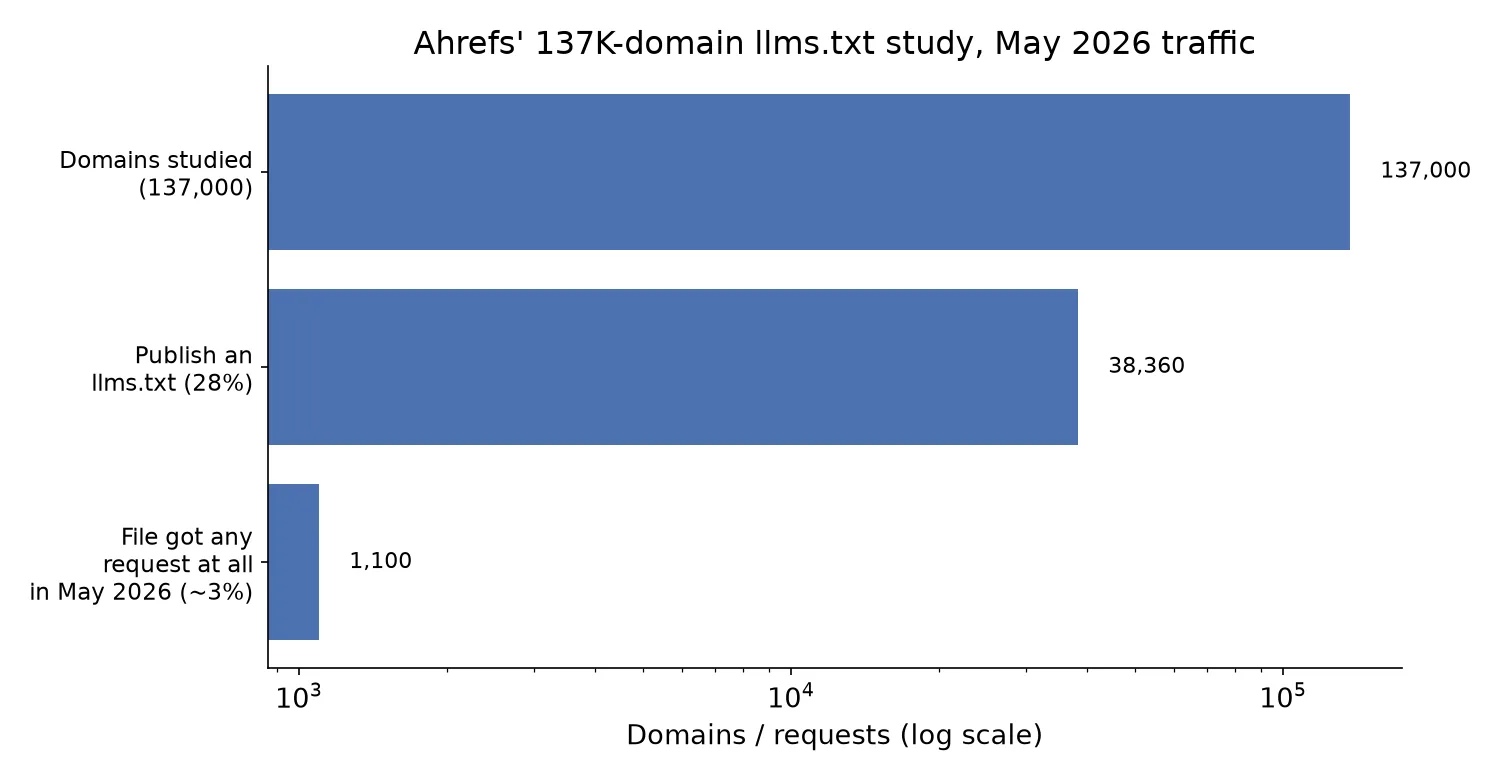
Here’s the part that should reset expectations further: of the requests that did land, the large majority came from bots, SEO audit tools, and scanners checking whether the file existed, not from AI systems using it to build an answer. Retrieval and citation crawlers, the ones actually deciding what gets quoted back to a user, accounted for roughly one in ninety of those requests. That’s not a rounding error. That’s most of the traffic being other people’s SEO tools checking your llms.txt, not AI systems reading it.
Google already told you to skip it
This isn’t just one study landing awkwardly. Google’s own public guidance says you don’t need to create special machine-readable AI text files, markup, or Markdown to show up in its generative AI search results, and llms.txt is specifically named in that list of things you can skip. John Mueller was more direct when someone pressed him on Reddit: if an AI platform that actually sends you clients asks for the file, build it. Otherwise, “prioritize needs before dreams.”
That’s a fair way to read the whole situation. Nobody’s claiming llms.txt actively hurts anything. The claim being walked back is the one that mattered: that publishing it does something measurable for AI search visibility. As of May 2026’s data, for most sites, it doesn’t.
Where it actually gets used
Here’s the finding that doesn’t fit the “llms.txt is dead” headline some outlets ran with. IDE coding agents fetch it routinely. Cursor, GitHub Copilot, Claude Code, Cline, and Windsurf all check for /llms.txt when a developer points them at a documentation site, because a clean markdown index of your docs is easier for an agent to work with than scraping rendered HTML, stripping navigation chrome, and guessing at what’s actually the content.
If you maintain a developer tool, an API, or documentation that people integrate against with AI coding assistants sitting next to them, that’s a real, present-day audience for the file. It’s just not the audience most of the hype was written for. The confusion comes from conflating “AI reads this” (true, for coding agents working against docs) with “AI search cites this” (not supported by the traffic data, as of now).
The format, if you’re building one
The spec, maintained at llmstxt.org, is intentionally minimal: a markdown file with an H1 naming your project, a blockquote summary, optional free-text context, and H2-delimited sections listing links with short descriptions. No XML, no required schema beyond that structure. If you’re building this for a documentation site specifically, that’s a reasonable investment of an afternoon, not a project.
Worth noting: the W3C opened a working draft in June 2026 aimed at formally standardizing the format, which suggests it’s not going away even as the near-term “does it move the needle” data comes back thin. Standards bodies don’t usually pick up conventions nobody’s using; they pick up conventions that are sticking around long enough to be worth reconciling into something more formal.
The same goes for SEO work more broadly: the things that move real numbers rarely look like the newest shiny convention, they look like the boring, well-measured basics done consistently. Our post on what 800 posts taught us about technical SEO measurement makes the longer version of that argument with a whole corpus instead of one file format.
The actual decision
Skip it if you’re chasing AI Overview citations or ChatGPT mentions specifically; that’s not what the current data supports, and Google is telling you the same thing directly. Build it if you run developer-facing documentation, because the coding agents your users already have open are checking for it. For most of the rest of the web, this is a low-cost, low-return afternoon project, not the urgent AI-SEO migration a lot of guides made it sound like. If you’re weighing where to actually spend GEO effort instead, answer engine optimization as a discipline is where the real, better-evidenced work is happening right now, and it’s worth reading before you spend the afternoon on this instead.
Frequently asked questions
- Does llms.txt help you get cited by ChatGPT or Google's AI Overviews?
- The evidence so far says no, or at least not yet. Ahrefs' server-log study across 137,000 domains found that retrieval and citation crawlers, the bots that actually decide what gets quoted in a live AI answer, accounted for roughly one in every ninety requests to llms.txt files that got any traffic at all. Google has stated directly that you don't need special AI text files to appear in its AI-generated search results.
- Is llms.txt a wasted effort, then?
- Not entirely, it depends on your audience. If your goal is AI search citation (ChatGPT, Perplexity, Google AI Overviews), the current data doesn't support it doing much. If you maintain developer documentation, it's a different story: IDE coding agents like Cursor, GitHub Copilot, and Claude Code do fetch llms.txt when working against your docs, because a clean markdown index is easier for them to use than scraping rendered HTML pages.
- What does Google actually say about llms.txt?
- Google's own guidance states you don't need to create machine-readable AI text files, special markup, or Markdown to appear in generative AI search, and lists llms.txt specifically among things site owners can skip. John Mueller, asked directly on Reddit, said if an AI platform that sends you real traffic asks for the file, build it. Otherwise, his advice was to prioritize needs before dreams, not to chase a convention with no confirmed ranking or citation benefit.
- What's the actual file format for llms.txt?
- A markdown file at your site's root (or a subpath) with a required H1 heading naming your site or project, a blockquote with a short summary, optional free-text sections with more detail, and H2-delimited sections listing links as a markdown list, each with an optional colon-separated description. It's deliberately simple: readable by a human, parseable by a model, no XML or JSON required.
- Should I build an llms.txt file for my site?
- If you run a documentation site, a developer tool, or an API that people integrate against with the help of AI coding assistants, yes, the audience that demonstrably uses the file is right there. If you're building it purely as an SEO or answer-engine-optimization play hoping it drives AI search citations, the current data doesn't back that expectation up, and your time is better spent elsewhere for now.
Sources
Sponsored
More from this category
More from AI Integration



Sponsored
Discussion
Join the conversation.
Comments are powered by GitHub Discussions. Sign in with your GitHub account to leave a comment.
Sponsored