Business · Hiring
How to Hire a Data Engineer in 2026
Data engineers build the pipelines, warehouses, and transformation layers. They aren't data scientists, backend developers, or analysts. How to hire for it.

Shashikant Gupta
8 min read

Sponsored
Hiring a data engineer is harder than it looks, partly because the role does not have clean boundaries and partly because every candidate pool contains three adjacent profiles that are not quite right for the job.
Data scientists who have done some pipeline work. Backend engineers who have written a few ETL scripts. Analysts who have taken a data engineering course. None of these are bad people or weak candidates. But none of them are data engineers without significant additional experience, and the gap shows up quickly in production.
The screen has to separate them from the real thing.
What data engineers actually do
The role exists because the work of moving, cleaning, and structuring data is distinct from using that data, and complex enough to be a full-time job at any team with meaningful data volume.
A data engineer’s typical responsibilities:
- Building ingestion pipelines from source systems (databases, third-party APIs, event streams) into a staging layer
- Writing transformation logic that turns raw data into clean, queryable tables, usually in SQL with dbt, sometimes in PySpark for large volumes
- Running an orchestration layer that schedules jobs, handles retries, monitors for failures, and tracks dependencies
- Managing the warehouse schema and its evolution as source data changes
- Building the data quality checks that catch bad data before it reaches analysts and dashboards
- Partnering with analysts and data scientists to understand what models they need
Note what is not on the list: building predictive models, doing statistical analysis, writing application backends, or managing application databases. These cross into adjacent roles.
The SQL screen: beyond basic queries
SQL is the data engineer’s primary tool and the floor of any screen. But a SQL screen for a data engineer should test different things than a SQL screen for a backend developer.
Window functions are the clearest differentiator. Give a problem that requires RANK(), LAG(), or a rolling aggregation with PARTITION BY. A backend developer often solves this with a subquery or a join. A working data engineer reaches for the window function because they have used it a hundred times.
A good problem:
-- Given a table of daily sales by product:
-- sales(product_id, sale_date, revenue)
-- Write a query that returns, for each product and each day:
-- the revenue for that day, the revenue from the previous day, and
-- the 7-day rolling average revenue.
Expected answer uses LAG(revenue, 1) OVER (PARTITION BY product_id ORDER BY sale_date) and AVG(revenue) OVER (PARTITION BY product_id ORDER BY sale_date ROWS BETWEEN 6 PRECEDING AND CURRENT ROW).
A candidate who writes three separate subqueries and a manual join to produce the same result is working much harder than necessary and has revealed they do not think in window functions yet.
Deduplication is the second test. Ask them to deduplicate a table where rows have a source_id, a created_at, and they want to keep only the most recently created row per source_id.
The clean answer: ROW_NUMBER() OVER (PARTITION BY source_id ORDER BY created_at DESC) in a CTE, then filter for rn = 1.
Incremental load logic is the third. Ask them to write a query that loads only rows from a source table that have changed since the last run, where the source table has an updated_at column. They should know to parameterize updated_at > :last_run_timestamp and handle the edge case where records updated during the load window might be missed.
Pipeline design and idempotency
SQL knowledge does not translate automatically into pipeline design. Test the transition explicitly.
Ask: “You have a pipeline that runs nightly, loading the previous day’s orders from a transactional database into the warehouse. The pipeline fails halfway through. What do you do, and how do you make sure the same orders are not duplicated when the pipeline reruns?”
The answer you are looking for involves idempotency: the pipeline should be designed so that rerunning it for the same date produces the correct result regardless of how many times it runs. The common pattern is either delete-and-replace (delete all rows for the target date, then reinsert) or a MERGE/UPSERT that handles both inserts and updates. Both are valid; what you are looking for is whether the candidate has thought about this at all.
A candidate who says “we would just fix the bug and rerun it” without mentioning the duplication risk has not operated a production pipeline.
The dbt screen
dbt is the default SQL transformation layer at most modern data teams. A strong data engineer in 2026 should understand it even if their current team uses something else.
Ask them to explain the difference between these materialization strategies:
models:
  my_project:
    staging:
      +materialized: view
    marts:
      +materialized: table
    events:
      +materialized: incremental
The answer: view runs the SQL on every query, no storage used, but slow for complex transformations at scale. table rebuilds the full table on every run, always correct, but expensive for large datasets. incremental only processes new or changed rows each run, efficient at scale, but requires careful design (idempotency, the is_incremental() macro, handling late-arriving data).
Ask why you might not want to use incremental for everything. Good answer: late-arriving data (events that arrive with a timestamp from two days ago are missed if the window is too narrow), schema evolution (changing the model requires a full rebuild with --full-refresh), and complexity in debugging when the incremental logic has a bug.
Orchestration: ask about the model, not the tool
Whether a candidate uses Airflow, Prefect, Dagster, or Temporal matters less than whether they understand the concepts behind any orchestration layer.
Ask: “You have a pipeline with three steps: extract, transform, load. The transform step depends on the extract step finishing. If the transform step fails, what should happen?”
The answer should cover: dependency declaration (the transform task should have an explicit upstream dependency on the extract task), retry logic (how many retries, with what backoff), alerting (when do you notify someone), and idempotency (can you retry the transform without rerunning the extract). These concepts apply equally to Airflow DAGs, Prefect flows, or Dagster assets.
The follow-up: “How do you monitor for silent failures, cases where the pipeline runs without errors but produces wrong results?”
Silent failures are the scariest category. The answer involves data quality checks: row count assertions, null checks on key columns, comparison of aggregate metrics against expected ranges, and alerting when those checks fail. dbt’s built-in not_null, unique, accepted_values, and relationships tests are one answer. Custom assertions in the pipeline are another. The worst answer is “we would notice when someone asks why the dashboard looks wrong.”
What separates a senior data engineer
Beyond the technical screen, senior data engineers have two additional skills that are hard to screen for but worth probing.
Data modeling judgment. Can they explain the tradeoff between a star schema and a one-big-table approach for a given analytics use case? Do they know when to denormalize for query performance versus when to normalize to reduce duplication? Do they understand slowly-changing dimensions?
Cross-functional communication. Data engineers translate between engineers (who think about systems and schemas) and analysts or data scientists (who think about business questions and model inputs). A senior who cannot explain a pipeline design to a non-technical stakeholder will create a knowledge silo.
Ask a short scenario question for the second one: “A product manager asks why the user conversion metric in the dashboard dropped 15% yesterday. How do you investigate?” A senior data engineer starts with data quality before assuming the metric is real, knows which tables to check, and can explain their process clearly to someone who does not know SQL.
The take-home task
For a mid-level or senior candidate, a take-home reveals more than the interview.
The task:
You are given a CSV file with 10,000 rows of e-commerce order data: order_id, customer_id, product_id, status (pending/completed/cancelled), amount, and created_at.
- Write a Python script that loads this data into a SQLite database (simulate a warehouse).
- Write SQL queries (or dbt models if you prefer) that produce:
- Daily revenue for the last 30 days, excluding cancelled orders
- Top 10 customers by total spend, with their order count and average order value
- 7-day rolling average of completed orders per day
- Add at least two data quality checks that would alert if the source data had unexpected issues (missing values, negative amounts, duplicate order IDs).
Expected time: 2-3 hours. What you are looking for: clean SQL (window functions used where appropriate), sensible quality checks, and some evidence they have thought about what could go wrong in the data.
For context on the full hiring process, see the technical interview guide and how to structure a vetted developer screen.
If you would rather skip the search, codercops screens data engineers and hands you a vetted shortlist. See available data engineers on codercops and post your role to get matched.
Frequently asked questions
- What is a data engineer, and how is it different from a data scientist or analyst?
- A data engineer builds and maintains the infrastructure that moves, transforms, and stores data. They write the pipelines that ingest raw data, run the transformation jobs that make it queryable, and manage the warehouses and data lakes that store it. A data scientist uses that infrastructure to build models. An analyst uses it to answer business questions. The skills overlap but the emphasis differs sharply: data engineers need strong software engineering fundamentals, production system reliability thinking, and SQL at scale. They typically write far more Python (for pipelines and tooling) than statistics.
- What tools should a data engineer in 2026 know?
- The modern data stack in 2026 centers on: a cloud data warehouse (BigQuery, Snowflake, or Redshift), dbt for SQL transformations, an orchestration tool (Airflow, Prefect, or Dagster), and at least one streaming/messaging layer (Kafka or Kinesis). For ingestion, Fivetran and Airbyte handle most standard sources. Python is the default scripting language. A senior engineer should also be comfortable with Spark for large-scale batch processing, though many teams never need it.
- What SQL skills should I screen for beyond basic queries?
- The SQL screen should include: window functions (LAG, LEAD, RANK, PARTITION BY — these are the clearest signal for data-scale SQL), CTEs for complex multi-step transformations, aggregation with HAVING and FILTER, and query performance reasoning (when does an index help, why does a large JOIN before a WHERE clause perform worse than filtering first). For data engineers specifically, also test: deduplication strategies, handling NULLs in aggregations, and incremental load patterns (where `updated_at > last_run_timestamp`).
- What is idempotency and why does it matter for data pipelines?
- An idempotent pipeline produces the same result no matter how many times it runs for the same time window. This matters because pipelines fail and are retried. If a pipeline that loaded yesterday's orders runs twice, a non-idempotent pipeline doubles the order counts. An idempotent one deletes-and-replaces (or uses MERGE statements) so the result is always correct regardless of retries. Candidates who have only worked with simple ETL scripts often have not thought about this. Candidates who have debugged a duplicate-data incident in production think about it constantly.
- What is the typical salary range for a data engineer?
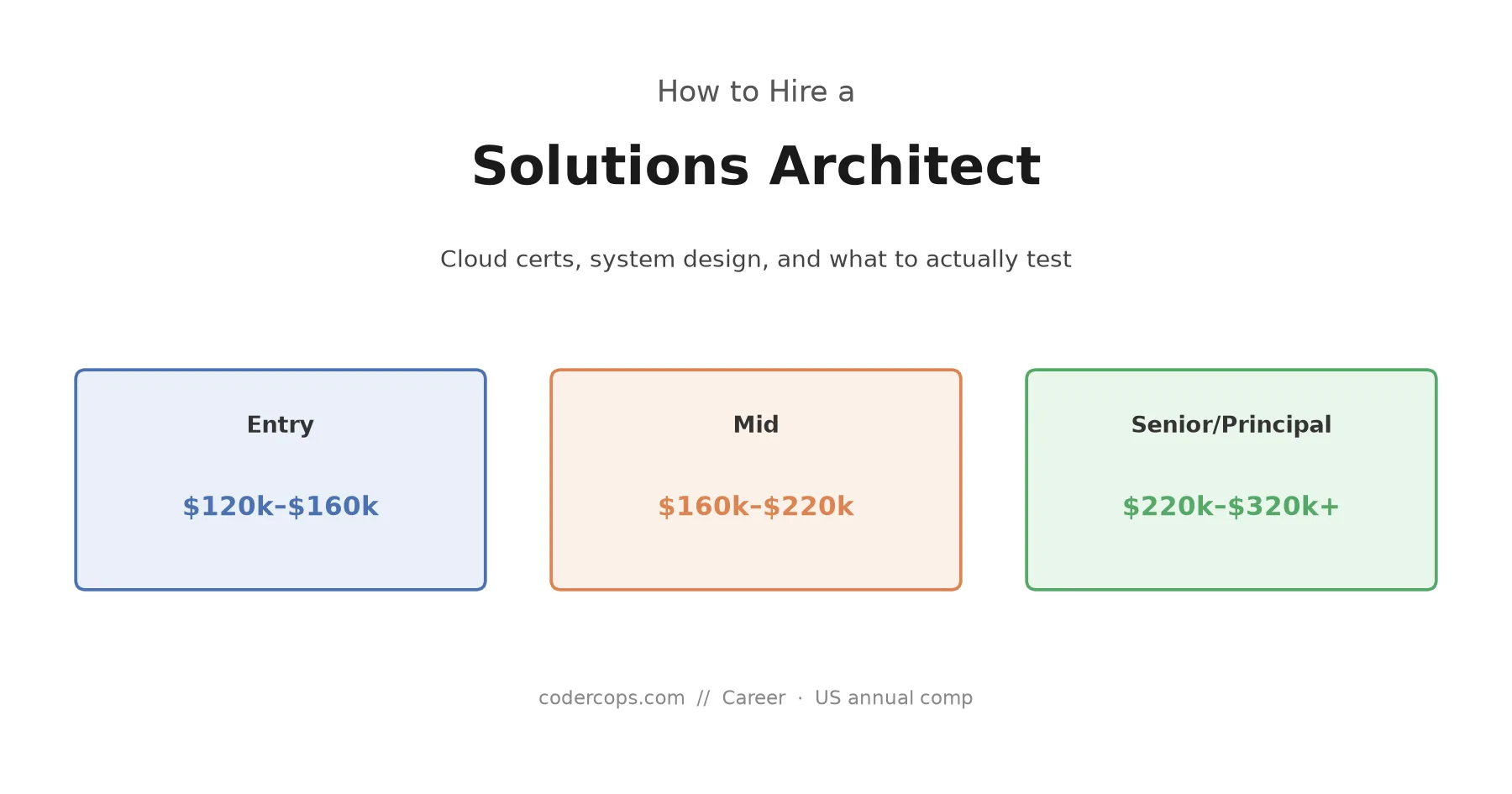
- In the US in 2026, a mid-level data engineer (2-4 years of pipeline experience) typically earns $120,000-$160,000. Senior data engineers with streaming experience or large-scale Spark background earn $160,000-$210,000. Specializations like real-time processing or ML feature pipelines push higher. Remote international data engineers are often 30-50% lower. See [what it costs to hire a developer in 2026](/blog/what-it-costs-to-hire-a-developer-2026/) for a broader breakdown.
Sources
Sponsored
Sponsored
Discussion
Join the conversation.
Comments are powered by GitHub Discussions. Sign in with your GitHub account to leave a comment.
Sponsored