Business · Hiring
How to Hire an Embedded Firmware Engineer in 2026
Firmware hiring fails differently from web hiring. The pool is small, the specialisms do not transfer, and the usual coding screen tells you almost nothing. Here is what to test and how to scope the role honestly.

Anurag Verma
8 min read
Sponsored
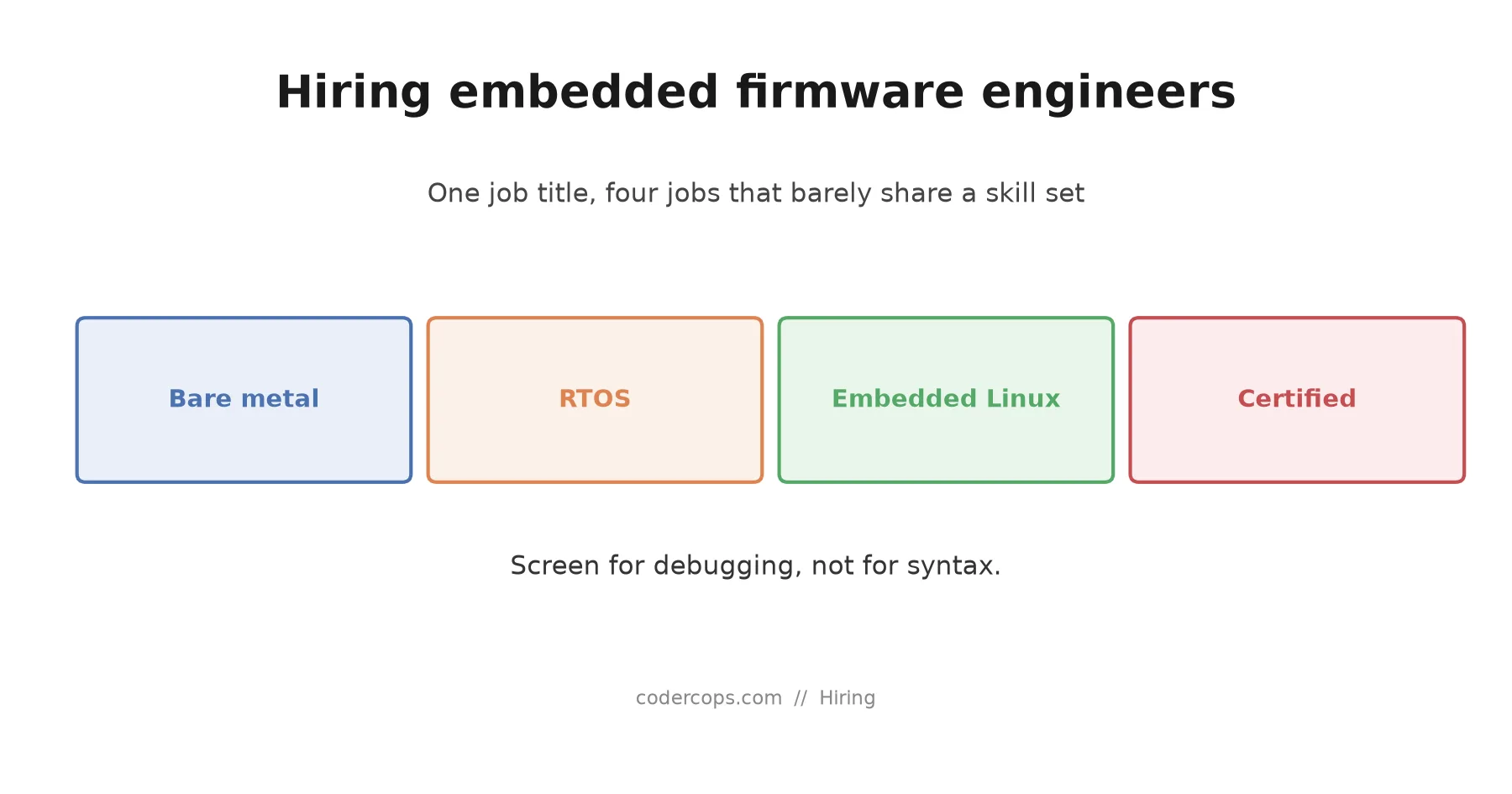
Most firmware hiring goes wrong before a single candidate is screened, at the moment somebody writes “Embedded Engineer” at the top of a job description. That title covers at least four jobs that share almost no day-to-day skills, and picking the wrong one wastes a quarter.
The fix is to hire against a constraint rather than a language. Everything below follows from that.
The four jobs hiding behind one title
An engineer who is excellent at one of these is frequently mediocre at the next. This is not a seniority question, it is a different accumulated skill set.
Bare-metal microcontroller work. No operating system. You are writing to registers, configuring clock trees, servicing interrupts, and counting bytes of RAM. Debugging often means a logic analyser and a toggled GPIO pin, because there is nowhere to print to. People who are good at this think in terms of the datasheet.
RTOS application work. FreeRTOS, Zephyr, ThreadX. Now you have tasks, priorities, queues, and a scheduler, and with them a whole class of bugs that bare-metal code does not have: priority inversion, stack overflow in a task nobody sized, and deadlock between two ISR-safe primitives that were not as ISR-safe as advertised. This is closer to concurrent systems programming than to register poking.
Embedded Linux. A device tree, kernel modules, a driver subsystem, Yocto or Buildroot, and a userspace with actual memory. The constraints loosen and the surface area explodes. Someone from this world dropped onto a 32 KB part will reach for abstractions the part cannot afford.
Safety-certified development. IEC 61508, ISO 26262, IEC 62304, DO-178C. Requirements traceability, coding standards such as MISRA, documented test coverage, and a process that makes every change expensive on purpose. Engineers who have shipped a certified product are rare, and the experience genuinely does not transfer in from the other three.
Decide which one you need before you write the posting. If the answer is genuinely two of them, that is a real and much harder search, and you should know that going in rather than discovering it in month three. The same principle applies to any specialised search, which we cover in how to hire a vetted software developer.
What to screen for
Firmware work is mostly diagnosis. The code is usually small. The difficulty is that the system spans software, hardware, timing, and physics, and the failure could be in any of them.
That points at a different screen from the one you would run for a backend role.
Debugging without a debugger
Ask directly: how do you debug a system where you cannot attach a debugger and there is no console?
Weak answers stop at “add printf.” Which is fine as far as it goes, except printf changes timing, needs a UART you may not have, and can hide the race you are chasing.
Strong answers show a toolkit. Toggle a GPIO and watch it on a scope, so you can see interrupt latency to the microsecond. Reserve a small RAM buffer that survives reset and dump it afterwards. Light an LED from a fault handler. Read the stack pointer at the point of a hard fault and walk backwards. Use a trace peripheral if the part has one.
What you are listening for is whether they have a mental model of the machine when the usual tools are gone. That capability is the job.
Reading a datasheet
Send a candidate a page from a real peripheral datasheet, ideally one relevant to your product, and ask what would go wrong if a specific register bit were set incorrectly.
This sounds basic. It is discriminating. Plenty of engineers with C on their CV have only ever used vendor HAL functions and have never opened the reference manual underneath. When the HAL has a bug, or the errata sheet contradicts the manual, those engineers are stuck and you are the one who gets paged.
The intermittent bug
This is my favourite question, because the answer maps almost perfectly onto seniority.
Describe a failure that only shows up after several hours, or only at temperature, or only on one unit out of fifty. Ask how they approach it.
Junior answers start changing code. Senior answers start establishing reproducibility: what is different about that unit, can we make it fail faster, can we instrument the state before the failure, can we run twenty boards overnight with logging. Then, only then, hypotheses. Stack overflow, an uninitialised variable that is usually zero, a race that needs a specific interrupt arrival, a marginal power supply, a solder joint.
The specific answer matters less than whether they try to make the bug deterministic before they try to fix it. That instinct is the difference between someone who solves the problem and someone who moves it.
Memory and timing discipline
A few short questions that reveal a lot.
How do you size a task stack, and how would you detect that you got it wrong? Good answers mention watermarking, filling the stack with a pattern and checking how much got overwritten, and a stack overflow hook.
When would you use dynamic allocation on a constrained device? The best answer is usually “at init, then never,” with reasons: fragmentation, non-deterministic timing, and no good failure path when malloc returns null at hour nine.
What does your interrupt handler not do? Anyone who has debugged an ISR that called into a blocking driver will have opinions.
How to structure the process
Skip the algorithm screen. Inverting a binary tree tells you nothing about whether someone can find a clock configuration bug.
A process that works, roughly:
A conversation about their last project, driven by constraints. Which part, how much RAM, what was the power budget, what was the hardest bug and how did they find it. Thirty minutes with a competent interviewer separates most of the field.
A debugging exercise built from one of your own real failures. Give the symptoms, let them ask for evidence, reveal it in stages. Score on which measurement they ask for first, not on whether they reach your answer.
A small code review rather than a code-writing test. Hand them a hundred lines of firmware with three defects planted: a missing volatile on a variable shared with an ISR, an unbounded loop waiting on a hardware flag with no timeout, and an off-by-one in a ring buffer. What they catch, and what they say about it, is more informative than anything they would write from scratch under time pressure.
If the role is hardware-adjacent, a short session with the actual board. Some candidates come alive with hardware in front of them in a way no video call reveals.
This is the same principle behind a technical interview process that predicts performance: test the thing the job consists of, not a proxy for it.
Scoping and expectations
Two practical points that come up in nearly every firmware search we run.
Write the constraints into the job description. Part family, RAM and flash budget, whether there is an RTOS, whether the product is certified, and whether the engineer will be involved in board bring-up. Candidates self-select accurately when you give them this, and vaguely when you do not. Nothing wastes more time than four rounds of interviews ending with “oh, I have never done bare-metal.”
Plan for a longer search. The pool is smaller than web development, fewer embedded engineers are actively looking, and the category match matters more. A role you would expect to fill in weeks on the web side can take months here. Budget the calendar rather than dropping the technical bar in week ten, which is how teams end up with a strong C programmer who has never shipped hardware. The cost framing in what it costs to hire a developer applies here with the timelines stretched.
If your product sits closer to application code on a Linux board, the adjacent screening in how to hire a C++ developer covers ground that overlaps with what you need.
The one thing to take away
Hire against the constraint. A 32 KB microcontroller with a watchdog and a two-year battery life is a different profession from a Linux board with a gigabyte of RAM and a package manager, even though both roles say “embedded” on the CV and both write C.
Name your constraint, screen for debugging over syntax, and accept that this search takes longer than the last one. Get those three right and the rest of the process is ordinary hiring.
Frequently asked questions
- What is the difference between an embedded engineer and a firmware engineer?
- In practice the titles overlap and companies use them interchangeably. Where a distinction is drawn, firmware usually means code running directly on a microcontroller with no operating system or with an RTOS, while embedded can extend to application code on embedded Linux. The useful question is not which title you post but which constraints the role lives under, because that is what determines who can do the job.
- Should I hire someone who knows my exact chip family?
- Rarely worth optimising for. A strong engineer picks up a new STM32 or nRF part in weeks because the concepts transfer. What does not transfer quickly is the category jump: bare-metal to embedded Linux, or non-safety to certified development. Screen for the category, be relaxed about the specific vendor.
- Is Rust worth requiring for embedded roles in 2026?
- Not as a requirement for most teams. Embedded Rust is real and growing, with mature HAL crates for common families, but the hiring pool is much smaller than C and the toolchain story varies a lot by target. Treat Rust as a strong positive signal about a candidate's interest in memory safety rather than as a filter.
- How do I test firmware skills without shipping hardware to candidates?
- Use a debugging conversation instead of a coding test. Present a real failure from your own history, hand over the symptoms in stages, and let the candidate ask for evidence. You learn more from which measurement they ask for first than from any amount of code they could write in an hour.
- How long does firmware hiring usually take compared to web hiring?
- Longer, and you should plan for it. The candidate pool is smaller, fewer people are actively looking, and the specialism match matters more, so a role that would fill in weeks on the web side often runs to months. Budget the calendar time rather than lowering the technical bar when the deadline arrives.
Sources
Sponsored
More from this category
More from Business
 R.01
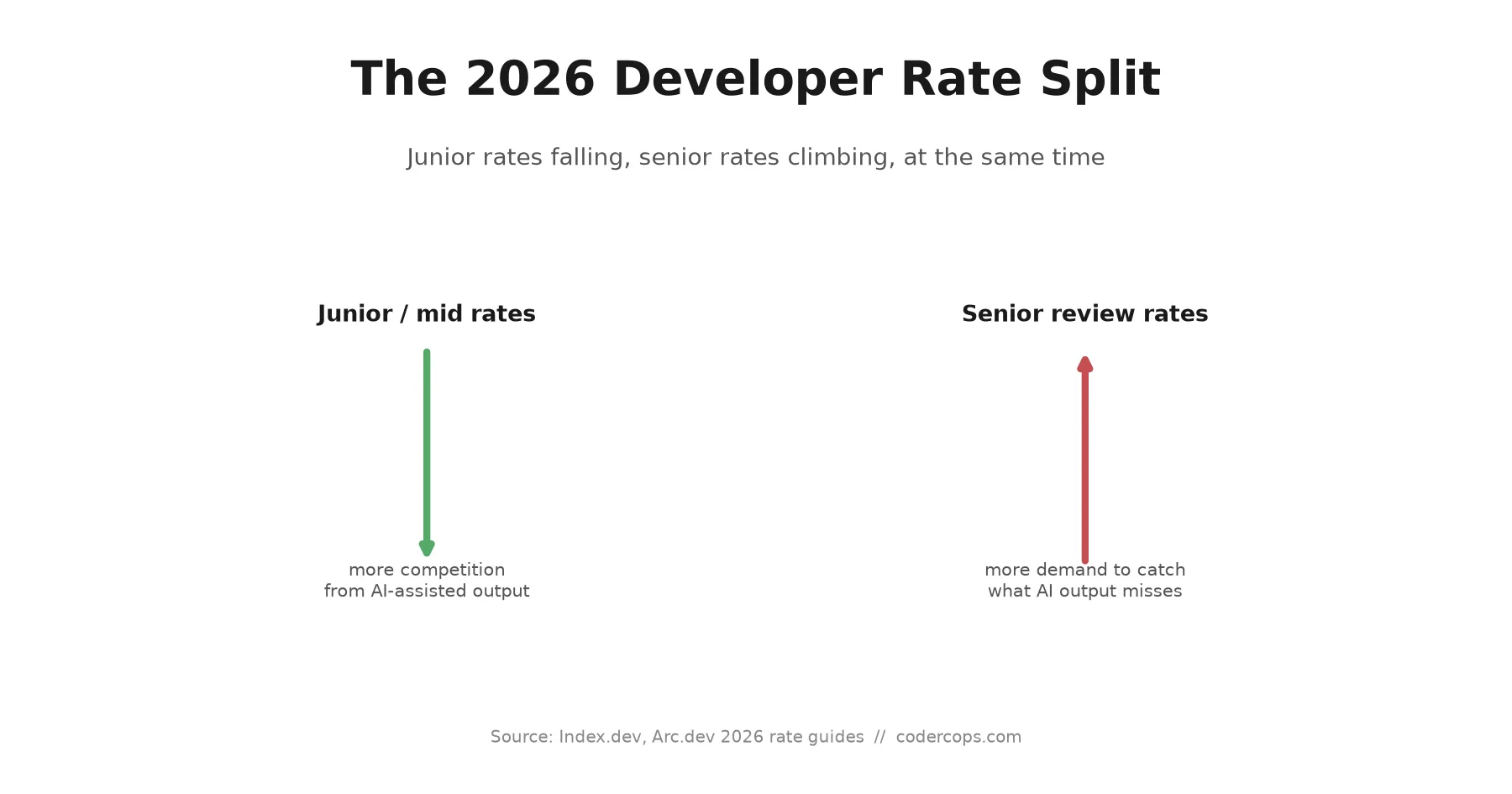
R.01 The 2026 Developer Rate Split: Junior Rates Are Falling, Senior Rates Are Climbing
 R.02
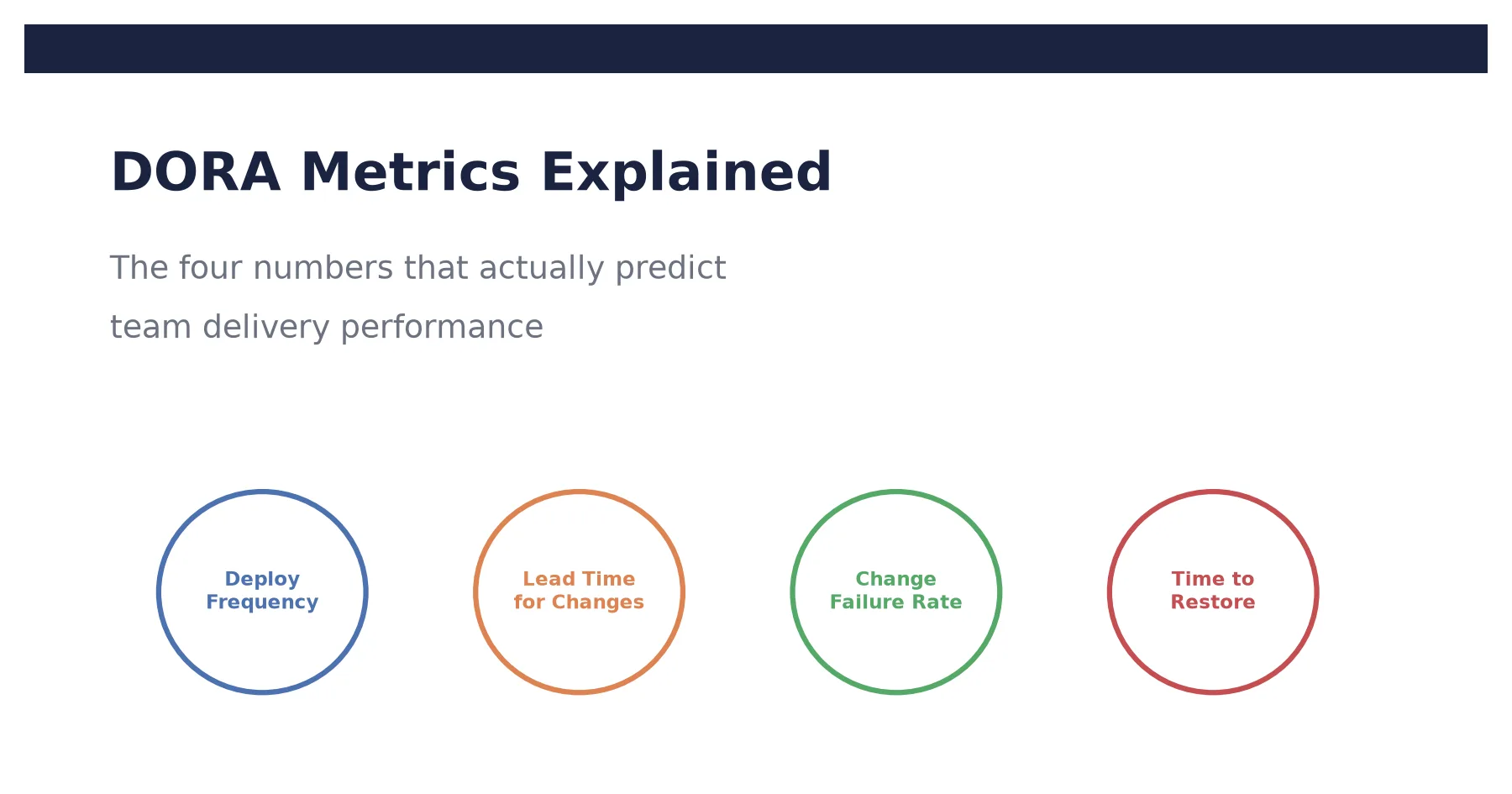
R.02 DORA Metrics Explained: The Four Numbers That Actually Predict Team Performance
 R.03
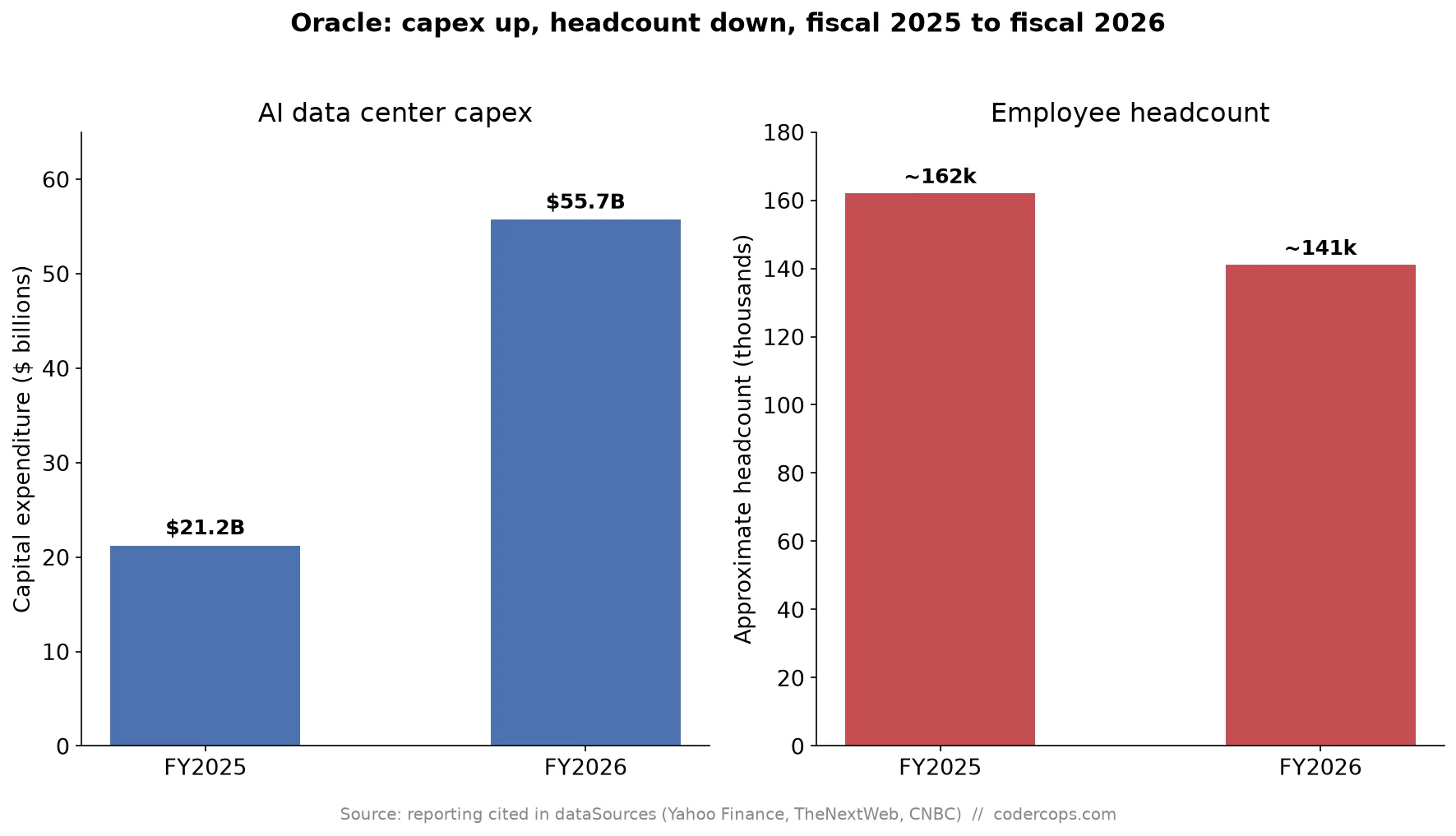
R.03 Oracle Is Borrowing Tens of Billions for AI Data Centers. What That Means If You Build on OCI.
Sponsored
Discussion
Join the conversation.
Comments are powered by GitHub Discussions. Sign in with your GitHub account to leave a comment.
Sponsored