
Sponsored
Game development hiring gets treated as a subset of general software hiring more often than it should be, and it shows up in the results: a strong web engineer gets hired to build a Unity prototype, and three months in, the project is stuck on a memory leak from improperly pooled objects or a physics bug that only reproduces at 60fps on specific hardware. The skills overlap with regular software engineering less than most hiring managers assume. Here’s how to hire for the actual job.
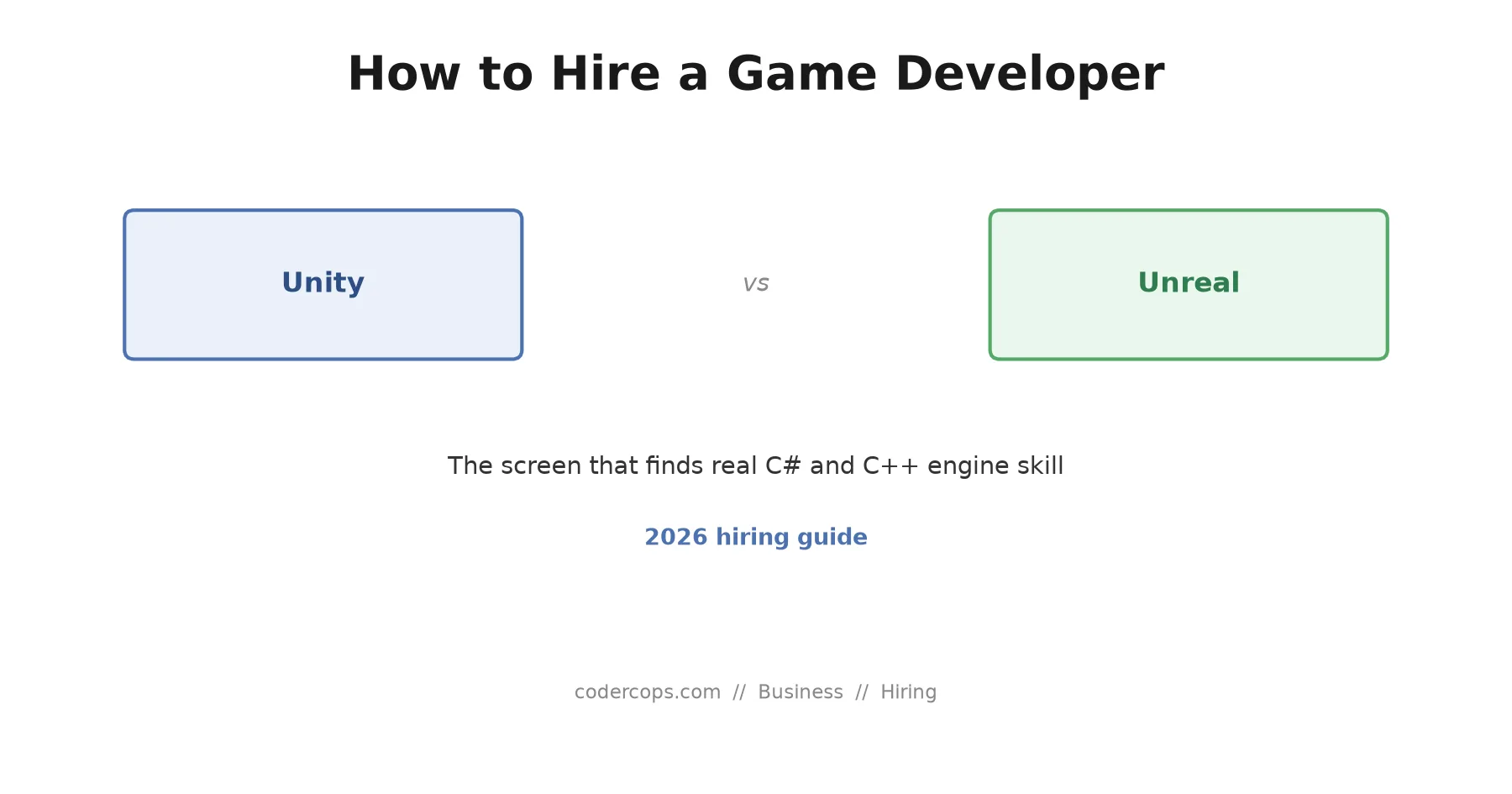
Unity and Unreal are different hires, not two flavors of the same one
The first decision isn’t about candidates, it’s about which engine your project needs, because it determines almost everything else about the screen.
Unity developers work primarily in C#, inside a component-based architecture (GameObjects, MonoBehaviours, and increasingly the Data-Oriented Technology Stack for performance-sensitive work). Unity is the faster path for 2D games, mobile titles, stylized or lower-fidelity 3D, and rapid prototyping. Strong Unity candidates understand the engine’s garbage collection behavior well enough to avoid frame-time spikes from allocation churn, know when to reach for object pooling, and can read a Profiler window without being told what to look for.
Unreal developers work primarily in C++, with Blueprint visual scripting layered on top for gameplay logic and iteration speed. Unreal is the stronger choice for high-fidelity 3D, its rendering pipeline (Lumen, Nanite) is a genuine differentiator for realistic visuals, and it’s the default in AAA and simulation-heavy work. Strong Unreal candidates are comfortable in both C++ and Blueprint, understand when each is the right tool (Blueprint for iteration and designer-facing logic, C++ for performance-critical systems), and have dealt with the engine’s build and packaging pipeline enough to not be surprised by a platform certification failure.
If you don’t know which engine your project needs, that’s a product decision to resolve before the job post goes out. Writing “Unity or Unreal developer” into a listing is the fastest way to attract candidates who are strong in neither.
What the portfolio should actually show
A resume listing “5 years Unity experience” tells you almost nothing. Ask for one of two things before scheduling a technical interview: a playable build, or access to a source repository.
A playable build tells you whether the candidate ships things that work, which is a real filter. A surprising number of portfolio projects listed on a resume don’t actually run, or run only on the developer’s own machine with undocumented dependencies.
A source repository, where the candidate is comfortable sharing one, tells you more. For Unity, look at how scenes and prefabs are organized, whether there’s a sane approach to version control for binary assets (this trips up more teams than it should), and whether the code shows separation between gameplay logic and engine-specific boilerplate. For Unreal, look at the split between Blueprint and C++, messy Blueprint spaghetti with no underlying C++ architecture is a common tell for someone who can prototype but hasn’t shipped anything at scale.
The screen that finds real skill
Skip the generic algorithms round. It filters for the wrong thing. Game development bugs are disproportionately about state management, timing, and performance under constraints, not sorting arrays.
A screen that works looks more like this:
- A live debugging session inside the engine. Give the candidate a small project with an intentional bug, a physics interaction that behaves inconsistently, an object pool that’s leaking, a Blueprint event chain firing in the wrong order, and watch how they investigate. Do they reach for the Profiler or debugger immediately, or guess? This surfaces real engine fluency faster than any interview question can.
- A performance-budget conversation. Ask how they’d approach a frame-time budget for a target platform, mobile at 60fps, console at 30fps, whatever fits your project. Candidates with real production experience talk concretely about draw calls, texture memory, and garbage collection pauses. Candidates without it talk in generalities about “optimizing code.”
- A architecture walkthrough of their own past project. Ask them to explain a design decision they’d make differently now. This is where you learn whether they’ve actually shipped something under real constraints, versus built a portfolio piece with no deadline or platform pressure.
What it costs, and when to hire versus contract
In the US, Unity and Unreal developer salaries both cluster in roughly the $80,000-$135,000 range depending on seniority, with senior engine-level specialists, particularly in multiplayer networking or rendering, commanding more. Outside the US, experienced remote developers in Eastern Europe, Latin America, or India are commonly available at 40-60% of US rates, though the pool of genuinely senior engine-level talent (as opposed to generalist developers who’ve touched Unity) is smaller than the equivalent pool for mainstream web stacks, and it’s worth budgeting extra time to find it rather than compromising on the screen above.
For most companies, games aren’t a permanent part of the roadmap, they’re a project: a client build, a marketing experience, a training simulation, a one-off product feature. In that case, a contractor or a small studio with a shipped title in your genre is usually the faster, lower-risk path compared to a full-time hire you’ll need to redeploy or let go once the project ships. Full-time hiring makes more sense when game or interactive-3D work is an ongoing part of your product, not a single deliverable. Either way, the screening principles above apply, a studio partner with no playable portfolio deserves the same scrutiny as an individual candidate with no playable portfolio.
If you’re weighing whether this project needs a specialist hire at all versus working with a vetted development team that already has game engine experience on staff, that’s usually the faster question to answer first, and it changes the whole hiring calculation that follows.
Frequently asked questions
- Should I hire a Unity developer or an Unreal developer?
- It depends on your project, not on which engine is more popular. Unity is generally faster to ship 2D, mobile, and stylized 3D games with, and its C# workflow is more approachable for teams without deep systems programming experience. Unreal is the stronger choice for high-fidelity 3D, especially anything leaning on its rendering pipeline, and it dominates in AAA and simulation work. If you don't already know which engine your project needs, that's a design decision to make before you write the job post, not something to leave open in a hiring process.
- What should a game developer's portfolio actually show?
- A playable build or an accessible source repository, not just screenshots and a description. For Unity candidates, ask to see a project's git history if possible, it tells you how they structure scenes, prefabs, and version control for binary assets, which is a real skill gap between hobbyists and production-ready developers. For Unreal candidates, a shipped title or a substantial Blueprint and C++ project matters more than engine certifications.
- How much does a game developer cost in 2026?
- In the US, Unity and Unreal developers both land roughly in the $80,000-$135,000 range annually depending on seniority, with senior specialists in performance-critical or multiplayer networking work commanding more. Rates outside the US vary widely; experienced remote Unity or Unreal developers from Eastern Europe, Latin America, or India are commonly available at 40-60% of US rates for comparable skill, though the pool of genuinely senior engine-level talent is smaller than for mainstream web stacks.
- What's the biggest mistake companies make hiring game developers?
- Running a generic software engineering interview, whiteboard algorithms, system design for a web backend, on a candidate whose actual job will be debugging frame-time spikes, physics edge cases, and asset memory budgets. Game development has its own failure modes: race conditions in gameplay state, garbage collection stalls in Unity, shader compilation costs, and platform certification requirements that a strong general-purpose engineer with no game background will not have encountered.
Sources
Sponsored
Sponsored
Discussion
Join the conversation.
Comments are powered by GitHub Discussions. Sign in with your GitHub account to leave a comment.
Sponsored