Career · Hiring
How to Hire a Developer Advocate in 2026
A DevRel posting draws speakers, content marketers, and ex-engineers who miss coding. How to work out which your product needs, what to test, what it costs.

Anurag Verma
5 min read
Sponsored
Post a “Developer Advocate” listing and the resumes that come in split into three clusters that don’t overlap much: conference speakers with a slide deck for every occasion, content marketers who’ve picked up “developer” as an audience segment, and engineers who left hands-on coding but still want to talk to other engineers. All three can plausibly do parts of the job. Few can do all of it well, and the job posting rarely says which parts actually matter for your product.
What the role actually is, and why it splits in two
A developer advocate’s core job is being the bridge between your product and the developers using it: technical content, talks, being present where developers already gather, and carrying real feedback back into product decisions. A developer relations engineer, a distinct but related role, spends more of their time writing code developers consume directly (SDKs, sample apps, integration guides) than standing in front of an audience.
At a startup with one DevRel hire, that person does both, by necessity. At a company with an established platform and real developer volume, splitting the roles usually works better than asking one person to be equally strong at public speaking and sustained software engineering. Those skills don’t reliably co-occur, and a job posting that demands both at a senior level from a single hire is often screening out strong candidates who are excellent at one half.
Before you write the posting, decide honestly which half your product needs more. A complex SDK with rough edges needs a DevRel engineer who’ll actually fix the rough edges in code. A product with solid docs but low community awareness needs an advocate who’ll go get developers’ attention. Hiring for the wrong half is a slower failure than hiring the wrong seniority, because both people will look busy and produce visible output that doesn’t move the metric you actually needed moved.
When to hire this role at all
The most common mistake isn’t hiring the wrong person, it’s hiring too early. Developer advocacy amplifies a product that’s already working for developers; it doesn’t create developer interest from nothing. If you don’t yet have real developers using your API or platform, with real friction points and real success stories to draw from, a DevRel hire has nothing to advocate around. Ship the product, get genuine usage, and let the first hire’s job be amplifying what’s already resonating and fixing what’s causing people to bounce, rather than generating interest in a product still finding its audience.
What to test in the interview
Ask for a real example of feedback that changed something. Not a talk they gave, not a blog post that got traffic: a specific case where they surfaced a developer complaint internally and it led to an actual product or documentation change. This is the hardest and most valuable part of the job, and it’s the part a polished conference reel doesn’t demonstrate. Plenty of candidates are excellent at producing content; fewer are good at listening to a community and translating friction into a decision an engineering team acts on.
Hand them your actual docs and ask what would confuse a new developer. Not a hypothetical product, yours. This tests whether they can put themselves in an unfamiliar developer’s position on your specific surface area, which is the daily version of the job, rather than their general communication skill in the abstract.
Have them build something small against your API. It doesn’t need to be production-grade, but it should be real, working code, not a demo held together by assumptions that don’t survive contact with an actual integration. A candidate who can extend their own sample past the happy path is more useful than one who can only present a working demo they can’t debug live.
Ask about a piece of content or a talk that didn’t land, and why. You’re listening for whether they can diagnose their own miss honestly (wrong audience, wrong format, wrong assumption about what developers already knew) versus attributing it to bad luck or a bad room. The self-diagnosis is the signal; everyone has content that underperforms.
What to pay
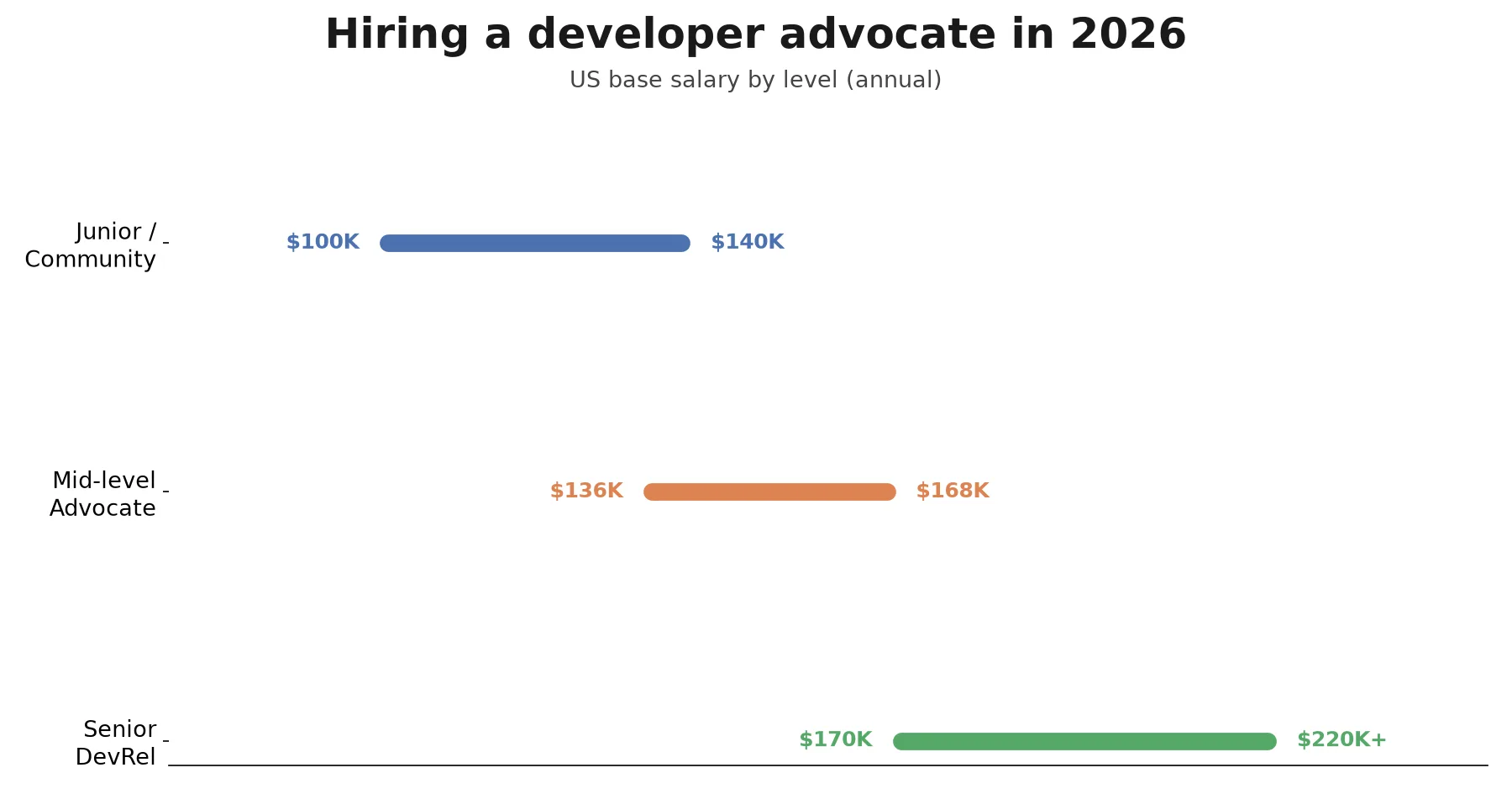
| Level | US (annual base) |
|---|---|
| Junior / community-focused | $100k-$140k |
| Mid-level advocate | $136k-$168k |
| Senior DevRel | $170k-$220k+ |
Total compensation varies more here than in most engineering hires, because company stage matters as much as level: an early-stage startup and a public company hiring for the same title can differ by six figures once equity, travel budget, and content production budget are counted. Be specific in your own posting about what’s actually funded, since a candidate evaluating an offer against a public company’s total comp will otherwise assume your base number is the whole picture.
This role sits adjacent to hiring an SRE and hiring a technical PM in the sense that all three ask you to evaluate a mix of technical depth and a skill that doesn’t show up cleanly on a resume, whether that’s operational judgment, product sense, or in this case, the ability to represent your product credibly to the people who’ll actually use it. For the broader screening approach this series is built on, see how we vet developers. If you’re not sure whether your product is ready for its first DevRel hire, that’s a scoping conversation worth having with our team before the job posting goes out.
Frequently asked questions
- What's the difference between a developer advocate and a developer relations engineer?
- A developer advocate is primarily community-facing: technical content, conference talks, answering developers where they already are, and carrying feedback back to the product team. A developer relations engineer spends most of their time writing code that developers consume directly: SDKs, sample applications, integration guides, and reference implementations. Developer Relations is the umbrella term covering both, plus community management. At small companies one person does all of it; at larger ones the roles usually split because the skills, public speaking and content versus sustained software engineering, don't reliably live in the same person.
- When should a company hire its first developer advocate?
- Once you have a developer-facing product (an API, SDK, or platform) with real usage and real friction, not before. Hiring DevRel to generate developer interest in a product that doesn't have developers yet usually produces content and talks with no audience. The better sequence is: ship the product, get real developers using it, then hire someone whose job is amplifying what's working and fixing what's causing them to churn.
- What should we actually test in the interview?
- Ask for a specific, real example: a piece of developer feedback they surfaced that changed a product decision, not a conference talk they gave or a blog post that got traffic. Content and speaking are visible and easy to pad a resume with; the harder, more valuable skill is listening to a developer community, synthesizing what's actually broken, and getting an engineering team to act on it. Also have them do a short technical exercise relevant to your stack: read your actual API docs and find the first thing that would confuse a new developer. That tests attention to the audience's actual experience, not just communication polish.
- Does a developer advocate need to write production code?
- Not necessarily, but they need to write code developers would actually ship, not just demo code that looks good on stage. A candidate who can build a working, reasonably idiomatic sample integration against your API is more valuable than one who gives a great talk about a demo they can't extend. If the role leans more toward developer relations engineering (SDKs, deeper technical content), production-quality code ability becomes a requirement rather than a nice-to-have.
- What does a developer advocate cost in 2026?
- In the US, junior or community-focused roles run roughly $100k-$140k, a mid-level developer advocate $136k-$168k, and senior DevRel $170k-$220k or more, frequently with equity and a travel or content budget layered on top of base. Compensation varies more by company stage and funding than most engineering roles do: an early-stage startup and a public company hiring for the same title can differ by six figures in total comp.
Sources
Sponsored
Sponsored
Discussion
Join the conversation.
Comments are powered by GitHub Discussions. Sign in with your GitHub account to leave a comment.
Sponsored