Industry News · Enterprise AI
Microsoft's $2.5B Frontier Company: The Real Bet
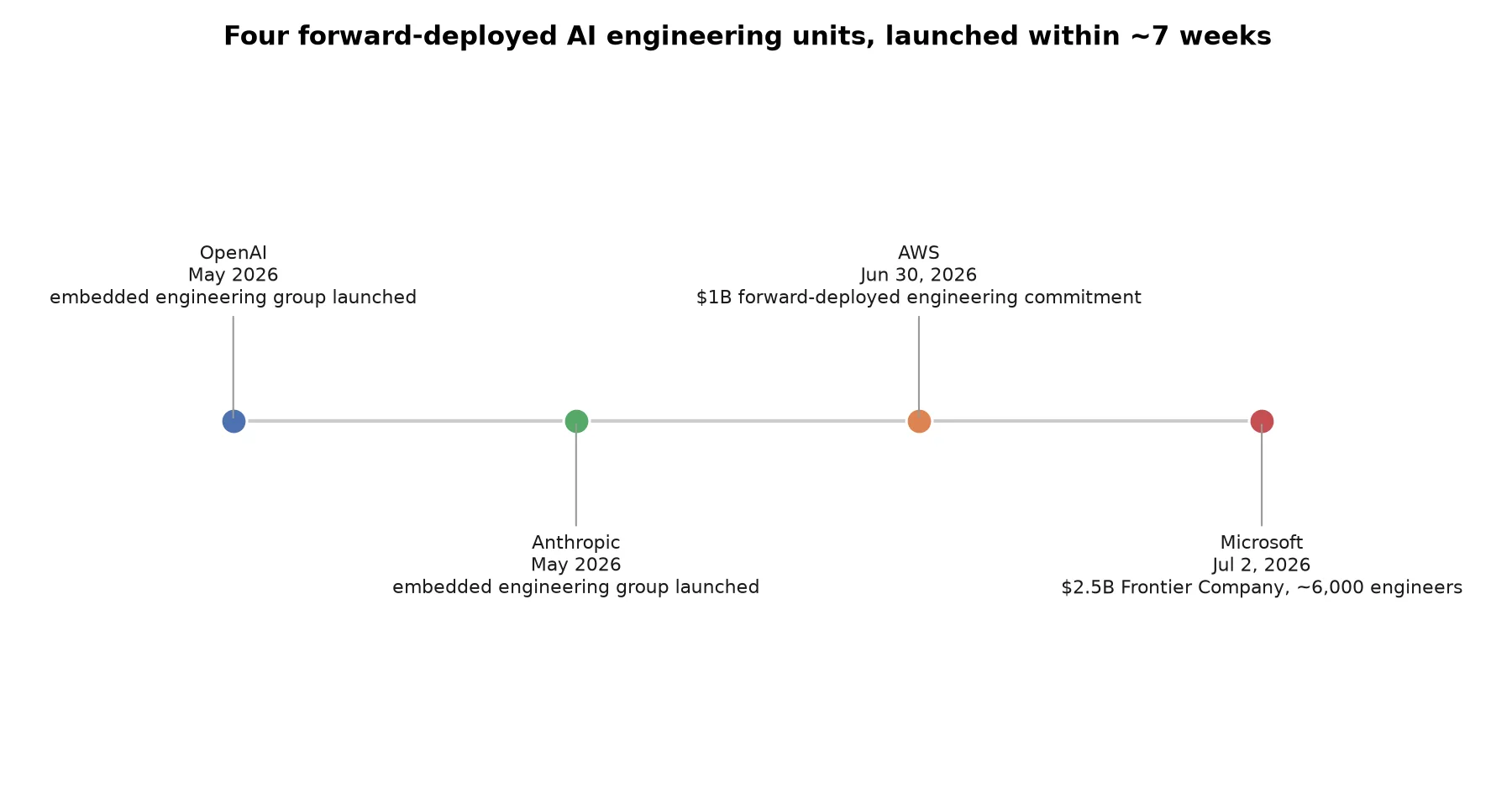
Microsoft launched Frontier Company with $2.5B and 6,000 engineers embedded in clients to get AI into production. AWS and Anthropic did the same this year.

Anurag Verma
5 min read
Sponsored
Microsoft didn’t announce a new model on July 2. It announced a staffing plan. Frontier Company is a $2.5 billion operating business with roughly 6,000 engineers whose entire mandate is showing up inside enterprise clients and making their AI deployments actually work. That’s a strange thing for a software company to spend that much money on, until you look at why every major AI vendor just did the same thing within about six weeks of each other.
What Frontier Company actually is
Announced by Commercial Business CEO Judson Althoff and led by Rodrigo Kede Lima, formerly president of Microsoft Asia, Frontier Company embeds Microsoft’s own technical staff directly inside client organizations to design and run AI systems, rather than shipping software and licensing seats. It’s structured around measurable business outcomes and, notably, it’s built to run AI models from multiple providers, OpenAI, Anthropic, open source, and Microsoft’s own, instead of locking clients into one stack. Microsoft is partnering with Accenture and KPMG to scale delivery, which tells you this isn’t a boutique pilot program; it’s meant to run at consulting-industry scale.
This is what the industry has started calling forward-deployed engineering: instead of selling a platform and hoping the customer’s team figures out how to use it, the vendor embeds its own engineers inside the customer’s operation to build the thing directly. Palantir popularized the model years ago. What changed in 2026 is that every frontier AI lab and hyperscaler decided it needed one.
The number that explains the timing
Microsoft didn’t do this in a vacuum. AWS committed $1 billion to a comparable forward-deployed engineering initiative on June 30, and Anthropic and OpenAI both launched similar groups back in May. Four companies, four forward-deployed engineering units, inside a two-month window. That’s not coincidence, that’s every major AI vendor independently reaching the same conclusion about where the actual bottleneck is.
The research backs up why. MIT’s Project NANDA found that roughly 95% of generative AI pilots deliver no measurable return on the profit-and-loss statement. RAND puts the broader AI project failure rate above 80%, about double the failure rate of a conventional IT project. The recurring causes named across multiple studies aren’t about model quality: unclear definitions of success before the project starts, weak data foundations, poor integration into actual workflows, and executive sponsorship that fades before the hard part. One widely cited figure attributes 84% of failures to leadership and process gaps rather than technical ones.
Put those two facts together and Frontier Company reads less like a product launch and more like an admission: the model is no longer the constraint. Getting a working system into a real company’s actual workflow, with its actual data quality and actual change-management friction, is the constraint. And that’s an engineering and integration problem, which is why the fix is engineers, not a better API.
What this means if you’re not Microsoft
If your team evaluates, builds, or sells AI implementation work, this changes who you’re competing against. A client shopping for help with an AI deployment now has an option that didn’t exist eighteen months ago: the model vendor’s own embedded team, backed by a direct relationship with the model provider and an incentive structure tied to the project’s measurable success, not license renewal.
That’s a real competitive pressure, but it’s not the whole picture. Frontier Company and its peers are built to sell outcomes at enterprise scale, with enterprise sales cycles and enterprise price tags. They are not going to be the right fit for a mid-market company that needs a working AI feature shipped in a quarter, not a multi-year transformation engagement with a Big Four co-pilot attached. The build vs. buy calculus for AI work increasingly has a third option alongside “build with our own team” and “buy a platform”: bring in outside engineering help sized to the actual problem, which is where a smaller, faster-moving delivery partner still wins on speed and cost even against a $2.5 billion internal unit.
The more useful takeaway from the MIT and RAND numbers isn’t about Microsoft specifically. It’s that the 95% pilot-failure rate is a data-readiness and integration problem, and that’s exactly the kind of gap a focused engineering team can close for a client without needing $2.5 billion or 6,000 people to do it. If you’ve watched an AI pilot stall inside your own organization, the diagnosis probably isn’t “we picked the wrong model.” Our own experience shipping AI products for clients lines up with what the research says: the parts that actually determine whether a pilot ships are unglamorous, data pipelines, evaluation harnesses, and a clear definition of what success looks like before anyone writes a line of model-calling code.
The vendors just spent a combined multi-billion-dollar bet confirming that diagnosis. Whether you act on it with an internal hire, an outside team, or your own version of forward-deployed engineering, the fix was never going to be a bigger model.
Frequently asked questions
- What is Microsoft Frontier Company?
- A new operating business inside Microsoft, announced July 2, 2026, backed by $2.5 billion and staffed with roughly 6,000 industry and engineering specialists. Its job is embedding inside enterprise clients to get AI pilots into production, structured around measurable business outcomes rather than software licensing.
- Is Frontier Company locked to Microsoft's own AI models?
- No. It's explicitly built to help clients run models from multiple providers, including OpenAI, Anthropic, open-source projects, and Microsoft's own models, rather than locking enterprise customers into a single vendor's stack.
- Why is Microsoft doing this now instead of just selling software?
- Because selling software isn't the bottleneck anymore. Research from MIT's Project NANDA found that about 95% of generative AI pilots produce no measurable return on the P&L, and separate research from RAND puts the overall AI project failure rate above 80%, roughly double that of conventional IT projects. The recurring causes are integration failures, weak data foundations, and unclear success metrics, not model capability. Selling a better model doesn't fix any of that; putting engineers inside the client's operation might.
- Is Microsoft the only company doing this?
- No. AWS committed $1 billion to its own forward-deployed engineering initiative on June 30, 2026, and Anthropic and OpenAI both launched comparable embedded-engineering groups in May 2026. Frontier Company is the largest of these by dollar commitment and headcount, but it's following an established pattern, not inventing one.
- What does this mean for development agencies and consultancies?
- It raises the bar on what 'AI implementation' competes against. A client evaluating help with an AI deployment now has the option of a vendor's own forward-deployed team, backed by direct model-provider relationships and a rebooked incentive to make the project succeed on paper. Agencies that win this work will do it on integration depth, multi-vendor flexibility, and speed, not on access to a model the client could get from the source directly.
Sources
- TechCrunch: Microsoft launches its own AI deployment company with $2.5 billion commitment
- CNBC: Microsoft commits $2.5 billion and 6,000 employees to new AI implementation unit
- GeekWire: Microsoft unveils $2.5B 'Frontier Company' to embed AI engineers inside customers
- Forbes: Why 95% of AI Pilots Fail, And What Business Leaders Should Do Instead
Sponsored
More from this category
More from Industry News
Sponsored
Discussion
Join the conversation.
Comments are powered by GitHub Discussions. Sign in with your GitHub account to leave a comment.
Sponsored