AI Integration · Model Strategy
Mistral's "Fat But Sparse" MoE: The Real Story
Mistral confirmed a new open-weight MoE model in partner early access. No specs yet, but Studio and Forge, its sovereign AI play, are the real story.

Prathviraj Singh
4 min read
Sponsored
Arthur Mensch didn’t publish a model card in July. He gave a description: a new mixture-of-experts family, “fat but sparse,” entering partner early access this month. No parameter count. No benchmarks. No license terms. Just a phrase and a promise that a broader release is coming later in the summer. If that sounds thin for a news story, it is, on its own. What makes it worth writing about is what Mistral is bundling around the model, because that part is concrete, and it’s aimed squarely at a problem most AI coverage ignores: where your model actually runs, and who can be legally compelled to hand over what it processes.
What “fat but sparse” actually means
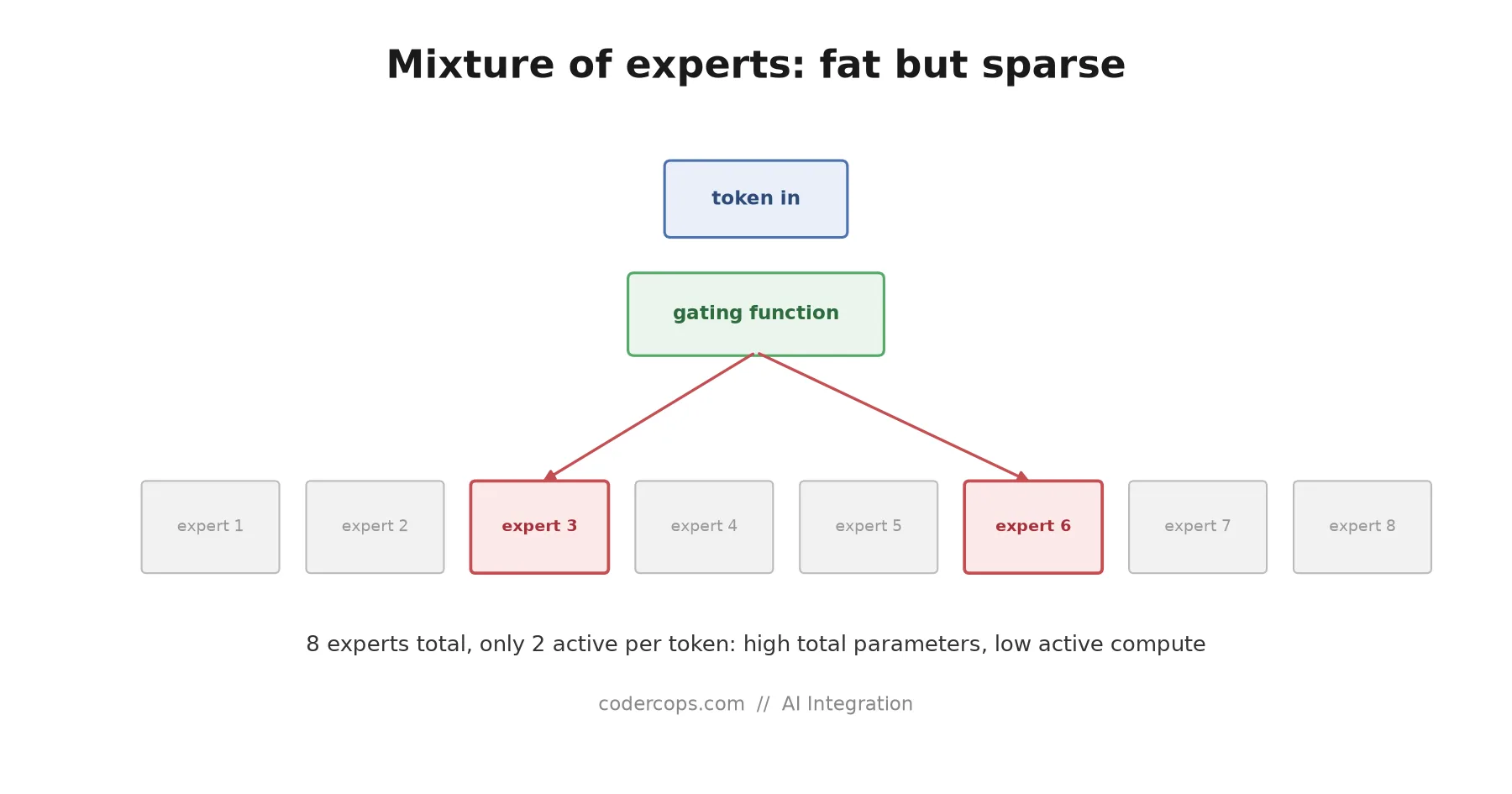
Mixture-of-experts isn’t a new idea, but it’s worth explaining plainly since Mensch’s phrase leans on the mechanics. An MoE model splits its parameters into many specialized sub-networks, called experts, plus a gating function that decides, per token, which small subset of experts actually gets used. Instead of running every parameter on every input the way a dense model does, an MoE model can carry an enormous total parameter count (the “fat” part) while keeping the compute spent per token close to what a much smaller dense model would need (the “sparse” part).
The practical upshot, if it holds once real numbers land, is a model that can compete on capability with proprietary frontier models while costing less to run at inference time. That’s the same bet GPT-4-class MoE architectures and DeepSeek’s V3/R1 line have made. Mistral isn’t inventing the technique. It’s applying it to close what Mensch has openly called a gap with proprietary rivals, at a moment when open-weight competitors like DeepSeek and Qwen have already captured real market share by doing exactly that.
The part that’s actually new: Studio and Forge
The model announcement landed alongside, and arguably in service of, two products that matter more for enterprise buyers: Forge and Studio. Forge is Mistral’s platform for fine-tuning custom models on a client’s own data. Studio adds version tracking and traceability on top, so a team can see what changed between one fine-tuned iteration and the next. Both can run in the customer’s own cloud, on-premises, or hosted by Mistral.
That deployment flexibility is the actual product. A European bank, hospital system, or government agency can fine-tune a Mistral model on sensitive internal data without that data, or the resulting model, ever leaving infrastructure they control. That’s a meaningfully different pitch than “our API is cheaper” or “our benchmark score is higher.” It’s a pitch about legal exposure: 93% of executives now call AI sovereignty mission-critical, and for organizations subject to EU data protection law or straightforwardly uncomfortable depending on a US company’s infrastructure decisions, that concern doesn’t go away no matter how good a competing model’s output is.
Mensch has been direct about the framing, warning that closed AI models give their providers “immense leverage” over the businesses that depend on them. Whether or not you buy the framing as neutral rather than self-serving, coming from the CEO of the company selling the alternative, the underlying business logic checks out. Mistral’s annual recurring revenue passed $400 million in February 2026, up from around $20 million a year earlier. That’s not a research lab burning venture money on open-weight goodwill. That’s a subscription business built on the idea that “you can inspect and control the model” is a feature enterprises will pay for, not just an ideology.
Why this belongs next to the Microsoft news
There’s a pattern worth naming here, and it connects to Microsoft’s newly launched Frontier Company, which is explicitly built to help enterprise clients run models from multiple providers rather than locking them into one stack. Put the two stories together and a trend emerges: the AI vendors themselves are now competing partly on how little they lock you in. Microsoft is selling multi-vendor flexibility as a service. Mistral is selling deployment sovereignty as a product. Both are responses to the same buyer behavior: enterprises that got burned by, or are simply wary of, single-vendor dependency on infrastructure they don’t control.
If your organization, or your clients, are evaluating an AI vendor relationship that will still matter in three years, the model’s benchmark score is the least durable part of that decision. Benchmarks get leapfrogged every few months. Where the model runs, who can compel access to it, and how easily you can leave if the vendor relationship sours are the parts of the decision that actually compound. Mistral doesn’t have a public number to show for its new model yet. It has a much clearer answer than most competitors to the sovereignty question, and for a meaningful slice of the enterprise market, that answer is worth more than a few points on a leaderboard.
Frequently asked questions
- What does 'fat but sparse' mean for an AI model?
- It describes a mixture-of-experts (MoE) architecture. The model is split into many specialized sub-networks (experts) plus a gating function that routes each incoming token to only a handful of the most relevant experts, rather than running every parameter on every token. 'Fat' refers to a very large total parameter count; 'sparse' refers to the much smaller amount of compute actually used per token, which is what makes a model that large practical to run.
- When is Mistral's new model actually available?
- Early access started in July 2026, limited to research, government, and industry partners. Mensch has said a broader open-weight release is expected later in the summer, but Mistral hasn't published a firm date, parameter count, or benchmark numbers as of this writing.
- What are Studio and Forge?
- Forge is Mistral's platform for building or fine-tuning custom models on a customer's own data. Studio adds version tracking and traceability for the prompts and skills built on top of those models. Both can run in a customer's own cloud, on-premises, or hosted by Mistral, which is the point: the customer chooses where the model and its training data physically live.
- Why does data sovereignty matter for an AI vendor choice?
- For European enterprises and government agencies specifically, running AI workloads on infrastructure controlled by a US company creates legal and operational exposure under frameworks like the CLOUD Act, independent of how good the model is. Mistral's pitch with Studio and Forge is that you get a frontier-adjacent model without that exposure, because the deployment can stay inside EU infrastructure the customer controls.
- Is Mistral's open-weight strategy actually a business, or a marketing angle?
- It's increasingly a real subscription business. Mistral's annual recurring revenue passed $400 million in February 2026, up from about $20 million a year earlier, and the Studio/Forge push turns 'open weights you can inspect' into a paid platform for fine-tuning and running those weights under your own control, rather than a one-off download with no ongoing revenue attached.
Sources
Sponsored
More from this category
More from AI Integration
Sponsored
Discussion
Join the conversation.
Comments are powered by GitHub Discussions. Sign in with your GitHub account to leave a comment.
Sponsored