AI & ML · Robotics
Robostral Navigate: Mistral Robotics on One Camera
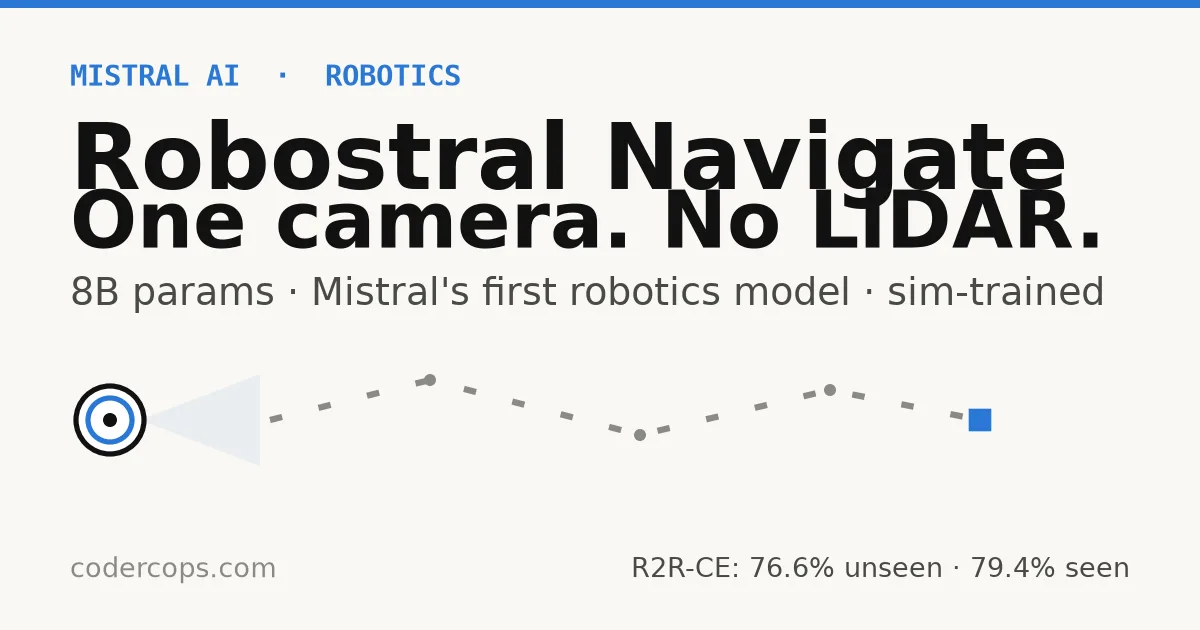
Mistral's first robotics model is an 8B vision-language model that navigates unfamiliar spaces from one RGB camera and a plain instruction. No LiDAR.

Shashikant Gupta
7 min read
Sponsored
Most robots that can find their way around a building on their own are carrying a small hardware tax to do it: a spinning LiDAR unit, a depth camera, sometimes a ring of cameras stitched into a panorama, plus the sensor-fusion code needed to reconcile all of it in real time. On July 8, 2026, Mistral AI shipped a model that does the same job with one ordinary RGB camera and a sentence of plain English. It’s called Robostral Navigate, and it’s Mistral’s first robotics release.
What it actually does
Robostral Navigate is an 8-billion-parameter vision-language model. Feed it one camera frame and an instruction like “leave the lobby, walk through the corridor, enter the supply room, and stop to face the second shelf,” and it returns one of two things: a point to move toward within that same image, or a short local displacement command. Run that loop repeatedly, frame by frame, and a robot works its way through a space it has never been in before, guided by language rather than a pre-built map.
The part worth sitting with is what’s absent. No LiDAR. No depth sensor. No multi-camera rig. Most indoor navigation stacks lean on at least one of those to handle obstacle avoidance and localization reliably, because a single 2D image genuinely under-specifies a 3D environment: distance, occlusion, and depth all have to be inferred rather than measured directly. Mistral’s bet is that a strong enough learned model can close that gap well enough to skip the extra hardware entirely, and the benchmark numbers below back that claim to a meaningful degree.
One camera, many bodies
Robostral Navigate isn’t tied to one chassis. Mistral reports it working across wheeled, legged, and flying robots, and it operates in continuous space, not a grid of pre-computed waypoints, which means it can react to an obstacle that wasn’t there when the route was planned, like a person walking through a doorway. That embodiment-agnostic property matters more than it might sound: a lot of robotics research is bound to the specific rig it was built on, and a model that transfers across drivetrains and control loops is a meaningfully more reusable piece of software. It’s the same broader shift covered in our rundown of how robots, drones, and autonomous systems are reaching commercial scale across industries: capability that used to require custom engineering per platform is increasingly available as a model you point at a new problem.
The training claim is the harder engineering story
Anyone can claim a model works well on a benchmark. The more interesting claim here is how Robostral Navigate got trained at all: entirely in-house, entirely in simulation, using roughly 400,000 recorded paths across more than 6,000 virtual spaces. There’s no real-world data collection phase in that description, no fleet of robots being driven around office buildings to gather footage. The model went from simulated training straight to real-world deployment, a zero-shot sim-to-real transfer.
That’s a harder thing to pull off than it sounds. Simulation-trained models routinely fail to transfer because simulated lighting, textures, and physics don’t match the real world closely enough, a gap researchers call the “reality gap.” Getting a navigation model to cross that gap without additional real-world fine-tuning is the kind of engineering claim that’s easy to state and expensive to actually earn, since it requires the simulator itself, the data sampled from it, and the model’s tolerance for visual mismatch to all be tuned together. If it holds up under independent testing, it also implies a much cheaper path to iterating on the next version: you don’t need a robot fleet and a data collection team, you need a better simulator.
What the benchmark numbers say, and don’t say
Mistral reports Robostral Navigate scoring 76.6% success on the R2R-CE validation-unseen split and 79.4% on validation-seen. R2R-CE, short for Room-to-Room in Continuous Environments, is a step up in difficulty from the earlier Room-to-Room benchmark: instead of letting an agent teleport between a fixed set of pre-mapped panoramic viewpoints, it requires genuine movement through continuous 3D space, closer to how a real robot actually has to operate.
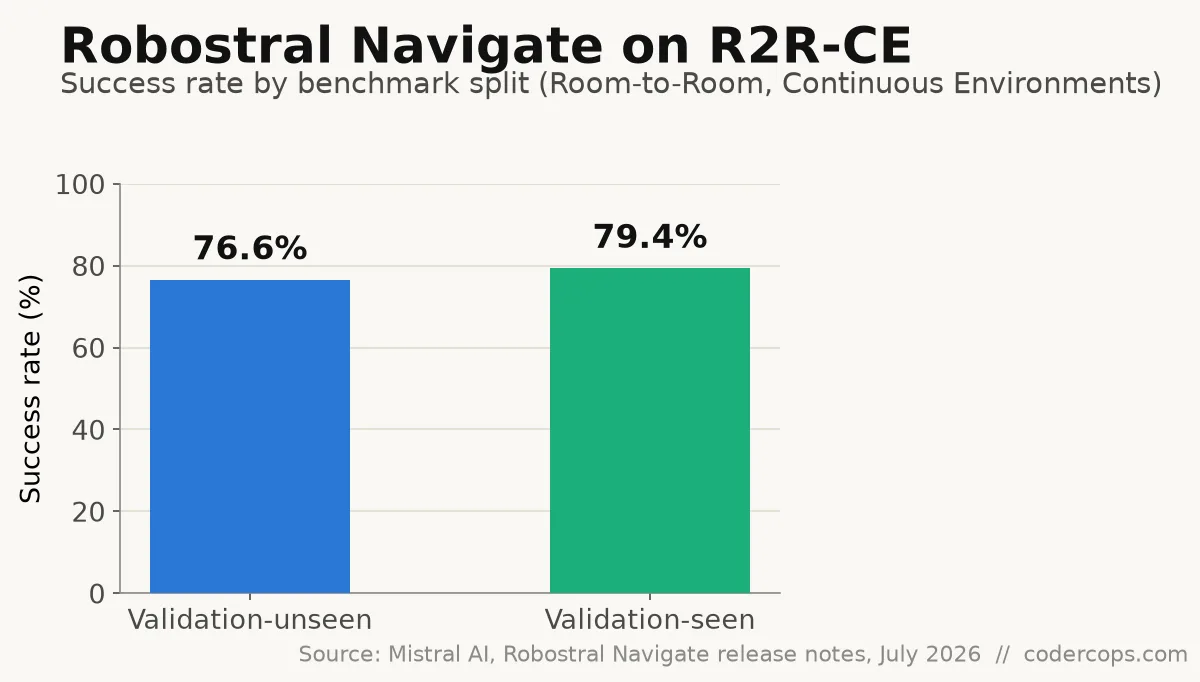
The gap between the two splits (76.6% vs. 79.4%) is worth reading correctly rather than glossing over. “Seen” environments overlap with training data in some form; “unseen” ones don’t. A model that only does well on seen environments has memorized rather than generalized. A roughly three-point gap here suggests Robostral Navigate is transferring reasonably well to new spaces rather than pattern-matching against familiar ones, which is the more relevant number for anyone evaluating whether this would hold up in a building it’s never mapped.
It’s also worth being honest about what a single benchmark can and can’t tell you. R2R-CE measures whether the agent reaches the right destination in a simulated indoor environment; it doesn’t measure how the model behaves around unpredictable humans, in poor lighting, on uneven outdoor terrain, or after weeks of camera drift and lens grime, all of which are exactly the conditions that separate a good benchmark score from a product that survives a warehouse floor.
Why this matters if you’re building on top of it
For a team building a robotics or embodied-AI product, the interesting part isn’t the parameter count, it’s what dropping LiDAR and depth sensors does to the rest of the stack. Sensor rigs add cost, weight, power draw, and a category of firmware and calibration work that has nothing to do with the actual task a robot is meant to perform. A navigation model that works from a camera most robots already carry for other reasons (identifying objects, reading signage, avoiding people) collapses several engineering problems into one model call instead of several sensor pipelines that all need to agree with each other.
That doesn’t mean LiDAR disappears from serious deployments. Safety-critical navigation, especially anything involving people in close proximity, still benefits from redundant sensing, and a single camera has failure modes (glare, motion blur, a lens obstruction) that a depth sensor doesn’t share. The realistic reading is that Robostral Navigate lowers the floor: it makes camera-only navigation viable for a wider set of use cases (indoor delivery, inspection, warehouse picking assistance) where a full sensor stack was previously the default simply because nothing else worked well enough.
One detail that’s easy to miss: this ships as an enterprise-access model rather than an open download, which is a notable departure for a company whose language model strategy has leaned hard into open weights, including the “fat but sparse” mixture-of-experts model Mistral confirmed the same month. Where that release was explicitly about giving enterprises control over deployment, Robostral Navigate is the opposite shape: a capability you access through Mistral rather than one you can inspect or self-host. If your roadmap depends on it, plan for a vendor relationship, not a weights file.
The takeaway
Robostral Navigate is a genuine reduction in what it costs to give a robot the ability to follow a spoken instruction through a space it’s never seen: one camera, one sentence, no LiDAR, no depth sensor, and a training pipeline that never left simulation. The R2R-CE numbers (76.6% unseen, 79.4% seen) suggest the approach generalizes rather than memorizes, which is the number that actually matters for anyone evaluating it. If you’re scoping a robotics or embodied-AI product this year, the practical move is to treat this as a live option for indoor navigation rather than a research curiosity, while keeping the caveats honest: it’s enterprise-access only for now, and a benchmark score in simulation is still one step removed from a robot on your actual floor.
Frequently asked questions
- What is Robostral Navigate?
- Robostral Navigate is Mistral AI's first robotics model, released July 8, 2026. It's an 8-billion-parameter vision-language model that takes a single RGB camera image and a plain-language instruction (such as 'walk through the corridor and stop at the second shelf') and outputs either a point to move toward in that image or a short movement command.
- Does Robostral Navigate need LiDAR or depth sensors?
- No. That's the headline claim: it works from one ordinary RGB camera with no LiDAR, no depth sensor, and no multi-camera panoramic rig, which most robot navigation stacks still rely on for reliable obstacle avoidance and mapping.
- What robots can run it?
- Mistral reports it generalizing across wheeled, legged, and flying platforms, and it operates in continuous 3D space rather than a fixed grid, so it can adjust to obstacles that move after a route was planned.
- How was it trained if it works in the real world?
- Entirely in simulation. Mistral built the training pipeline in-house and trained on about 400,000 recorded paths across more than 6,000 virtual environments, then deployed the resulting model to real robots without any additional real-world fine-tuning, a zero-shot sim-to-real transfer.
- What does the R2R-CE benchmark actually measure?
- Room-to-Room, Continuous Environments (R2R-CE) tests whether a robot given a language instruction can reach the correct location by moving freely through 3D space, rather than hopping between a fixed set of pre-mapped viewpoints. Robostral Navigate scores 76.6% success on the unseen split (environments the model wasn't trained on) and 79.4% on the seen split.
- Can I use Robostral Navigate today?
- Not as an open download. Unlike several of Mistral's language models, Robostral Navigate launched as an enterprise access model, meaning teams that want it need to go through Mistral directly rather than pulling weights from a public repository.
Sources
Sponsored
Sponsored
Discussion
Join the conversation.
Comments are powered by GitHub Discussions. Sign in with your GitHub account to leave a comment.
Sponsored