AI & ML · Model Releases
Kimi K3: 2.8 Trillion Parameters, Open Weight
Moonshot's Kimi K3 is the largest open-weight model yet and already leads closed frontier models on several benchmarks. What it costs, and when it matters.

Shashikant Gupta
5 min read
Sponsored
Moonshot AI shipped Kimi K3 on July 16, and the headline number, 2.8 trillion parameters, is the least interesting part of the story. What actually matters is that this open-weight model now beats or matches closed frontier systems on a handful of real-world benchmarks, not just synthetic ones, and it does it at a fraction of the API price. If you’ve been assuming open models are a generation behind, this release is the point where that assumption stops holding for at least some workloads.
What Moonshot actually shipped
K3 is a sparse mixture-of-experts model: 896 experts total, with only 16 active for any given token. That architecture is what makes a 2.8-trillion-parameter model practical to serve at all, since a dense model of that size would be unworkable for most inference budgets. It ships with a 1-million-token context window and native visual input, and it runs at maximum reasoning effort by default rather than offering a lighter, faster mode out of the box.
The other headline feature is Kimi Delta Attention, a new attention mechanism Moonshot says delivers up to 6.3x faster decoding than standard approaches. For a model this size, decoding speed is usually the real constraint on usability, not raw benchmark scores, so this is arguably a bigger deal for production use than the parameter count.
As of this writing, K3 is live in Moonshot’s own products and through its API, but the model weights themselves haven’t shipped yet. Moonshot has committed to releasing the full weights on July 27, 2026, under a Modified MIT license that permits commercial use and fine-tuning. Until then, self-hosting isn’t on the table, API access is the only way in.
Where it actually wins, and where it doesn’t
Independent evaluation from Artificial Analysis gives the clearest picture, and it’s a mixed one, which is more credible than a clean sweep would be.
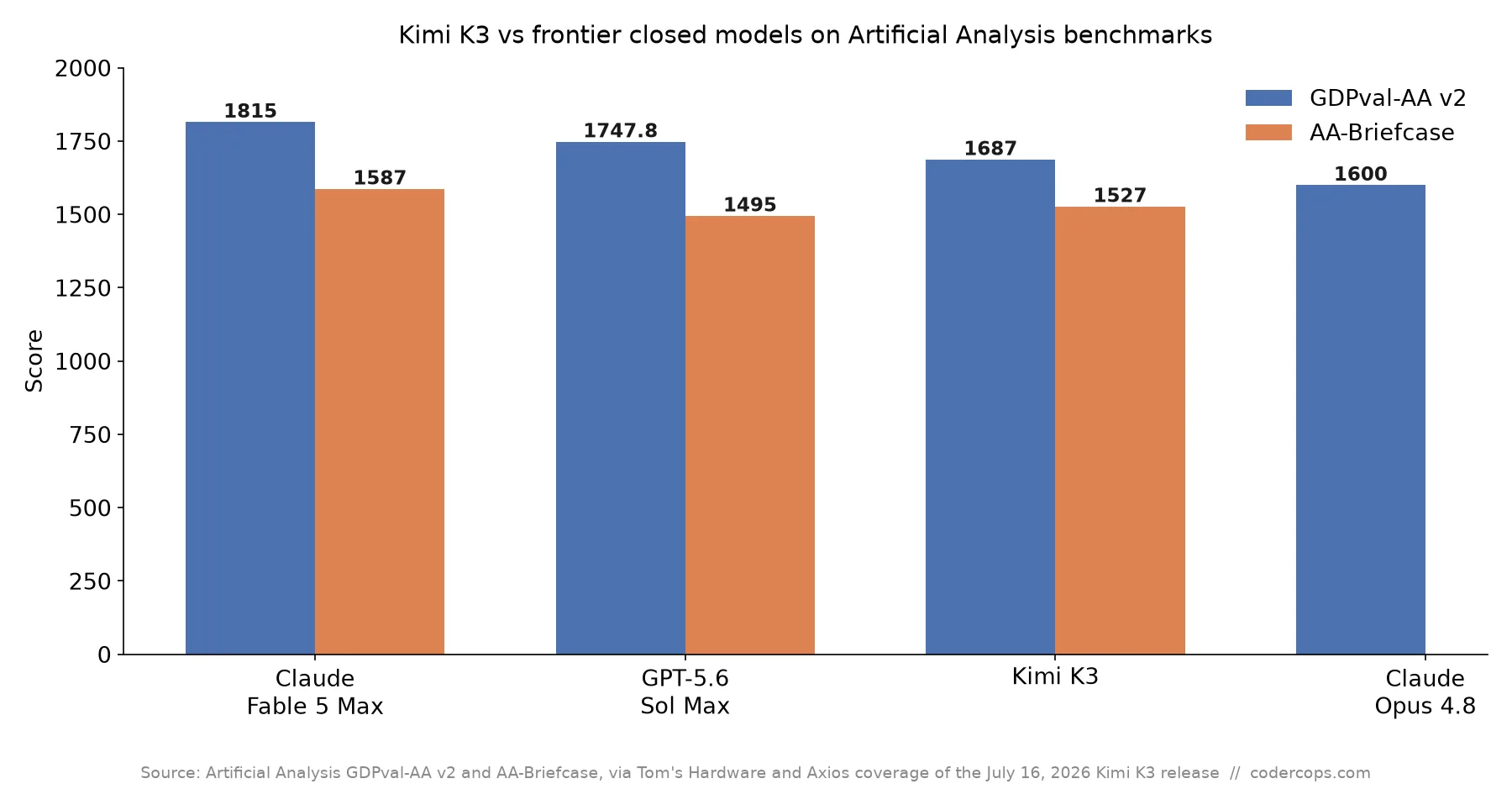
On GDPval-AA v2, a benchmark built around real-world tasks spanning 44 occupations and 9 industries, K3 scores 1,687, placing it third behind Claude Fable 5 Max (1,815) and GPT-5.6 Sol Max (1,747.8), but ahead of Claude Opus 4.8 (1,600). That’s a solid showing for an open model against three closed frontier systems, but it’s not a win.
On AA-Briefcase, Artificial Analysis’s benchmark for long-horizon agentic knowledge work, K3 actually moves up to second place with a score of 1,527, beating GPT-5.6 Sol Max’s 1,495 and trailing only Fable 5 Max’s 1,587. That flip matters: it suggests K3’s strength is specifically in sustained, multi-step agentic tasks rather than one-shot question answering.
The pattern holds elsewhere. K3 ranked first in 4 of 8 real-world task automation benchmarks, including Automation Bench, SpreadsheetBench 2, and BrowseComp. In blind developer testing on the Frontend Code Arena, it scored 1,679, ahead of Fable 5. None of this makes K3 the best model available across every category, but it’s the first open-weight model to lead on categories that closed frontier labs have treated as their strongest ground: agentic execution and front-end code generation specifically.
What it costs
| Item | Price |
|---|---|
| Input, cache hit | $0.30 per million tokens |
| Input, cache miss | $3.00 per million tokens |
| Output | $15.00 per million tokens |
| Context window | 1,000,000 tokens |
| Open weights | Available July 27, 2026 (Modified MIT license) |
That cache-hit pricing is the number worth sitting with. For workloads that repeatedly reference the same system prompt or long context, like an agent working through a large codebase or document set, the effective cost per request can drop well below what closed frontier APIs charge for comparable context sizes. We’ve covered prompt caching and cost optimization patterns in more depth elsewhere, and K3’s pricing structure rewards the same caching discipline.
Should you actually use it
If your team is choosing a model for agentic workflows, long-document processing, or front-end code generation, and you’re not locked into a specific vendor for compliance or existing tooling reasons, K3 is worth an evaluation slot now rather than waiting. The API is live today, so there’s no reason to wait for the July 27 weight release just to run a comparison against whatever you’re currently using.
If you need guaranteed maximum performance across general reasoning and don’t want to manage a second model integration, Fable 5 Max and GPT-5.6 Sol Max still lead on the broadest benchmark, GDPval-AA v2, and that’s a legitimate reason to stay put. The honest read is that K3 doesn’t replace a frontier closed model outright, it adds a genuinely competitive option in the categories where it wins, at a price point that makes running both in production, routed by task type, cheaper than defaulting to a single closed model for everything.
For teams building agent infrastructure who want to route requests across multiple providers rather than commit to one, this is exactly the kind of release that makes model routing worth the engineering investment rather than a hypothetical optimization.
Frequently asked questions
- Is Kimi K3 actually better than GPT-5.6 or Claude?
- It depends on the task. On Artificial Analysis's GDPval-AA v2 benchmark, K3 scores 1,687 against GPT-5.6 Sol Max's 1,747.8 and Claude Fable 5 Max's 1,815, so it trails both. But it beats GPT-5.6 Sol Max on the AA-Briefcase long-horizon knowledge work benchmark, and it topped the Frontend Code Arena ahead of Fable 5 in blind developer testing. There is no single model that wins everywhere right now, K3 wins on specific categories, not across the board.
- When do the open weights actually become available?
- Moonshot shipped K3 through its own products and API on July 16, 2026, but has not yet published the model weights. The company has committed to a July 27, 2026 release of the full weights under a Modified MIT license, which permits commercial use and fine-tuning. Until then, self-hosting is not an option; API access is the only way to use K3.
- What is Kimi Delta Attention and why does it matter?
- It's a new attention mechanism Moonshot built for K3 that the company says delivers up to 6.3x faster decoding than standard approaches. For a 2.8-trillion-parameter model, inference speed is often the practical bottleneck, not raw capability, so a decoding speedup like this determines whether the model is usable for latency-sensitive agentic workflows or stays a benchmark curiosity.
- What hardware would I need to self-host Kimi K3?
- Moonshot has not published minimum hardware specs as of this writing, and the open weights are not out yet, so any specific GPU count would be a guess. What's known is the architecture: a sparse mixture-of-experts model with 896 experts and only 16 active per token, which keeps inference cost far below what a dense 2.8-trillion-parameter model would require. Expect requirements in the same range as other trillion-parameter-class open MoE models, several high-memory GPUs at minimum, once official guidance lands.
- Is this the same as Kimi K2.5?
- No. Kimi K2.5, which Moonshot released in February 2026, was a 1-trillion-parameter model with a 2-million-token context window. K3 is a different, larger model: 2.8 trillion parameters, a 1-million-token context window, and a new attention architecture. It's a generational jump, not a patch release.
Sources
Sponsored
Sponsored
Discussion
Join the conversation.
Comments are powered by GitHub Discussions. Sign in with your GitHub account to leave a comment.
Sponsored