Web Development · Authentication
OAuth 2.1 Explained: What Changed and Do You Actually Need to Migrate
OAuth 2.1 is still an IETF draft, not a finished RFC, but most providers already enforce it. Here's what actually changed from OAuth 2.0 and a real checklist for auditing your implementation.

Abhishek Gupta
8 min read
Sponsored
Someone on your team just read “OAuth 2.1” in a changelog or a security newsletter and asked if you need to migrate. Short answer: probably not, and if you have to ask, you’re probably fine. OAuth 2.1 isn’t a new protocol you install or a breaking change that flips a switch on a given date. It’s a cleanup draft that takes OAuth 2.0 plus roughly a decade of security best-practice RFCs and folds them into one document, while removing a couple of flows that should have died years ago.
If you set up your OAuth integration recently through a managed identity provider like Auth0, Okta, Clerk, or WorkOS, with PKCE enabled (which has been the default for a while now), you’re already compliant with the parts that matter. The real exposure sits with integrations built five or more years ago, back when the implicit flow was still the textbook answer for single-page apps and nobody blinked at a wildcard redirect URI. Those are worth an actual audit, and this post is that audit.
OAuth 2.1’s status, plainly
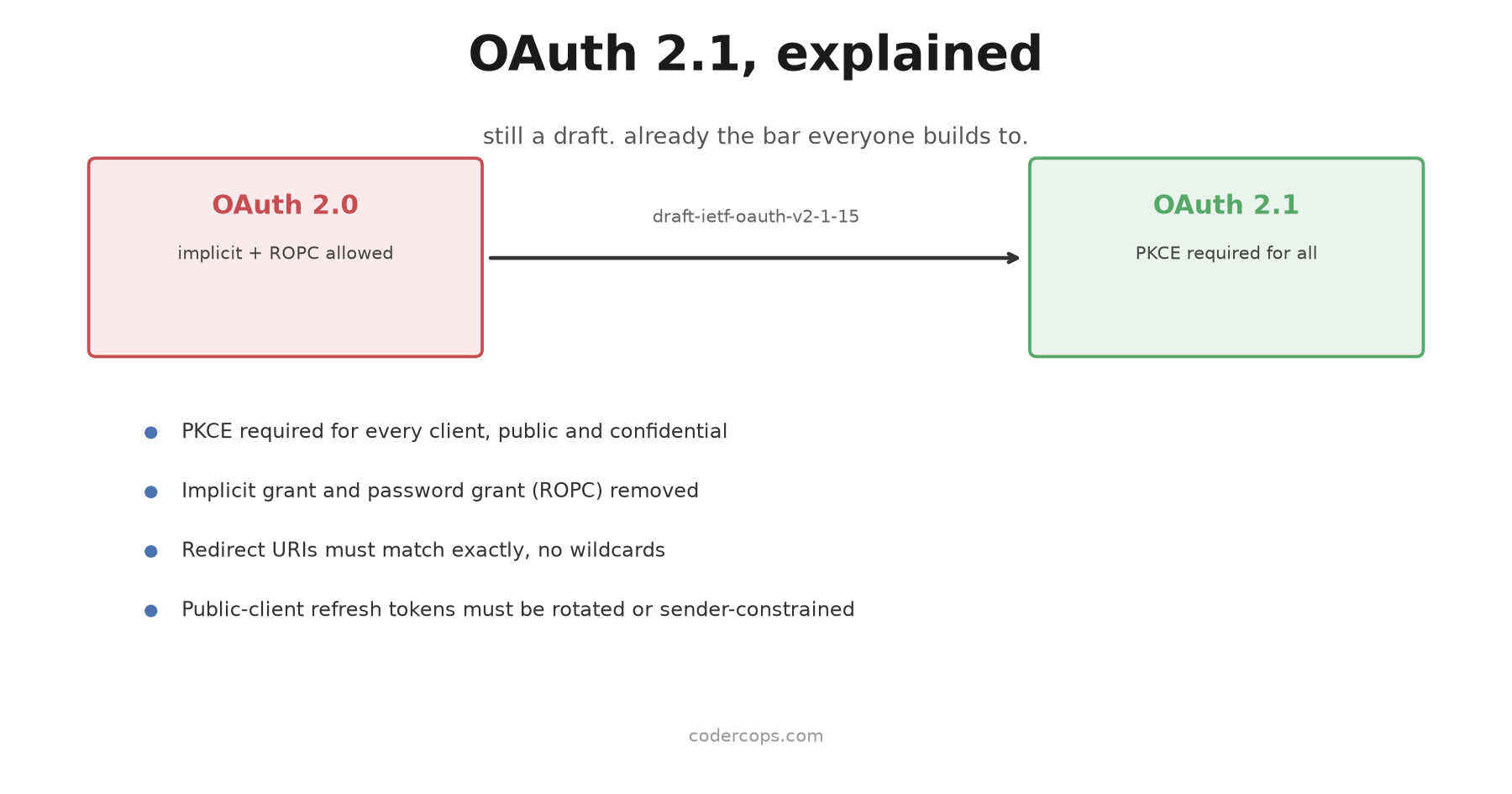
OAuth 2.1 is an IETF Internet-Draft, currently at revision 15 (draft-ietf-oauth-v2-1-15). It has not been published as a final RFC as of today. It’s been circulating in draft form for years, which sounds alarming until you realize most of its content isn’t new: it’s a consolidation of RFC 6749 (the original OAuth 2.0 core spec) plus the OAuth 2.0 Security Best Current Practice, the PKCE RFC, and a handful of other extensions, rewritten as a single coherent spec instead of five documents you had to cross-reference.
That’s why “still a draft” doesn’t mean “safe to ignore.” Providers started enforcing most of these rules years before the draft settled, because the underlying security guidance already existed and was already being treated as the correct way to build OAuth. The draft’s formal RFC status is mostly a paperwork detail at this point.
What actually changed from OAuth 2.0
| OAuth 2.0 | OAuth 2.1 | |
|---|---|---|
| PKCE | Recommended for public clients, optional for confidential clients | Required for all clients |
| Implicit grant | Allowed, though discouraged in later guidance | Removed entirely |
| ROPC (password grant) | Allowed | Removed entirely |
| Redirect URI matching | Exact or pattern matching permitted | Exact string match only |
| Bearer tokens in query strings | Permitted | Disallowed |
| Refresh tokens for public clients | No specific constraint required | Must be sender-constrained or rotated on every use |
Each row maps to a real attack that was observed in the wild, not a hypothetical hardening exercise. PKCE closes the authorization-code-interception gap where a malicious app on the same device grabs a code meant for a legitimate client. Removing the implicit flow closes the token-leaks-via-URL-fragment problem: fragments end up in browser history, in referrer headers, and sometimes in server logs when a redirect passes through an intermediate hop. Removing ROPC stops a pattern where users type their password directly into a third-party client, which trains people to hand over credentials to whatever app asks nicely and gives that client far more trust than it needs. Exact redirect URI matching closes an open-redirect-style hole where a loosely written wildcard pattern like https://yourapp.com/* could be satisfied by an attacker-controlled path they weren’t supposed to have access to.
The audit checklist
Go through this against your current implementation. Each item maps to one of the changes above.
- Confirm PKCE is on for every client type, not just your mobile app or SPA. If you have a server-side confidential client that skips PKCE because it “already has a client secret,” add it anyway. It’s now required for both client types, and it costs you nothing.
- Grep your codebase for
response_type=token. That’s the implicit flow. If you find it, you’re returning tokens in a URL fragment, and it needs to move to authorization code flow with PKCE. - Grep for
grant_type=password. That’s ROPC. If any internal tool or legacy integration still does this, it needs a real authorization code flow instead, even if it’s more setup work. - Check your redirect URI configuration in your identity provider’s dashboard. If you see anything with a wildcard, an asterisk, or a regex-style pattern, replace it with the exact, fully-qualified URI your app actually redirects to. Register one entry per environment (dev, staging, prod) rather than trying to cover them all with one pattern.
- Search your logs and analytics for access tokens showing up in query strings. If your API ever accepted a token as
?access_token=..., that’s leaking into server logs, browser history, and referrer headers on every request. Move it to theAuthorizationheader. - Check how refresh tokens are issued to browser-based and mobile clients. If they’re long-lived and not rotated, or not bound to the client via DPoP or mTLS, a leaked refresh token can be replayed indefinitely. Confirm rotation is enabled with your provider, or ask for DPoP if you’re issuing tokens yourself.
If your provider is a mainstream managed one, items 1 through 5 are usually already handled server-side and you just need to confirm your client-side code isn’t doing something older that the provider happens to still tolerate. Item 6 is the one that most commonly needs actual configuration work, since token lifetime and rotation policy is something teams set once at initial setup and rarely revisit.
A PKCE flow that satisfies OAuth 2.1
If you’re building or fixing a client-side flow, here’s a minimal, runnable authorization code flow with PKCE in TypeScript. This is deliberately compact; for a deeper walkthrough of token storage, refresh rotation, and JWT validation, see the OAuth 2.0 and PKCE guide which covers those parts in more depth.
// Step 1: generate a code_verifier and derive the code_challenge
function base64url(bytes: Uint8Array): string {
  return btoa(String.fromCharCode(...bytes))
    .replace(/\+/g, '-')
    .replace(/\//g, '_')
    .replace(/=/g, '')
}

function generateCodeVerifier(): string {
  const bytes = new Uint8Array(32)
  crypto.getRandomValues(bytes)
  return base64url(bytes)
}

async function generateCodeChallenge(verifier: string): Promise<string> {
  const data = new TextEncoder().encode(verifier)
  const digest = await crypto.subtle.digest('SHA-256', data)
  return base64url(new Uint8Array(digest))
}

// Step 2: kick off the authorization request
async function startLogin() {
  const verifier = generateCodeVerifier()
  const challenge = await generateCodeChallenge(verifier)
  sessionStorage.setItem('pkce_verifier', verifier)

  const params = new URLSearchParams({
    response_type: 'code', // never 'token', that's the removed implicit flow
    client_id: 'your-client-id',
    redirect_uri: 'https://yourapp.com/callback', // must match an exact, registered URI
    scope: 'openid profile email',
    code_challenge: challenge,
    code_challenge_method: 'S256',
  })

  window.location.href = `https://auth.example.com/authorize?${params}`
}

// Step 3: exchange the code for tokens on the callback route
async function exchangeCodeForTokens(code: string) {
  const verifier = sessionStorage.getItem('pkce_verifier')
  const response = await fetch('https://auth.example.com/token', {
    method: 'POST',
    headers: { 'Content-Type': 'application/x-www-form-urlencoded' },
    body: new URLSearchParams({
      grant_type: 'authorization_code', // never 'password', that's the removed ROPC grant
      client_id: 'your-client-id',
      redirect_uri: 'https://yourapp.com/callback',
      code,
      code_verifier: verifier ?? '',
    }),
  })

  if (!response.ok) {
    throw new Error(`Token exchange failed: ${response.status}`)
  }

  sessionStorage.removeItem('pkce_verifier')
  return response.json() // { access_token, refresh_token, id_token, expires_in, token_type }
}
The comments mark the two spots where an older OAuth 2.0 implementation would diverge: response_type: 'token' for implicit flow, and grant_type: 'password' for ROPC. If neither of those strings appears anywhere in your codebase, you’ve already cleared the two biggest OAuth 2.1 requirements.
Where this fits with the rest of your stack
None of this is exotic. If your team builds custom authenticated APIs regularly, this checklist is worth running once and then treating as a standing requirement for new integrations, the same way you’d treat input validation or rate limiting. Teams that outsource parts of their backend work, including through a custom software development engagement, should ask the same six questions of any contractor’s OAuth implementation before it ships, since “we used a library” isn’t the same as “we configured the library correctly.”
The actual takeaway
OAuth 2.1 not being a final RFC yet is a technicality, not a loophole. The security behavior it describes has been the correct way to build OAuth since well before the draft existed, and every major provider treats it as the baseline today regardless of what the IETF calendar says. Run the six-item checklist above against your integration. If it comes back clean, you’re done, no migration needed. If it doesn’t, the fixes are concrete and mostly configuration, not a rewrite: turn on PKCE everywhere, delete the implicit and password grants if anything still uses them, tighten your redirect URIs to exact matches, and confirm refresh token rotation is actually enabled rather than assumed.
Frequently asked questions
- Is OAuth 2.1 a final, published standard?
- No. As of July 2026 it's still an IETF Internet-Draft (draft-ietf-oauth-v2-1-15), not an RFC. It has been in this late-draft state for years while the working group irons out edge cases. In practice this doesn't matter much: the draft consolidates security behavior that's already been mandatory reading via separate RFCs like the OAuth 2.0 Security Best Current Practice, so providers implement it regardless of its formal publication status.
- Do I need to rewrite my OAuth integration right now?
- Only if it's old or was built loosely against the OAuth 2.0 spec. If you're using a managed identity provider and PKCE has been on since you set it up, you likely have nothing to do. If your app still uses the implicit flow, ROPC, wildcard redirect URIs, or hands out long-lived unconstrained refresh tokens to a browser app, that's the part that needs real work.
- What's the difference between OAuth 2.1 and OAuth 2.0 with PKCE added manually?
- For a well-built OAuth 2.0 integration that already uses PKCE, exact redirect matching, and refresh token rotation, there's functionally very little difference. OAuth 2.1's main value is that it makes those practices mandatory and removes the deprecated flows outright, instead of leaving them as optional recommendations buried across multiple separate RFCs.
- Does OAuth 2.1 replace OpenID Connect?
- No, they solve different problems and OAuth 2.1 doesn't touch OIDC. OAuth is about authorization (what a client can access), OIDC is a layer on top of OAuth that handles authentication (who the user is) via ID tokens. If you use OIDC today, you keep using it. The OAuth 2.1 changes apply to the underlying OAuth flows OIDC relies on.
- Will my existing access tokens or sessions stop working when providers finish adopting OAuth 2.1?
- No. OAuth 2.1 changes how new authorization flows and token issuance are validated, not the token format itself. Existing valid tokens keep working under normal expiry rules. What can break is the authorization request itself, if your client is still sending an implicit-flow request or a wildcard redirect_uri that the server now rejects.
Sources
Sponsored
More from this category
More from Web Development
 R.01
R.01 Exactly-Once vs At-Least-Once Delivery: What Your Message Queue Actually Guarantees
 R.02
R.02 Optimistic vs Pessimistic Locking: Which One Your Database Actually Needs
 R.03
R.03 Soft Delete vs Hard Delete: What Actually Breaks When You Pick Wrong
Sponsored
Discussion
Join the conversation.
Comments are powered by GitHub Discussions. Sign in with your GitHub account to leave a comment.
Sponsored