Web Development · Architecture Patterns
Soft Delete vs Hard Delete: What Breaks If You're Wrong
Soft delete sounds like the safe default, but it quietly breaks unique constraints, foreign keys, and query performance unless you design for it up front.

Shashikant Gupta
6 min read
Sponsored
A user clicks delete on their account, changes their mind ten minutes later, and asks support to undo it. Whether that’s a five-minute fix or an impossible one was decided months earlier, at schema design time, by whether that table hard deletes or soft deletes. Both are legitimate choices. The mistake is picking one as a blanket default and not noticing where it breaks.
Hard delete: the row is actually gone
Hard delete is the SQL you’d write without thinking about it:
DELETE FROM sessions WHERE id = 'abc123';The row is gone. Every index shrinks by one entry, every constraint behaves exactly as designed, and every query written against the table sees exactly the rows that currently exist, because there’s no other kind of row to accidentally include. This is the right default for anything where “gone” should genuinely mean gone: expired sessions, one-time verification codes, temporary cache entries, and any data you’re under a legal obligation to actually erase rather than merely hide from the application layer.
The cost is that it’s unforgiving. There’s no built-in undo, no audit trail of what existed before the delete, and if another table has a foreign key pointing at the deleted row without ON DELETE CASCADE or ON DELETE SET NULL explicitly handling it, that reference now points at nothing and the query referencing it breaks.
Soft delete: mark it, don’t remove it
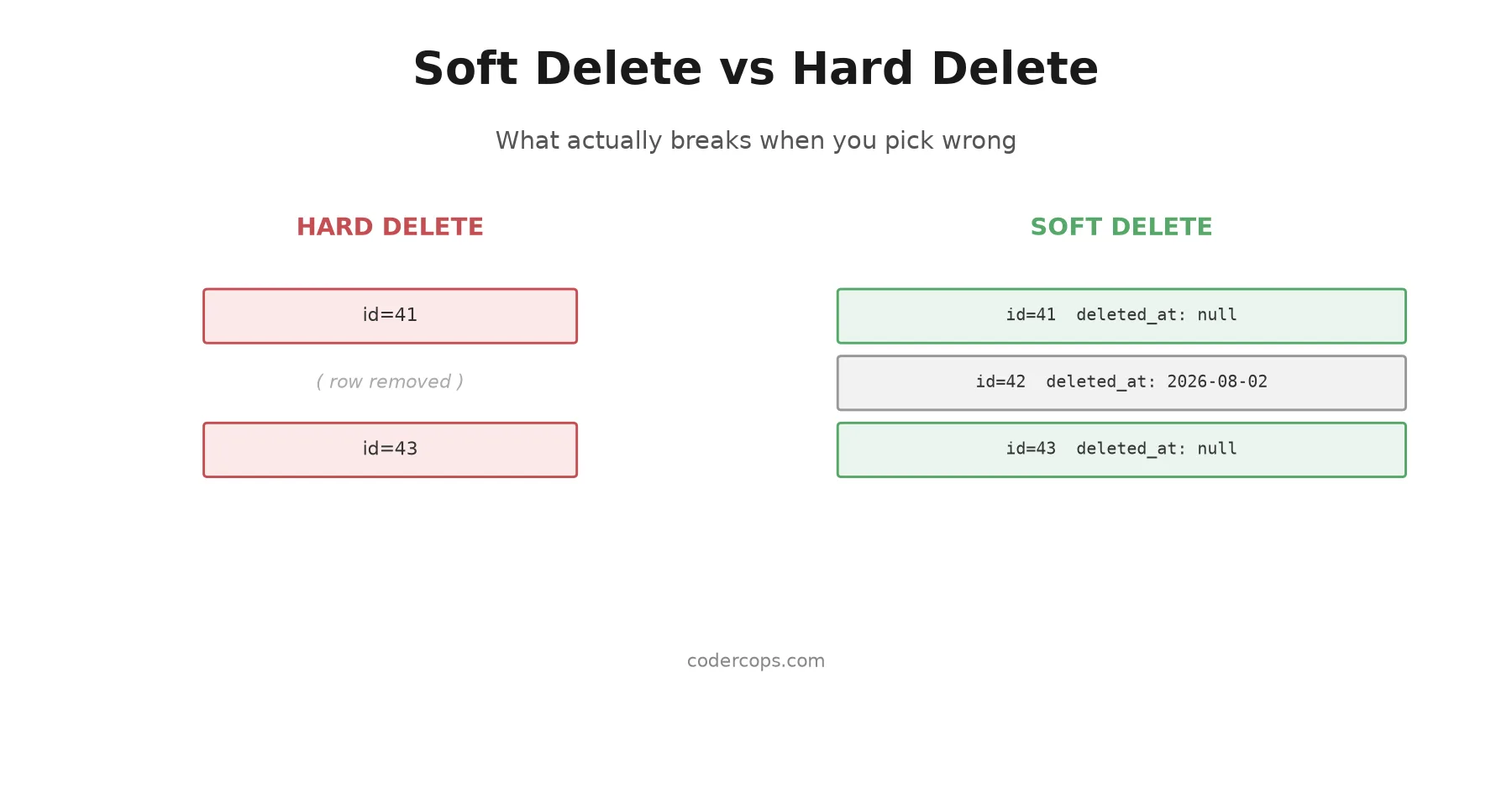
Soft delete keeps the row and flags it instead:
ALTER TABLE users ADD COLUMN deleted_at TIMESTAMPTZ;

-- "delete"
UPDATE users SET deleted_at = now() WHERE id = 42;

-- every read now needs this filter
SELECT * FROM users WHERE id = 42 AND deleted_at IS NULL;
Nothing is actually removed. Undo is a single UPDATE ... SET deleted_at = NULL. An audit log can show exactly when something was deleted and by whom. Anything referencing the row by foreign key, an order that points at a now-discontinued product, keeps resolving to a real row with real data instead of a broken reference or a null.
That convenience comes with an obligation the schema doesn’t enforce for you: every single query against that table now needs to know about deleted_at, and nothing stops a new report, a new join, or a new admin panel from forgetting the filter and quietly surfacing rows the rest of the application treats as gone.
The constraint problem nobody expects the first time
This is the one that catches teams off guard in production, not in code review. A standard unique constraint has no concept of soft-deleted rows:
-- naive: this index doesn't know deleted_at exists
CREATE UNIQUE INDEX users_email_unique ON users (email);
Soft-delete a user with a@example.com, and that email is still occupying the unique index, attached to a row your application no longer shows anywhere. A new signup with the same email hits a constraint violation the user has no way to understand, since as far as they can tell, that email has never been used.
The fix is a partial index, scoped to only the rows that count:
CREATE UNIQUE INDEX users_email_unique
  ON users (email)
  WHERE deleted_at IS NULL;
Now uniqueness only applies among active rows. A soft-deleted user’s email frees up for reuse the moment the row is marked deleted, exactly matching what the application actually promises the user. This single index type is the most common thing missing from soft-delete implementations that “worked fine in testing” and then failed the first time a real user deleted an account and someone else tried to sign up with the same email.
Query performance and table growth
Two separate costs. First, every query against a soft-deleted table needs deleted_at IS NULL (or the equivalent) in its WHERE clause and in the index supporting it, usually as a partial index like the one above, or the query planner scans rows it should have excluded from consideration entirely. Second, a soft-delete table never shrinks on its own. Rows accumulate forever unless something separately archives or purges old soft-deleted data on a schedule, which most teams don’t set up until the table is already large enough to be a problem.
| Hard delete | Soft delete | |
|---|---|---|
| Undo | Not built in | Trivial |
| Audit trail | None by default | Built in |
| Foreign key references | Break unless handled explicitly | Keep resolving |
| Unique constraints | Work as written | Need a partial index scoped to non-deleted rows |
| Every query | Sees only real rows | Needs an explicit filter, every time |
| Table growth | Bounded by active data | Unbounded without a separate purge job |
| Legal “right to erasure” | Satisfies it directly | Does not, on its own |
Deciding per table, not per project
Treat this as a decision made once per table, based on what that specific data needs, not a global setting applied to every model in your ORM out of habit. Session tokens, password reset codes, and rate-limit counters should hard delete; nothing benefits from keeping them around, and undo isn’t a meaningful concept for a token. User accounts, orders, and content with downstream references or a genuine “restore this” user expectation are strong candidates for soft delete, paired with the partial unique index from the start, not added after the first collision in production.
One case deserves its own hard rule regardless of the rest of your schema: if a table holds personal data subject to a deletion request under a real privacy regulation, soft delete alone doesn’t satisfy it. Marking a row deleted_at while the underlying data still sits in your database and your backups is not the same as erasing it. That data needs an actual hard-delete path, on a defined schedule, separate from whatever soft-delete convenience the rest of the application relies on for undo and audit history. The same due-diligence habit that catches a missing partial index before it hits production is the one worth applying here too: decide the deletion strategy, and its constraints, at schema design time, not after the first user asks for their account back.
Frequently asked questions
- What is soft delete, exactly?
- Instead of running DELETE FROM table WHERE id = ?, a soft delete sets a column, typically deleted_at, to the current timestamp and leaves the row in place. Application queries then filter out rows where deleted_at is not null, so the data behaves as deleted from the application's perspective while still existing in the database.
- Why would you soft delete instead of just deleting the row?
- Three common reasons: you need to support undo or restore, a user deletes something by accident and expects to get it back; you need an audit trail that shows what existed and when it was removed; or other rows reference the deleted row by foreign key and you need that reference to keep resolving to something, an order needs to keep pointing at the product it was for even after the product is discontinued.
- How does soft delete break unique constraints?
- A standard unique index doesn't know about your deleted_at column, it just enforces uniqueness across every row, deleted or not. If a user with email a@example.com is soft-deleted, that email is still sitting in the unique index attached to a row that your application considers gone, so a genuinely new signup with the same email hits a constraint violation. The fix is a partial unique index scoped to non-deleted rows, or folding a deleted marker into the uniqueness key itself.
- Does soft delete hurt query performance?
- It can, in two ways. Every query needs the deleted_at IS NULL filter added and indexed, or it scans rows it should have excluded. And tables that never actually shrink, because rows only ever get marked, not removed, grow indefinitely unless you separately archive or purge old soft-deleted rows on a schedule.
- Should you soft delete everything by default?
- No. Treat it as a per-table decision based on whether recovery, audit history, or referential integrity actually matters for that specific data. Session tokens, verification codes, and anything with a legal requirement to be genuinely erased, personal data under a deletion request, for instance, should hard delete. User accounts, orders, and anything with downstream references or a real 'undo' expectation are better candidates for soft delete.
Sponsored
More from this category
More from Web Development
Sponsored
Discussion
Join the conversation.
Comments are powered by GitHub Discussions. Sign in with your GitHub account to leave a comment.
Sponsored