Web Development · Architecture Patterns
Optimistic vs Pessimistic Locking: Which to Use
Pessimistic locking stops one request from starting; optimistic lets both run and catches the conflict at the end. How each works, with SQL, and how to pick.

Abhishek Gupta
6 min read
Sponsored
Two requests hit the same row at nearly the same instant. One is decrementing inventory for the last unit of something in stock, the other is doing the exact same thing a few milliseconds later. Whether your database handles that correctly, and how much it costs you when it’s not actually contended, comes down to a choice you usually make once, early, and then live with across the whole schema: optimistic locking or pessimistic locking.
Pessimistic locking: stop the collision before it happens
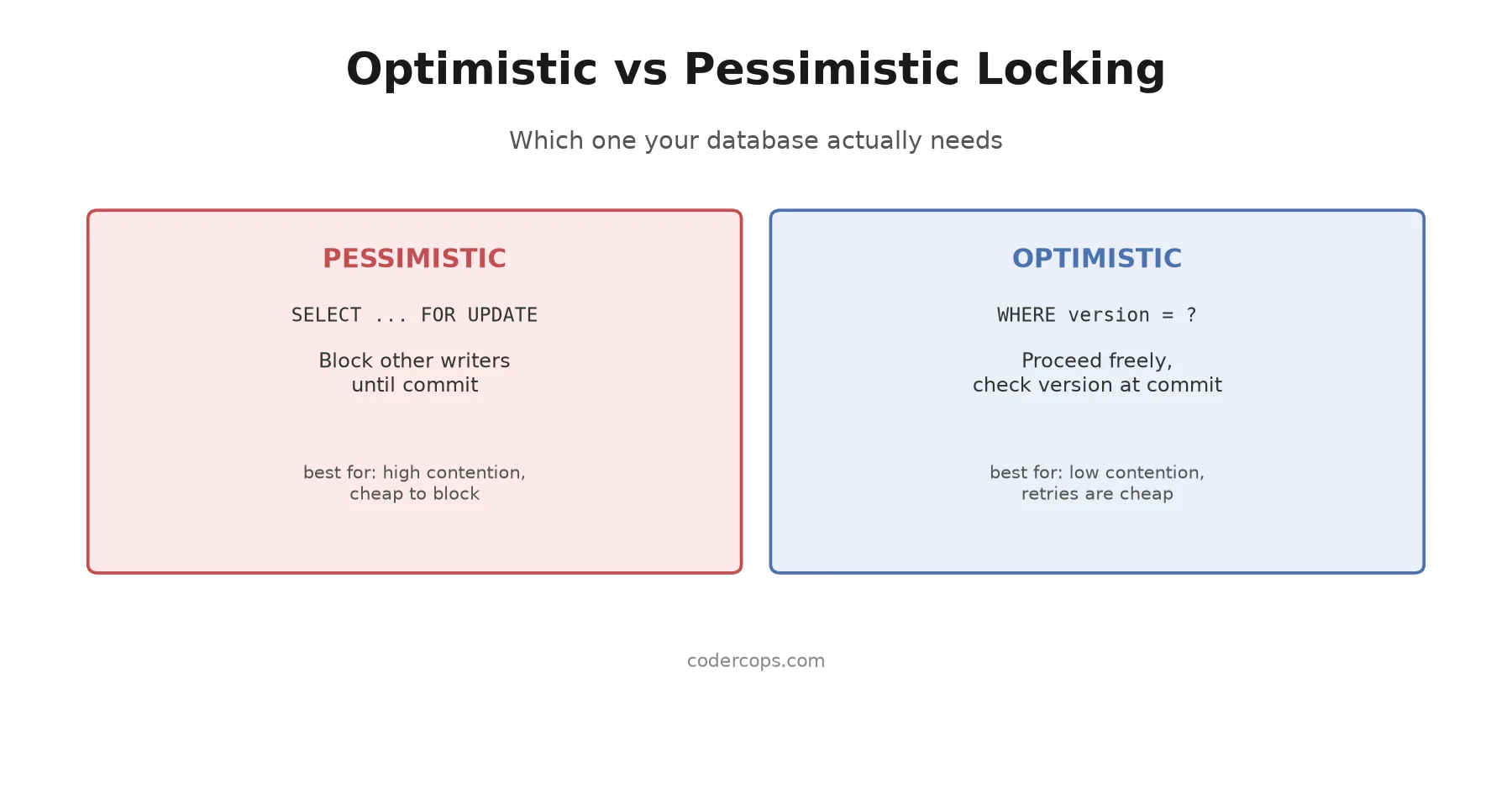
Pessimistic locking assumes conflicts are common enough that preventing them upfront is cheaper than detecting and cleaning them up after. The mechanism is a row lock, acquired the moment a transaction touches the row, held until that transaction commits or rolls back.
BEGIN;
SELECT quantity FROM inventory WHERE sku = 'WIDGET-1' FOR UPDATE;
-- any other transaction running the same SELECT ... FOR UPDATE
-- on this row now blocks until this transaction ends
UPDATE inventory SET quantity = quantity - 1 WHERE sku = 'WIDGET-1';
COMMIT;
FOR UPDATE tells the database: lock this row for writing, and make every other transaction that wants the same lock wait in line. Nothing weird can happen to quantity between the read and the write, because nothing else can touch the row at all during that window.
The cost is exactly what you’d expect from making transactions wait: throughput on that row drops to however fast transactions can process one at a time, and a transaction that holds the lock too long, waiting on a slow network call before committing, for instance, blocks everyone behind it. Pessimistic locking is a good trade when the row really is hot and the alternative, retries, would be expensive or messy. It’s a bad trade applied blanket-wide to rows that see one write a month.
Optimistic locking: let it run, check at the end
Optimistic locking assumes most transactions won’t actually collide, so it skips the upfront blocking and instead checks for a conflict right before the write commits. The standard mechanism is a version column:
ALTER TABLE accounts ADD COLUMN version INT NOT NULL DEFAULT 0;Read the row, including its current version, do whatever work the application needs, then write back with the version as a condition:
-- read
SELECT balance, version FROM accounts WHERE id = 42;
-- application computes new_balance using the balance it read

-- write, conditioned on the version not having changed
UPDATE accounts
SET balance = :new_balance, version = version + 1
WHERE id = 42 AND version = :version_read;
If nothing else touched the row between the read and the write, the version still matches, the update succeeds, and the row count is 1. If another transaction got there first and incremented the version, this update’s WHERE clause matches zero rows. Nothing is silently overwritten. The application checks the affected row count, sees zero, and knows to retry (re-read the current state and try again) or surface a conflict to the caller.
def update_balance(account_id, delta, max_retries=3):
    for attempt in range(max_retries):
        row = db.execute(
            "SELECT balance, version FROM accounts WHERE id = %s", (account_id,)
        ).fetchone()
        new_balance = row["balance"] + delta
        result = db.execute(
            """UPDATE accounts SET balance = %s, version = version + 1
               WHERE id = %s AND version = %s""",
            (new_balance, account_id, row["version"]),
        )
        if result.rowcount == 1:
            db.commit()
            return new_balance
        db.rollback()  # someone else won, retry with fresh data
    raise ConflictError(f"Too much contention on account {account_id}")
No row was ever locked. Two transactions on the same account can both proceed at once; only the loser has to redo its read-modify-write cycle. This is where the tradeoff actually lives: optimistic locking costs nothing when there’s no conflict, and costs a full retry, wasted work plus latency, when there is one.
Picking between them isn’t about preference
The deciding variable is contention rate weighed against retry cost, not which pattern feels more modern. A shared row that many requests genuinely race for, a limited-quantity item at checkout, a single counter incremented by thousands of concurrent workers, has a high enough collision rate that pessimistic locking’s upfront blocking costs less than optimistic locking’s constant stream of failed, retried writes. A typical user profile update, an order status change one specific order goes through once, has such low collision odds that pessimistic locking’s blocking overhead is paid on every single write for a conflict that almost never happens.
Pessimistic (FOR UPDATE) | Optimistic (version column) | |
|---|---|---|
| Best for | High contention, cheap to block | Low contention, retries are cheap |
| Cost when uncontended | Blocking overhead paid anyway | Near zero |
| Cost when contended | Transactions queue and wait | Losers redo the whole operation |
| Failure mode if done wrong | Lock held too long, blocks pile up | Version check skipped, updates silently lost |
| Typical use | Inventory decrements, seat reservations, counters | Most ordinary row updates |
Most production schemas end up using both, not one exclusively. A checkout flow might use FOR UPDATE on the specific inventory row being decremented, because that row really does see bursts of concurrent demand, while every other table in the same schema uses optimistic version checks, because a customer’s shipping address or a support ticket’s status almost never has two writers racing for it at once. Treating locking strategy as a per-table decision instead of a single project-wide default is usually the right level of granularity: it matches the actual shape of where your contention lives, similar to how idempotency keys get applied to the specific endpoints that need retry safety rather than blanket across an entire API.
What actually breaks in practice
The most common pessimistic-locking bug is holding the lock across something slow, a third-party API call, a synchronous email send, inside the same transaction as the row lock. Every other request wanting that row queues behind that slow call, and a minor latency spike upstream turns into a full outage on that table. The fix is almost always to shrink the transaction: do the slow work before acquiring the lock or after releasing it, never while holding it.
The most common optimistic-locking bug is quieter and more dangerous: an UPDATE that omits the version check entirely, or code that doesn’t inspect the affected row count and treats every write as successful. Both produce lost updates that pass every test written against a single-user scenario and only show up under real concurrent load, usually in production, usually against data someone cares about. If you adopt optimistic locking, the row-count check on every write isn’t optional error handling, it’s the entire mechanism.
Frequently asked questions
- What's the actual difference between optimistic and pessimistic locking?
- Pessimistic locking assumes conflicts are likely, so it prevents them by blocking other transactions from touching a row until the current one finishes. Optimistic locking assumes conflicts are rare, so it lets transactions proceed freely and only checks for a conflict right before committing, rejecting the write if the data changed in the meantime.
- How do you actually implement optimistic locking?
- The standard pattern is a version column on the row. Every update includes the version it read in its WHERE clause and increments it: UPDATE accounts SET balance = ?, version = version + 1 WHERE id = ? AND version = ?. If another transaction updated the row first, the version no longer matches, zero rows update, and your application code checks the row count and retries or surfaces a conflict.
- Doesn't SELECT FOR UPDATE just slow everything down?
- It adds latency for any other transaction that wants the same row while the lock is held, which is exactly the point when conflicts are actually likely. On a row nobody else is touching, the cost is negligible. The problem shows up when FOR UPDATE gets applied broadly, to rows that rarely see contention, where you're paying a blocking cost for a collision that was never going to happen.
- Can optimistic locking fail silently and lose an update?
- Not if it's implemented correctly. A correct implementation checks the affected row count after the conditional UPDATE and treats zero rows as a signal to retry or fail, not as success. The bug that causes silent lost updates is skipping that check, updating without the version condition in the WHERE clause, or ignoring a zero-row result as if the write succeeded.
- Which one should a typical CRUD application default to?
- Optimistic locking, for most tables. Most application data sees low contention on any individual row, a specific user's profile, a specific order, and paying the coordination overhead of pessimistic locks on all of it is waste. Reach for pessimistic locking specifically on the paths you know are hot: shared counters, inventory decrements, seat or slot reservations, anything where you can predict multiple requests will race for the same row regularly.
Sponsored
More from this category
More from Web Development
Sponsored
Discussion
Join the conversation.
Comments are powered by GitHub Discussions. Sign in with your GitHub account to leave a comment.
Sponsored