Industry News · AI Policy
OpenAI Wants Washington to Own 5% of It: What That Means
OpenAI proposed handing the U.S. government a voluntary 5% stake worth roughly $42.6 billion. What's on the table, why now, and what critics say it breaks.

Anurag Verma
5 min read
Sponsored
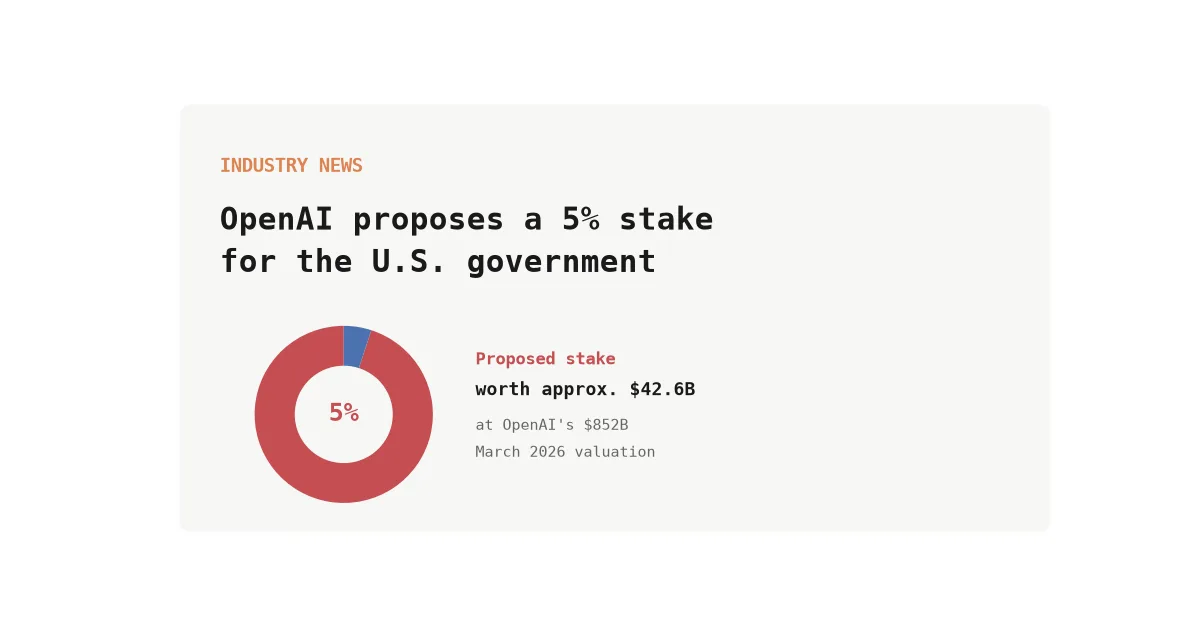
OpenAI has proposed giving the U.S. government a 5% stake in the company, worth roughly $42.6 billion at its current $852 billion valuation, for free. Framed publicly as a way to share AI’s upside with the public, the timing and the reporting around it point to a more specific motive: smoothing over a regulatory relationship that’s gotten noticeably rougher in the past few months.
What’s on the table
The proposal is straightforward on paper: OpenAI hands the federal government a 5% equity stake, no purchase price attached, and in exchange gets a public that has a direct financial interest in the company doing well. Sam Altman has been pitching some version of this idea since early 2025, and the argument he’s made publicly is that broad-based equity ownership is a fairer way to distribute AI’s economic gains than leaving all of the upside with private shareholders and venture investors.
That argument isn’t new; Altman has floated public AI ownership concepts before. What changed is the timing. Reporting from CNBC and Axios ties the current proposal directly to recent friction between OpenAI, Anthropic, and federal regulators, including a period where the government forced Anthropic to pause its newest models for weeks and delayed OpenAI’s own GPT-5.6 launch. An investor with stakes in both companies told Axios the proposal reads more like a political move to gain favor with the administration than a genuine public-benefit mechanism, which is the read most coverage has settled on.
The bigger pitch: every major lab, not just OpenAI
Altman’s stated ambition goes beyond his own company. The pitch, as reported, is that the government would hold a stake in each major AI lab, OpenAI, Anthropic, Google, and Meta specifically named. Whether any of those companies would actually agree to hand over equity on the same terms is an open question; none has confirmed a matching arrangement, and each has a different ownership structure, investor base, and set of incentives that makes a uniform deal harder than it sounds in a single sentence.
It’s also worth noting this isn’t happening in isolation. The Trump administration has separately been taking equity stakes in strategically important companies through other mechanisms, including a reported 10% stake in Intel, and has floated a broader sovereign wealth fund concept that would extend beyond AI specifically.
Why critics are uneasy
| Concern | Who’s raising it | The core objection |
|---|---|---|
| Regulatory conflict of interest | Public Knowledge (Nat Purser) | A government that owns equity has a financial reason to go easy on enforcement against that same company |
| Entrenches incumbent advantage | David Sherman, io.net | Gives one lab a government stamp of approval while smaller developers and labs get nothing |
| Reads as political favor-trading | Unnamed investor, via Axios | The timing, right after regulatory friction, suggests the goal is smoother relations, not public benefit |
| Voluntary and company-specific, not systemic | Sen. Bernie Sanders | A single company’s gift doesn’t scale into broad public ownership the way a mandatory, industry-wide mechanism would |
The regulatory conflict-of-interest concern is the one worth sitting with longest if you’re trying to understand what this actually changes. A regulator that holds equity in the company it oversees doesn’t lose its authority to enforce rules, but its incentives shift: enforcement actions that hurt the company’s valuation now cost the government money too. That’s a structurally different position than “the government sets rules for an industry it has no financial stake in,” and it’s the crux of why this proposal has drawn more skepticism than straightforward praise, even from people broadly sympathetic to the idea of the public benefiting from AI’s growth.
The alternative on the table
Sen. Bernie Sanders’ American AI Sovereign Wealth Fund Act takes a different structural approach entirely: a one-time 50% tax on AI company stock across the industry, funding a public wealth fund with broad citizen ownership and board-level voting power. Where OpenAI’s proposal is voluntary, company-specific, and framed as a gift, Sanders’ proposal is mandatory, industry-wide, and framed as a tax. Neither has passed into anything binding as of this writing, but they represent two genuinely different philosophies for the same underlying question: if AI companies are going to generate enormous value partly on the back of public infrastructure, research, and data, how much of that value should flow back to the public, and through what mechanism.
What this means if you build on these platforms
For teams and agencies building products on top of OpenAI’s API or competing platforms, the direct product impact of this proposal today is close to zero: nothing about model access, pricing, or terms of service changes because of an equity conversation happening at the policy level. The relevant signal is upstream of your stack, in how AI regulation and platform relationships with government evolve over the next year. If you’re tracking that broader regulatory picture, our breakdown of the federal versus state AI regulation fight is a useful companion read, since a government with equity in a major lab is one more variable in an already fragmented set of rules.
Whatever happens to this specific proposal, it’s a preview of a negotiation every major AI lab is going to have some version of eventually: how does an industry this economically significant relate to the government that both regulates it and, increasingly, wants a piece of it.
Frequently asked questions
- What is OpenAI actually proposing?
- A voluntary 5% equity stake in OpenAI, handed to the U.S. government at no cost, valued at approximately $42.6 billion based on the company's $852 billion valuation from its March 2026 funding round. It isn't a purchase or an investment by the government, it's framed as a gift intended to give the public a direct financial interest in the company's success.
- Why is OpenAI doing this now?
- Publicly, Sam Altman frames it as the fairest way to share AI's economic upside with the public that helped create the conditions for it to grow, an idea he's reportedly been pitching to the Trump administration since early 2025. Reporting from Axios and other outlets describes the more immediate driver as political: the government recently forced Anthropic to disable its newest models for weeks and delayed OpenAI's own GPT-5.6 launch, and an equity stake is widely read as an attempt to secure better relations with regulators after friction like that.
- Would this apply to other AI companies too?
- Altman's stated pitch extends the concept to every major AI lab, Anthropic, Google, and Meta included, under the idea that the government would hold a stake in each. None of those companies has confirmed a similar arrangement, and there's no indication they're required to participate even if OpenAI's deal goes through.
- What's the main criticism of this proposal?
- That it creates a direct conflict of interest. If the government owns a financial stake in a company, it has a monetary incentive to see that company succeed, which sits uneasily next to its role setting and enforcing AI safety rules for that same company. Public Knowledge's Nat Purser has specifically warned this could make regulators less willing to enforce rules that would reduce the value of the government's own investment. Critics have also called it a move that entrenches one company's position rather than genuinely broadening public benefit.
- What's the alternative some lawmakers are proposing instead?
- Sen. Bernie Sanders has proposed the American AI Sovereign Wealth Fund Act: a one-time 50% tax on AI company stock across the industry, not a voluntary gift from a single company, funding a public wealth fund with broad ownership and board-level voting power for citizens. It's a structurally different approach: mandatory and industry-wide instead of voluntary and company-specific.
Sources
Sponsored
More from this category
More from Industry News
Sponsored
Discussion
Join the conversation.
Comments are powered by GitHub Discussions. Sign in with your GitHub account to leave a comment.
Sponsored