Cybersecurity · Vulnerability Management
CVE-2026-46242 Bad Epoll: Linux Kernel Local Root
A race in the Linux kernel's epoll subsystem lets any local user reach root, with an exploit that works 99% of the time. Who's affected, and what to patch.

Prathviraj Singh
5 min read
Sponsored
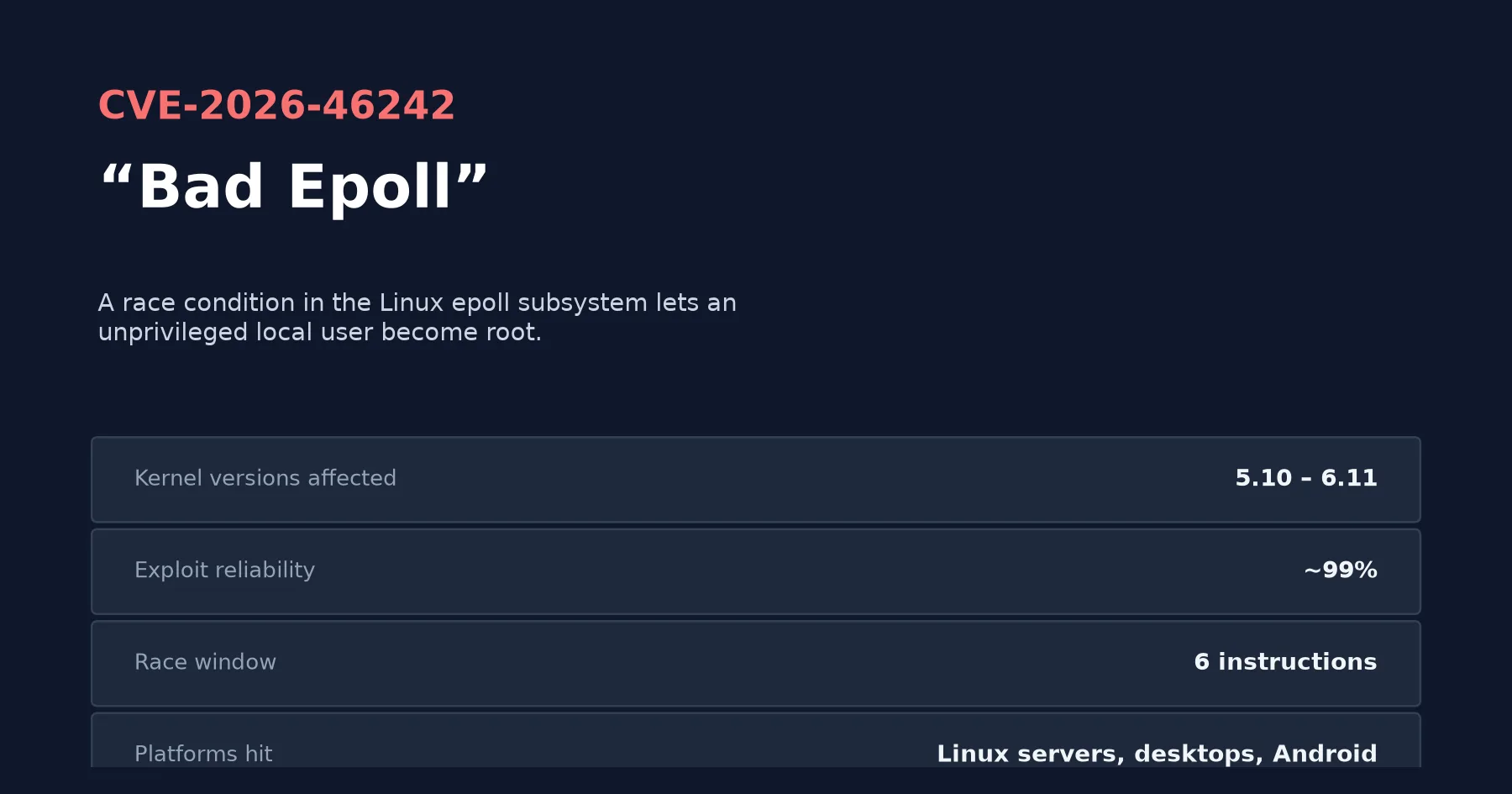
A bug with a 99% reliable exploit and a six-instruction timing window sounds like a contradiction. It isn’t. CVE-2026-46242, already going by the nickname Bad Epoll, is a Linux kernel race condition that lets any local user walk straight to root, and it affects most of the Linux and Android machines currently running in production. If you manage servers, containers, or fleets of Android devices, this is this week’s patch, not next month’s.
What the bug actually is
Bad Epoll lives in the kernel’s epoll subsystem, the I/O multiplexing facility that lets a single process watch thousands of file descriptors for activity without polling each one individually. It’s a use-after-free triggered by a race condition: two code paths inside the kernel try to tear down the same internal epoll object at the same time. One path frees the memory. The other is still writing to it. Whichever attacker wins that race gets to corrupt kernel memory in a controlled way, and a controlled kernel memory corruption is the raw material for privilege escalation.
The race window is narrow, about six CPU instructions, which is part of why the bug went unnoticed through several kernel release cycles. Narrow windows are hard to hit by accident, but they aren’t hard to hit on purpose once someone has mapped out the exact sequence of syscalls that opens them. Security researcher Jaeyoung Chung did that work and published an exploit that lands successfully close to 99% of the time.
Thread A (closing an fd)          Thread B (epoll_ctl on same fd)
  -> begins releasing the         -> still reads/writes fields
     epoll_item structure            on the same epoll_item
  -> frees the memory      <race>  -> writes into freed memory
                                       (use-after-free)
That’s the shape of the bug. Nothing exotic, just a classic use-after-free in a place the kernel didn’t expect two paths to collide, and a narrow enough window that it survived review until someone went looking specifically for it.
Why this reaches almost everything
Epoll isn’t a niche subsystem. It’s the mechanism behind:
- nginx and Apache for handling thousands of concurrent connections per worker
- Node.js’s event loop, via libuv
- Python’s
asyncio, for async I/O - Most production databases, for connection handling
- Android’s event loop infrastructure, which runs on the same kernel family
That breadth is exactly why “which kernel versions” matters more here than “which distro” or “which application.” CVE-2026-46242 affects Linux kernel versions 5.10 through 6.11, which is the range currently running on the large majority of production Linux servers and Android devices. A vulnerability scoped to a specific web server or database would be bad. A vulnerability scoped to the kernel primitive underneath nearly all of them is worse, because patching one application does nothing for the rest.
The part that should worry you specifically
Local privilege escalation bugs get less attention than remote code execution bugs, because they don’t hand an outside attacker a way in on their own. That’s the wrong way to weigh this one. Local privesc is the step that turns every other limited compromise into a total one:
- A vulnerable web application gives an attacker a shell as
www-data. Bad Epoll turns that into root. - A malicious Android app gets sandboxed, unprivileged execution. Bad Epoll turns that into a device compromise.
- A multi-tenant host or CI runner lets untrusted code execute as a low-privileged user by design. Bad Epoll turns that into a breakout affecting every other tenant on the box.
If your threat model assumes “worst case, they get a low-privileged shell,” this CVE is the reason that assumption doesn’t hold anymore on an unpatched kernel.
What to do
A fix is already out. The practical steps, in order:
- Check your kernel version against your distribution’s security advisory. Debian, Ubuntu, RHEL, and the mainline kernel have all shipped patches; the exact fixed build number depends on which branch you track.
- Prioritize by exposure, not convenience. Shared hosting, CI/CD runners, multi-tenant Kubernetes nodes, and anywhere else untrusted or semi-trusted code runs as a low-privileged user should go first. These are precisely the environments where “just a local user” is one step away from “arbitrary code,” by design.
- Push Android updates as they land from device vendors. Google’s own patch schedule will vary by OEM, so treat this as an ongoing rollout to track, not a single event.
- If you can’t patch this week, reduce the number of processes and accounts capable of running arbitrary local code as a stopgap. It narrows the attack surface; it doesn’t close the hole.
Kernel-level bugs are also a good prompt to revisit the isolation assumptions in your infrastructure more broadly. If you’re weighing how much to trust workload isolation at the VM or container boundary, our post on a recent Linux KVM VM-escape CVE covers a related failure mode: what happens when the boundary you’re relying on turns out to be the thing that breaks.
The pattern
Bad Epoll is the second major local-privilege-escalation bug to surface in core Linux infrastructure this year, and it follows a familiar shape: a subsystem that’s stable, heavily used, and hasn’t needed a rewrite in years turns out to have a race condition that nobody happened to go looking for until now. Stability isn’t the same thing as having been audited recently. If your patch cadence treats kernel updates as routine maintenance rather than a security control, this is a good week to reconsider that.
Patch the kernel. Then check which of your hosts run untrusted code as a low-privileged user, because those are the ones where this bug matters most.
Frequently asked questions
- What is CVE-2026-46242 ("Bad Epoll")?
- It's a local privilege escalation vulnerability in the Linux kernel. Two parts of the kernel try to clean up the same internal epoll object at the same time, one frees the memory while the other is still writing to it, and an attacker who wins that race can corrupt kernel memory in a way that escalates an ordinary user account to root. No remote access or special permissions are needed to trigger it, just a local (or locally-reachable, e.g. via a hosted shell or container escape) account.
- Which systems are affected?
- Linux kernel versions 5.10 through 6.11, which is the range running on most current Linux servers, desktops, and Android devices. Because epoll is a core kernel facility rather than an optional module, the exposure isn't limited to a specific distro or use case, any system running an affected kernel version is in scope.
- Is this actually exploitable, or is it mostly theoretical?
- It's exploitable today. The race window is narrow (about six CPU instructions), but the researcher who disclosed the bug, Jaeyoung Chung, built a working exploit that reaches root reliably around 99% of the time in testing. A narrow timing window makes a bug harder to find, not harder to weaponize once someone has found it.
- Does this require the attacker to already have some access to my system?
- Yes, it's a local privilege escalation bug, not a remote code execution bug on its own. The attacker needs some way to run code as a low-privileged user first: a compromised web app account, a malicious app on Android, a tenant in a shared hosting environment, or a foothold from an unrelated vulnerability. The danger is what it does after that: it turns any of those limited footholds into full root, which is exactly the step that turns a contained incident into a total compromise.
- What should I do right now?
- Patch your kernel. Check your distribution's advisory for the specific fixed build (Debian, Ubuntu, RHEL, and the mainline kernel have all shipped updates), and prioritize any host where untrusted code runs as a low-privileged user: shared hosting, CI runners, multi-tenant containers, and Android devices pending an OS update. If you can't patch immediately, reducing the number of accounts and processes that can run arbitrary local code narrows your exposure, but it isn't a substitute for the kernel update.
Sources
Sponsored
More from this category
More from Cybersecurity
Sponsored
Discussion
Join the conversation.
Comments are powered by GitHub Discussions. Sign in with your GitHub account to leave a comment.
Sponsored