Cybersecurity · Vulnerability Management
CVE-2026-48558: SimpleHelp's MSP Supply Chain Bug
A forged OIDC token in SimpleHelp RMM lets an unauthenticated attacker create an admin and reach every managed endpoint. CISA added it on June 29.

Prathviraj Singh
5 min read
Sponsored
If your agency, or a vendor you rely on, runs SimpleHelp for remote support and endpoint management, stop and check the authentication configuration before reading further. CVE-2026-48558 lets an unauthenticated attacker forge a login token, create an administrator account, and reach every machine that SimpleHelp instance manages. CISA added it to the Known Exploited Vulnerabilities catalog on June 29, with a remediation deadline of July 2. That deadline has already passed for federal agencies, which tells you how it’s being treated.
How the bypass actually works
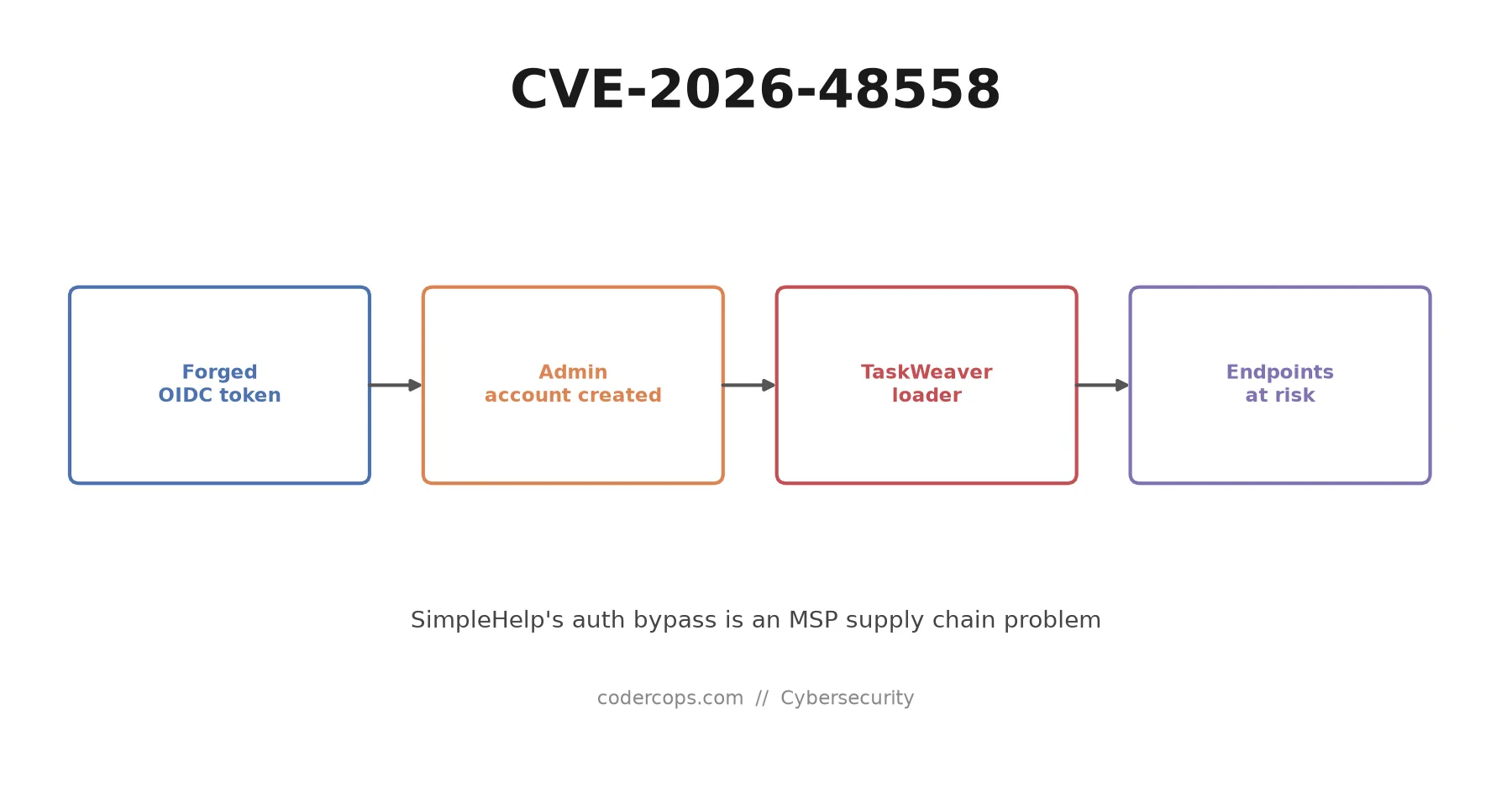
SimpleHelp supports OpenID Connect as a login method, letting an organization plug in its existing identity provider instead of managing separate local accounts. The flaw is in how the server handles OIDC tokens: it accepts them without verifying the cryptographic signature that’s supposed to prove the token actually came from the identity provider.
That single missing check is the whole vulnerability. An attacker who understands the token format can construct one that looks valid, submit it to SimpleHelp, and the server creates a Technician account, SimpleHelp’s term for an account with full administrative privileges, no password required, no real identity provider involved at all.
This is a category of bug security teams have seen before in other SSO integrations: trusting the shape of a token instead of its signature. It’s a reminder that adding SSO to a system is not automatically a security upgrade if the verification step is implemented loosely. The severity here earned it a maximum CVSS score of 10.0.
Why attackers went straight for a loader, not just access
Confirmed exploitation didn’t stop at account creation. Researchers observed attackers using the forged access to deploy TaskWeaver, a modular Node.js loader built to evade static analysis. TaskWeaver’s design is intentionally minimal: it has essentially one command, “deliver,” which runs whatever code its operator sends. That’s what makes it dangerous as a foothold. The same compromised instance can drop an infostealer one day and a ransomware payload the next, because the loader itself doesn’t commit to a single objective. In this case, the observed payload was Djinn Stealer, an infostealer aimed at harvesting credentials and session data from the machines it lands on.
The attack chain is worth internalizing because it’s not unique to SimpleHelp: auth bypass, then a general-purpose loader, then whatever the operator decides to run that week. Patching the auth bypass stops new intrusions. It does nothing about a loader that’s already sitting on an endpoint from before the patch.
The part that makes this an MSP problem, not a server problem
A typical web application vulnerability, even a critical one, usually has a blast radius bounded by the application’s own data and users. RMM software is structurally different. Its entire purpose is giving one console administrative reach into many other machines, often across many different client organizations if you’re an MSP or an agency running support for multiple accounts on shared tooling.
That means CVE-2026-48558 isn’t really a “SimpleHelp server got popped” story. It’s a supply chain story: compromise one under-patched instance, and you potentially have a path into every endpoint it manages. If your agency evaluates vendors on this kind of exposure, the same due diligence that applies to choosing a software development agency in the first place, ask what remote access tooling they run and how quickly they patch it, applies just as much to your IT and support vendors as it does to your dev vendors.
What to actually do about it
The patch itself is straightforward:
# Confirm your SimpleHelp version and authentication method first
simplehelp-server --version
# Apply the vendor-supplied patch or upgrade to the fixed release
# per SimpleHelp's advisory for your deployment type
But stopping at “patched” is the mistake teams make under deadline pressure, the same mistake that shows up in almost every KEV-listed vulnerability response. The forged-token bypass doesn’t leave the kind of obvious trace a brute-force login attempt does, so absence of alerts isn’t evidence of absence of compromise. Treat the pre-patch window as a suspected breach:
- Audit Technician account creation logs for the weeks before you patched. Any account you don’t recognize creating was created legitimately is suspect.
- Rotate credentials and session tokens for accounts active during that window, not just ones you can specifically tie to malicious activity.
- Scan managed endpoints for TaskWeaver and Djinn Stealer indicators of compromise. The vulnerability check and the compromise check are two different tasks.
- If you’re an agency running SimpleHelp for client support, notify affected clients. The exposure isn’t contained to your own infrastructure.
The pattern underneath the CVE number
This isn’t the first time a tool built for convenience across many machines has turned into the highest-leverage target on the network, and it won’t be the last. Any software whose entire job is centralized administrative reach, RMM tools, configuration management systems, patch deployment platforms, deserves security scrutiny proportional to what it can touch, not to how it’s marketed. A tool sold as “lightweight remote support” is, from an attacker’s perspective, a master key.
If you run SimpleHelp with OIDC enabled, patch today if you haven’t, and start the credential rotation and log review regardless of whether you’ve seen anything unusual yet. The absence of an alert is not the same thing as the absence of an intrusion.
Frequently asked questions
- What is CVE-2026-48558?
- It's an authentication bypass in SimpleHelp RMM software. When SimpleHelp is configured to use OpenID Connect for login, it accepts OIDC tokens without verifying their signature. An attacker can forge a token, use it to create a new Technician account with administrative rights, and log in with no valid credentials at all.
- Do I need to have SimpleHelp configured with OIDC to be affected?
- Yes, the bypass specifically targets instances with OIDC authentication enabled. If your instance uses only local accounts or a different SSO method, this particular flaw doesn't apply, though it's worth confirming your authentication configuration rather than assuming.
- Is this being actively exploited?
- Yes. Security researchers have confirmed exploitation in the wild, with attackers deploying a Node.js loader tracked as TaskWeaver, which in turn delivers an infostealer known as Djinn Stealer. CISA's Known Exploited Vulnerabilities listing on June 29, 2026 reflects that confirmed activity, not a theoretical risk.
- Why does this matter more for SimpleHelp than for a typical business application?
- SimpleHelp is remote monitoring and management software, the tool MSPs and IT teams use to reach and administer client machines at scale. Compromising one SimpleHelp instance doesn't just expose that server. It hands the attacker administrative reach into every endpoint that instance manages, which for an MSP can mean thousands of client systems across many different companies.
- What should I do if my agency or vendor runs SimpleHelp?
- Patch to the fixed version immediately, then treat the pre-patch window as a suspected breach rather than a closed ticket. Review Technician account creation logs for the affected period, rotate credentials for any account created or modified during that window, and check managed endpoints for TaskWeaver or Djinn Stealer indicators of compromise, not just for the vulnerability itself.
Sources
Sponsored
More from this category
More from Cybersecurity
Sponsored
Discussion
Join the conversation.
Comments are powered by GitHub Discussions. Sign in with your GitHub account to leave a comment.
Sponsored