Industry News · Developer Surveys
The Stack Overflow Survey's AI Trust Gap
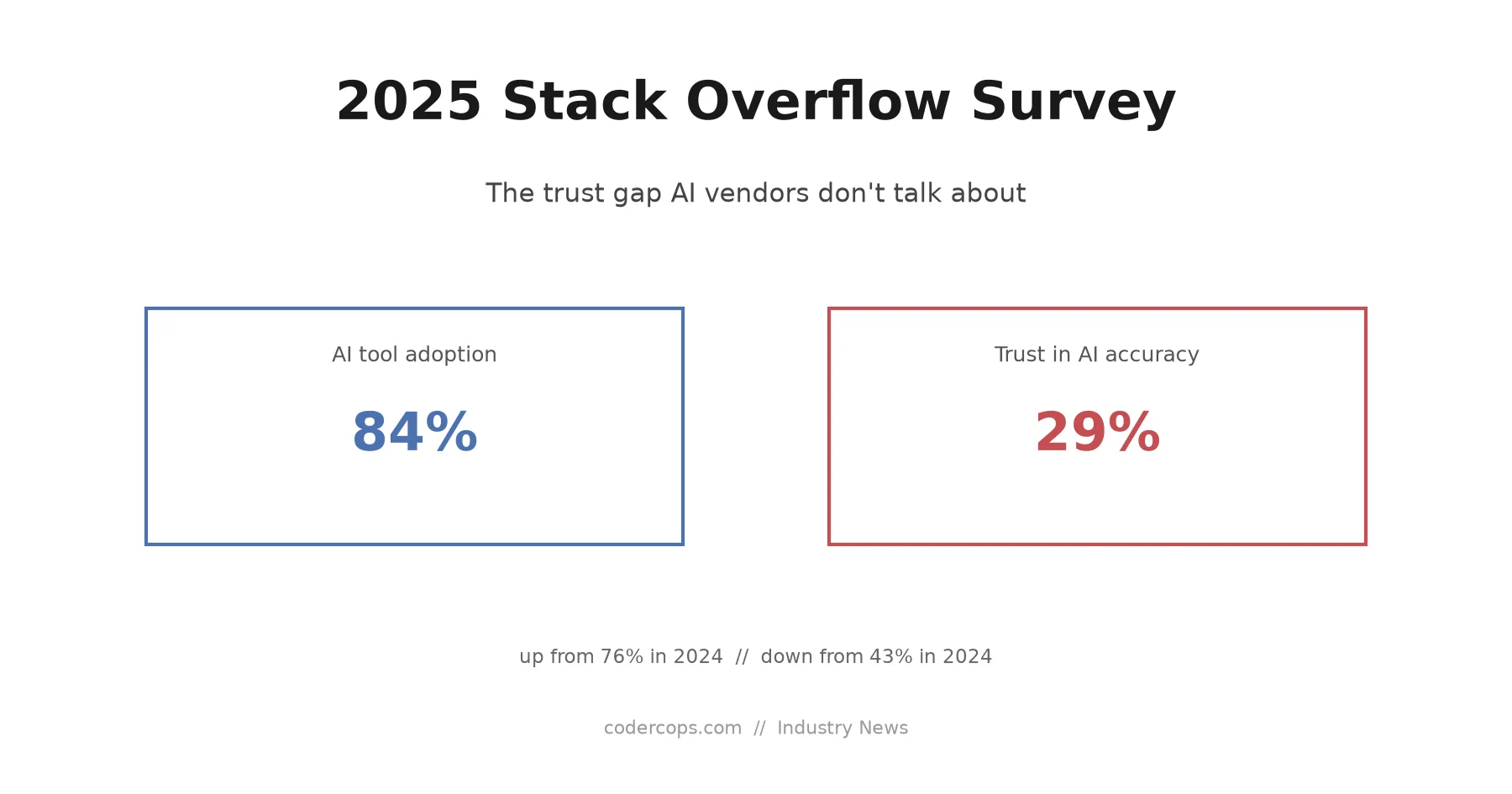
AI tool use hit 84% in the 2025 Stack Overflow survey while trust in accuracy fell to 29%. Usage up, trust down. What that gap means for how teams work.

Shashikant Gupta
5 min read
Sponsored
Usage of AI coding tools among developers climbed to 84% in the 2025 Stack Overflow Developer Survey. Trust in the accuracy of what those same tools produce fell to 29%, down from 43% the year before. Those two numbers moving in opposite directions, at the same time, from the same 49,000-plus respondents, is the actual story in this year’s data. Adoption isn’t the open question anymore. Trust is.
The gap, in numbers
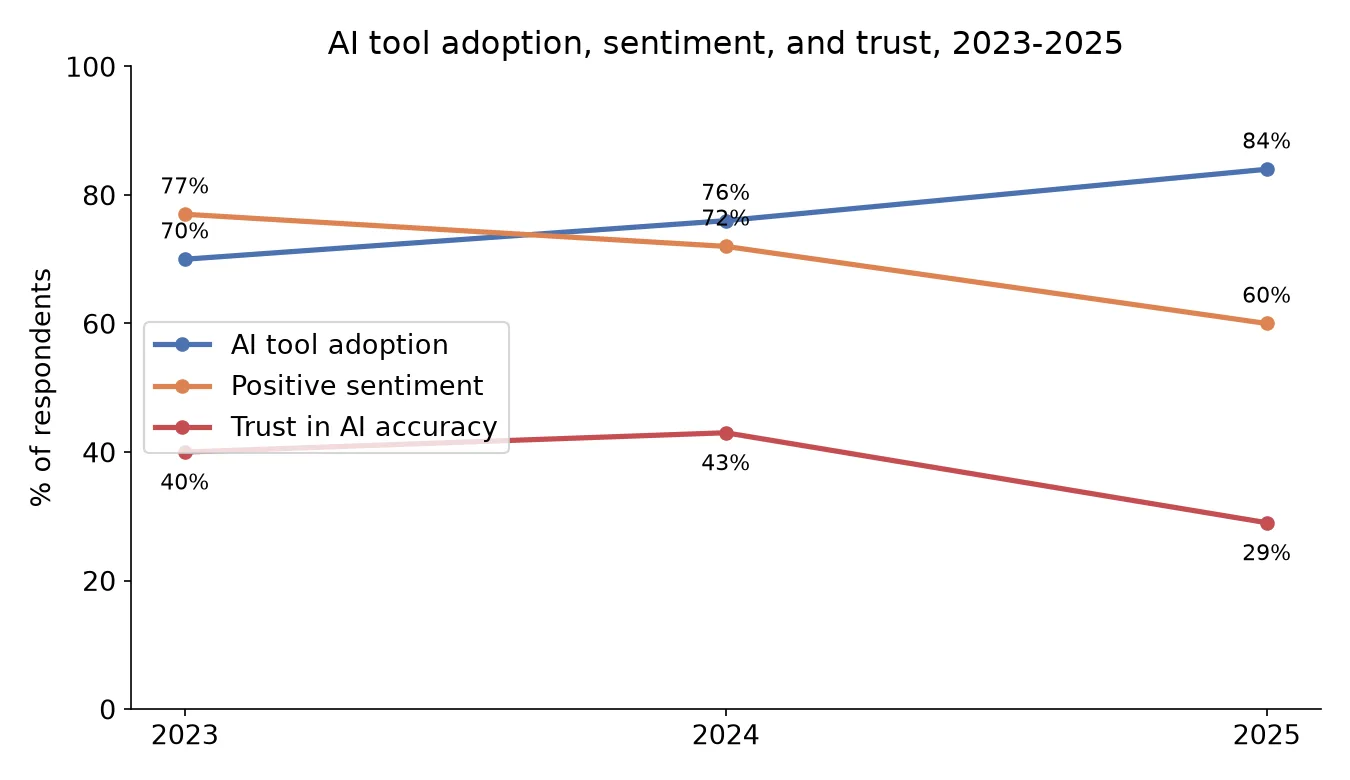
Adoption has climbed every year the survey has tracked it: 70% in 2023, 76% in 2024, 84% in 2025. Sentiment moved the other way, from 77% positive in 2023, to 72% in 2024, down to 60% in 2025. The trust-in-accuracy number, a narrower and blunter question than general sentiment, fell even harder: 40% in 2023, 43% in 2024, then a drop to 29% in 2025. Professional developers hold a more favorable overall view (61%) than people still learning to code (53%), which on its own is a useful data point: the group with the most hands-on experience using these tools professionally is also the group least starry-eyed about them.
This isn’t a story about AI tools getting worse. It’s a story about developers getting a clearer picture of where the tools actually help and where they don’t, after a year or more of daily use rather than a few weeks of novelty.
What’s actually generating the frustration
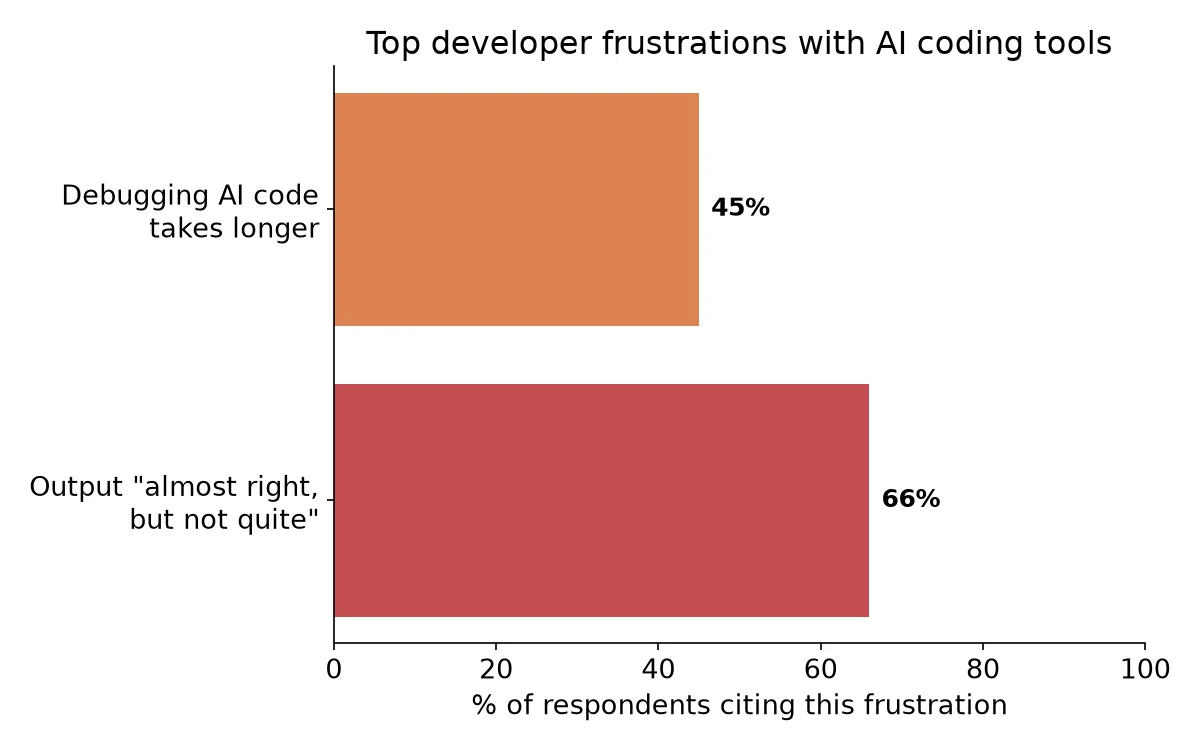
The survey asked developers directly what frustrates them about AI tools, and the answers cluster tightly around one theme. 66%, the largest share by a wide margin, pointed to output that’s “almost right, but not quite.” 45% said debugging AI-generated code takes more time than they expected it to.
Read together, those two numbers describe a specific and unglamorous failure mode. It’s not that the tools produce obviously broken code that fails a build immediately; that would be cheap to catch. It’s plausible-looking code that passes a casual read and fails somewhere subtler, a wrong assumption about an edge case, a slightly incorrect API usage, a test that looks like it covers the right thing but doesn’t. That kind of near-miss is more expensive to find than an outright failure, because it requires the same level of scrutiny as reviewing unfamiliar code from a human, and developers report they’re spending closer to that level of time, not less.
Python keeps winning, and it’s not close
Away from the AI-specific questions, Python’s usage climbed 7 percentage points year over year, the largest single-year jump for any major language in recent survey history. The driver isn’t mysterious: Python sits at the center of AI, data science, and increasingly backend development, which means its usage curve is riding three separate growth trends simultaneously rather than one.
For teams making a language choice for a new service, or scoping what to look for when they hire a Python developer, this kind of broad-based, multi-driver growth is a stronger signal than a language spiking because of one trend, since it suggests staying power rather than a temporary fad.
The IDE category has new top-tier entrants
Cursor and Claude Code both appeared in the survey’s IDE rankings for the first time this year and immediately landed in the top tier, alongside VS Code, which continues to dominate on raw usage. That’s a fast climb for tools that didn’t have enough of a user base to register a year or two ago, and it lines up with the adoption number: developers are reaching for AI-native tooling, not just AI features bolted onto existing editors.
On the model side, Anthropic’s Claude Sonnet came out as the most admired language model among respondents who evaluated it, with roughly 67.5% expressing admiration, and it ranked near the top on desirability too. That’s one data point among many in a survey covering 314 technologies, not a verdict on the entire model landscape, but it’s a notable result given how competitive the frontier model space has been this year.
What this actually means for how teams should operate
The practical takeaway isn’t “use AI tools less” or “use them more.” It’s to calibrate review discipline to the actual failure mode the survey describes. Code from an AI assistant deserves the same scrutiny you’d give a fast but unfamiliar contributor: someone who can produce a lot of plausible-looking work quickly, and who you haven’t yet built a track record with. That’s a different posture than either blind trust or blanket rejection, and it’s closer to what the survey data suggests developers are already doing instinctively, which may be exactly why trust is dropping even as usage climbs: people are using the tools more and learning their specific failure modes at the same time.
For teams building AI review practices into their workflow, that means treating “the code compiles and passes tests” as a floor, not a ceiling, and putting real weight on the same code review habits that caught bad human-written code before any of this tooling existed. The tools changed. The discipline that catches their mistakes shouldn’t have to.
Frequently asked questions
- How many developers responded to the 2025 Stack Overflow survey?
- Over 49,000 developers from 177 countries responded, answering up to 62 questions covering 314 different technologies. It remains one of the largest recurring developer surveys, which is what gives its year-over-year trend data more weight than a smaller, one-off poll.
- Why would AI tool usage rise while trust in AI tools falls?
- The survey's own framing is that adoption and satisfaction are answering different questions. Usage reflects how many developers have integrated these tools into some part of their workflow, often because the tools are now bundled into IDEs and CI pipelines by default. Sentiment reflects how much developers actually trust the output once they've used it enough to see its failure modes. The sharpest version of this gap shows up in the survey's trust-in-accuracy question: only 29% of 2025 respondents said they trust AI tool output, down from 43% in 2024, an 11-point drop in a single year even as usage kept climbing.
- What's the most common complaint developers have about AI coding tools?
- 66% cited AI output that's 'almost right, but not quite' as their top frustration, ahead of any other complaint category. That was followed by 45% citing that debugging AI-generated code takes more time than expected. Together, these point to a specific failure mode: not obviously wrong output that gets caught immediately, but subtly wrong output that costs review time to catch.
- Did any particular AI model or tool stand out in the survey?
- Anthropic's Claude Sonnet was rated the most admired language model among respondents who evaluated it, with roughly 67.5% expressing admiration, and it ranked highly on desirability as well. Cursor and Claude Code, an IDE and coding agent respectively, both appeared in the survey's IDE category for the first time and immediately ranked in the top tier alongside long-established tools like VS Code.
- What should engineering teams take away from the trust gap?
- Treat AI-assisted output the way you'd treat a fast, inexperienced contributor: useful for velocity, but requiring the same or greater review scrutiny than code from an unfamiliar human contributor, not less. The survey data suggests most developers are already doing this instinctively, which is likely why trust is falling even as usage rises: people are using the tools and simultaneously learning where they fail.
Sources
Sponsored
More from this category
More from Industry News
Sponsored
Discussion
Join the conversation.
Comments are powered by GitHub Discussions. Sign in with your GitHub account to leave a comment.
Sponsored