AI Integration · Machine Learning
Small Language Models: Why SLMs Are Winning in 2026
Small language models now beat frontier LLMs on cost and latency for narrow tasks. Here is why teams are shipping SLMs in production in 2026.

Anurag Verma
9 min read
Sponsored
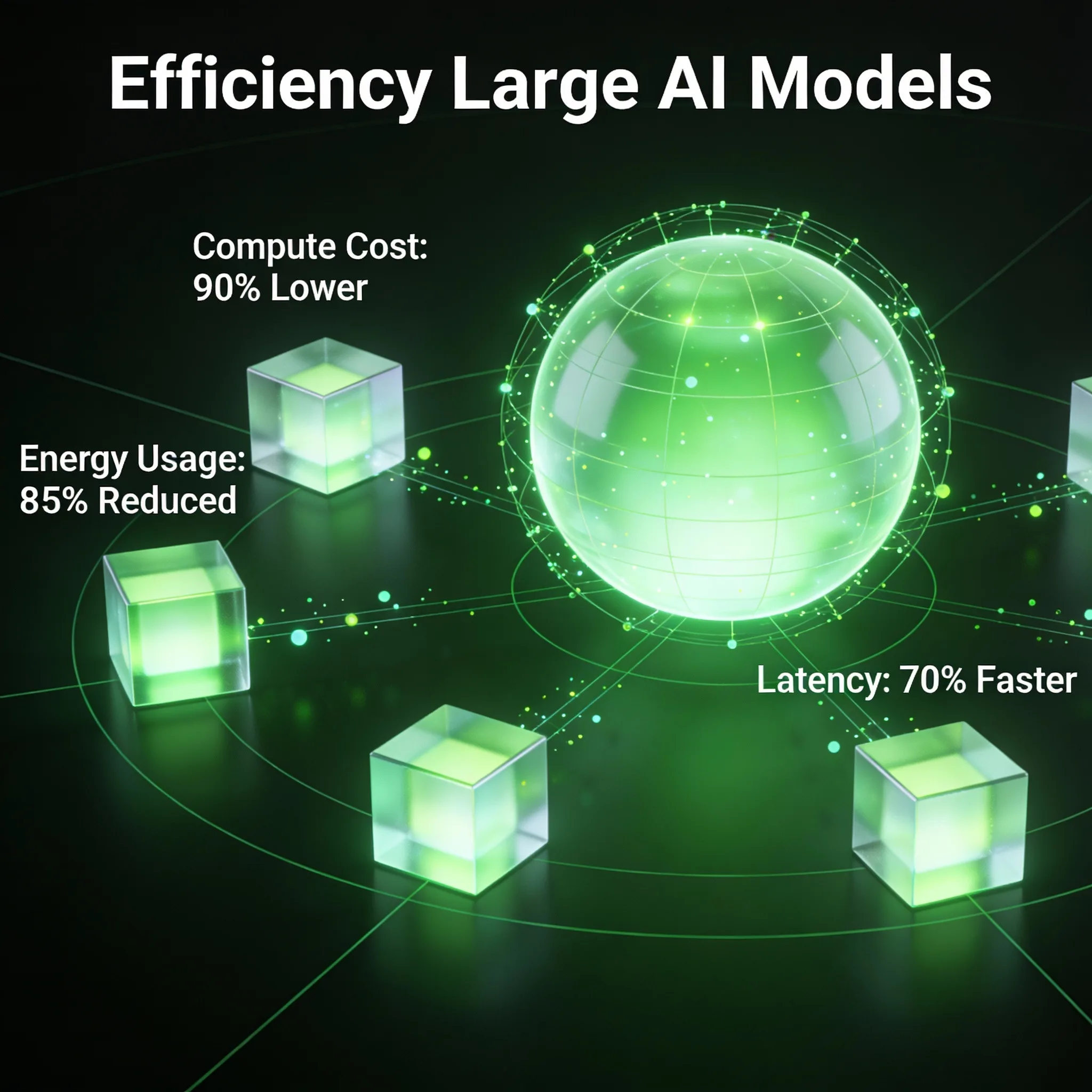
The AI arms race for bigger models is officially over. January 2026 marked a decisive shift in the industry: Small Language Models (SLMs) are now the focus of serious engineering effort. With 10-30x improvements in latency, cost, and energy efficiency, the question is no longer “how big?” but “how efficient?”

The Numbers Tell the Story
| Metric | GPT-4 Class | SLM (Optimized) | Improvement |
|---|---|---|---|
| Latency (P50) | 800ms | 45ms | 18x faster |
| Cost per 1M tokens | $30 | $0.50 | 60x cheaper |
| Energy per request | 0.05 kWh | 0.002 kWh | 25x greener |
| Memory required | 180GB+ | 4-8GB | 22x smaller |
| Can run on-device | No | Yes | ∞ |
These aren’t marginal improvements. They’re paradigm shifts.
What Are Small Language Models?
SLMs are language models typically ranging from 1B to 13B parameters, compared to frontier models with 100B-1T+ parameters. But “small” is relative:
Model Size Spectrum (2026)
├── Tiny (< 1B params)
│   ├── Phi-4-mini
│   ├── Gemma-2-2B
│   └── Best for: Classification, extraction
│
├── Small (1-7B params)
│   ├── Llama-3.2-7B
│   ├── Mistral-7B-v3
│   ├── Qwen2.5-7B
│   └── Best for: General tasks, chat, code
│
├── Medium (7-13B params)
│   ├── Llama-3.3-13B
│   ├── DeepSeek-13B
│   └── Best for: Complex reasoning, long context
│
└── Large/Frontier (70B+)
    ├── GPT-4.5, Claude Opus
    └── Best for: When quality > everything else
Why the Shift Now?
1. Distillation Has Matured
Knowledge distillation, training small models to mimic large ones, has gotten remarkably effective:
# Modern distillation captures most capability
class DistillationMetrics:
    # On common benchmarks
    teacher_performance = 0.92  # GPT-4 class
    student_performance = 0.87  # 7B SLM
    capability_retained = 0.95  # 95% of capability at 1% of cost
2. Specialized > Generalized
For most production use cases, you don’t need a model that can do everything:
// The generalist trap
const gpt4Response = await openai.chat({
  model: 'gpt-4-turbo',
  messages: [{ role: 'user', content: 'Extract the date from: "Meeting on Jan 15th"' }]
});
// Cost: $0.01, Latency: 400ms, Accuracy: 99%

// The specialist advantage
const slmResponse = await localModel.extract({
  model: 'date-extractor-1b',
  text: 'Meeting on Jan 15th'
});
// Cost: $0.0001, Latency: 5ms, Accuracy: 99.5%
3. Edge Deployment is Real
With Apple Silicon, Qualcomm Snapdragon, and Intel NPUs, running models locally is practical:
On-Device AI Capabilities (2026)
├── iPhone 16 Pro
│   ├── 8B parameter models @ 30 tok/s
│   ├── 3B parameter models @ 60 tok/s
│   └── No cloud required
│
├── MacBook Pro M4
│   ├── 13B parameter models @ 40 tok/s
│   ├── 7B parameter models @ 80 tok/s
│   └── Runs multiple models simultaneously
│
└── Android Flagship (Snapdragon 8 Gen 4)
    ├── 7B parameter models @ 25 tok/s
    └── Power efficient inference
4. Privacy Requirements
Enterprises increasingly can’t send data to external APIs, the same pressure driving adoption of edge AI for on-device intelligence in IoT and sensors:
- Healthcare - HIPAA compliance
- Finance - Regulatory requirements
- Legal - Client confidentiality
- Government - Classification requirements
SLMs running on-premises or on-device solve this completely.

The Technical Innovations
Quantization
Reducing precision while maintaining quality:
# Model precision comparison
model_sizes = {
    'FP32': '28 GB',   # Original
    'FP16': '14 GB',   # Half precision
    'INT8': '7 GB',    # 8-bit quantization
    'INT4': '3.5 GB',  # 4-bit quantization
    'GGUF Q4_K_M': '4.2 GB'  # Optimized 4-bit
}

# Quality retention
accuracy_retention = {
    'FP16': 0.99,  # 99% of original
    'INT8': 0.98,  # 98% of original
    'INT4': 0.95   # 95% of original - still excellent
}
Speculative Decoding
Using a tiny model to propose tokens, verified by the main model:
Traditional Decoding:
  Main Model → Token 1 → Main Model → Token 2 → ...
  Latency: N × model_inference_time

Speculative Decoding:
  Draft Model → [Token 1, 2, 3, 4, 5] → Main Model verifies
  Accepted: [Token 1, 2, 3] ← 3 tokens in one forward pass
  Speedup: 2-3x without quality loss
Mixture of Experts (MoE)
Only activate relevant parameters per query:
class MixtureOfExperts:
    def __init__(self):
        self.total_params = 47_000_000_000  # 47B total
        self.active_params = 8_000_000_000   # 8B active per forward pass
        self.num_experts = 8
        self.active_experts = 2

    def forward(self, input):
        # Router selects which experts to use
        expert_indices = self.router(input)  # e.g., [2, 5]

        # Only compute with selected experts
        outputs = [self.experts[i](input) for i in expert_indices]

        return self.combine(outputs)
Production Patterns
Pattern 1: Router Architecture
Use a tiny model to route requests:
class ModelRouter {
  private classifier: TinyClassifier;  // 100M params
  private codeModel: CodeSLM;          // 7B params
  private chatModel: ChatSLM;          // 3B params
  private reasoningModel: ReasoningSLM; // 13B params

  async route(request: Request): Promise<Response> {
    const taskType = await this.classifier.classify(request.content);

    switch (taskType) {
      case 'code':
        return this.codeModel.generate(request);
      case 'chat':
        return this.chatModel.generate(request);
      case 'reasoning':
        return this.reasoningModel.generate(request);
      default:
        // Fall back to cloud for edge cases
        return this.cloudFallback(request);
    }
  }
}
Pattern 2: Cascading Models
Start small, escalate if needed:
async def cascading_inference(prompt: str) -> str:
    # Try smallest model first
    response = await tiny_model.generate(prompt)
    if confidence(response) > 0.9:
        return response  # 90% of requests stop here

    # Escalate to medium model
    response = await medium_model.generate(prompt)
    if confidence(response) > 0.8:
        return response  # 8% of requests stop here

    # Final escalation to large model
    return await large_model.generate(prompt)  # 2% of requests
Pattern 3: Hybrid Cloud-Edge
const hybridInference = async (request) => {
  // Fast path: Handle on-device
  if (request.type === 'autocomplete' || request.type === 'simple_chat') {
    return await localSLM.generate(request);
  }

  // Privacy-sensitive: Keep local even if slower
  if (request.containsPII || request.isConfidential) {
    return await localSLM.generate(request, { maxTokens: 2000 });
  }

  // Complex reasoning: Use cloud
  if (request.requiresAdvancedReasoning) {
    return await cloudAPI.generate(request);
  }

  // Default: Try local, fallback to cloud
  try {
    return await localSLM.generate(request, { timeout: 5000 });
  } catch (e) {
    return await cloudAPI.generate(request);
  }
};
Real-World Deployments
Grammarly
- Switched to on-device SLMs for real-time suggestions
- 50ms latency (down from 200ms with cloud)
- Works offline
- Processes 1B+ daily corrections
Notion
- Local SLM for page summarization
- Cloud escalation for complex analysis
- 80% cost reduction
VS Code Copilot
- Local 3B model for autocomplete
- Cloud for complex generation
- Instant suggestions without network round-trip
Where SLMs Still Fall Short
None of this makes SLMs a universal replacement for frontier models. A 7B model that nails date extraction or intent classification will still struggle with a task that needs several chained reasoning steps, synthesis across a long document, or broad general knowledge it was never specialized on. Distillation transfers most of a teacher model’s narrow-task performance, not its full range.
This is why almost none of the production patterns above use an SLM alone. The router and cascading architectures exist specifically to catch the cases a small model handles badly and hand them to something larger before the user notices a bad answer. Teams that skip the escalation path and ship an SLM as a standalone general assistant tend to find its limits the hard way, usually through a support ticket.
The cost side has its own limit too. Running a fleet of on-device or self-hosted SLMs shifts the bill from per-token API costs to infrastructure and engineering time, GPU or NPU capacity, model versioning, and monitoring for drift. Our guide to reducing LLM API costs in production covers the same tradeoff from the other direction: sometimes caching and prompt optimization on a frontier model’s API is cheaper than standing up local inference at all.
Choosing the Right SLM
For Code Tasks
| Model | Size | Specialty | License |
|---|---|---|---|
| DeepSeek-Coder-7B | 7B | General coding | MIT |
| CodeLlama-13B | 13B | Python/JS | Llama |
| StarCoder2-7B | 7B | Multi-language | BigCode |
| Qwen2.5-Coder-7B | 7B | Full-stack | Apache |
For Chat/Assistant
| Model | Size | Specialty | License |
|---|---|---|---|
| Llama-3.2-7B-Instruct | 7B | General chat | Llama |
| Mistral-7B-Instruct-v3 | 7B | Instruction following | Apache |
| Phi-4-7B | 7B | Reasoning | MIT |
| Gemma-2-9B-it | 9B | Safety-tuned | Gemma |
For Specialized Tasks
| Model | Size | Specialty | Use Case |
|---|---|---|---|
| BioMistral-7B | 7B | Medical | Healthcare apps |
| FinGPT-7B | 7B | Finance | Financial analysis |
| LegalBERT-v2 | 400M | Legal | Contract analysis |
| SQLCoder-7B | 7B | SQL | Database queries |
Getting Started
Local Inference with Ollama
Our walkthrough on running local LLMs with Ollama covers the setup below in more depth, including model management and hardware sizing.
# Install Ollama
curl -fsSL https://ollama.com/install.sh | sh

# Pull a model
ollama pull llama3.2:7b

# Run inference
ollama run llama3.2:7b "Explain quantum computing"

# API access
curl http://localhost:11434/api/generate -d '{
  "model": "llama3.2:7b",
  "prompt": "Hello!"
}'
Python with llama.cpp
from llama_cpp import Llama

# Load quantized model
llm = Llama(
    model_path="./models/llama-3.2-7b.Q4_K_M.gguf",
    n_ctx=4096,
    n_gpu_layers=35  # Offload to GPU
)

# Generate
response = llm.create_chat_completion(
    messages=[{"role": "user", "content": "Write a haiku about coding"}],
    max_tokens=100
)
Node.js with node-llama-cpp
import { LlamaModel, LlamaContext } from 'node-llama-cpp';

const model = new LlamaModel({
  modelPath: './models/mistral-7b.gguf'
});

const context = new LlamaContext({ model });
const session = new LlamaChatSession({ context });

const response = await session.prompt('Explain REST APIs');
console.log(response);
The Future: 2026 and Beyond
Immediate trends:
- Sub-1B models achieving GPT-3.5 level on specific tasks
- Unified model formats (GGUF becoming standard)
- Native OS integration (macOS, iOS, Android, Windows)
Medium-term:
- Every smartphone ships with a capable local LLM
- SLMs embedded in databases, browsers, and operating systems
- “AI-native” applications that work entirely offline
Long-term:
- Personal AI that learns and runs locally
- Privacy-first AI as the default
- Large models become specialized tools, not general solutions
Resources
Need help choosing the right model for your use case or deploying SLMs in production? Contact CODERCOPS for expert AI integration consulting.
Frequently asked questions
- What counts as a small language model?
- Most of the industry treats SLMs as roughly 1B to 13B parameters, compared to frontier models in the 100B-1T+ range. The boundary is fuzzy since a well-distilled 7B model can match a much larger general model on a narrow task.
- Are small language models less accurate than large ones?
- On open-ended, general tasks, usually yes. On a narrow, well-defined task like date extraction or classification, a specialized SLM can match or beat a frontier model's accuracy while costing a fraction as much and running far faster.
- Can small language models run entirely on-device?
- Yes, on current hardware. Apple Silicon, Qualcomm Snapdragon, and Intel NPUs can run 3B to 13B parameter models locally at usable speeds, which is what makes offline and privacy-sensitive applications practical without a round trip to the cloud.
- When should I still use a large frontier model instead of an SLM?
- When the task needs multi-step reasoning, long-context synthesis, or broad general knowledge the SLM wasn't specialized for. Most production systems that use SLMs pair them with a cascade or router pattern that escalates to a larger model when the small model's confidence is low.
- What is the fastest way to try an SLM locally?
- Ollama is the simplest starting point: install it, pull a model like llama3.2:7b, and run inference from the command line or its local API. From there, llama.cpp and node-llama-cpp give more control if you're embedding a quantized model directly into a Python or Node.js application.
Sponsored
More from this category
More from AI Integration
Sponsored
Discussion
Join the conversation.
Comments are powered by GitHub Discussions. Sign in with your GitHub account to leave a comment.
Sponsored