
Sponsored
A TechCrunch report from June 24, 2026 has a straightforward headline: AI was supposed to kill engineering jobs, but new data suggests they’re the most resilient. The data is worth looking at directly rather than through the lens of either the AI-doom or AI-hype frame.
The short version: software engineering employment is growing, job listings are up significantly, and long-term projections remain strong. But the growth is uneven, the entry-level market has contracted in specific ways, and “AI fluency” has gone from a nice-to-have to a filter in a majority of job postings. That’s a more complicated picture than either “AI destroyed the job market” or “nothing has changed.”
What the numbers say
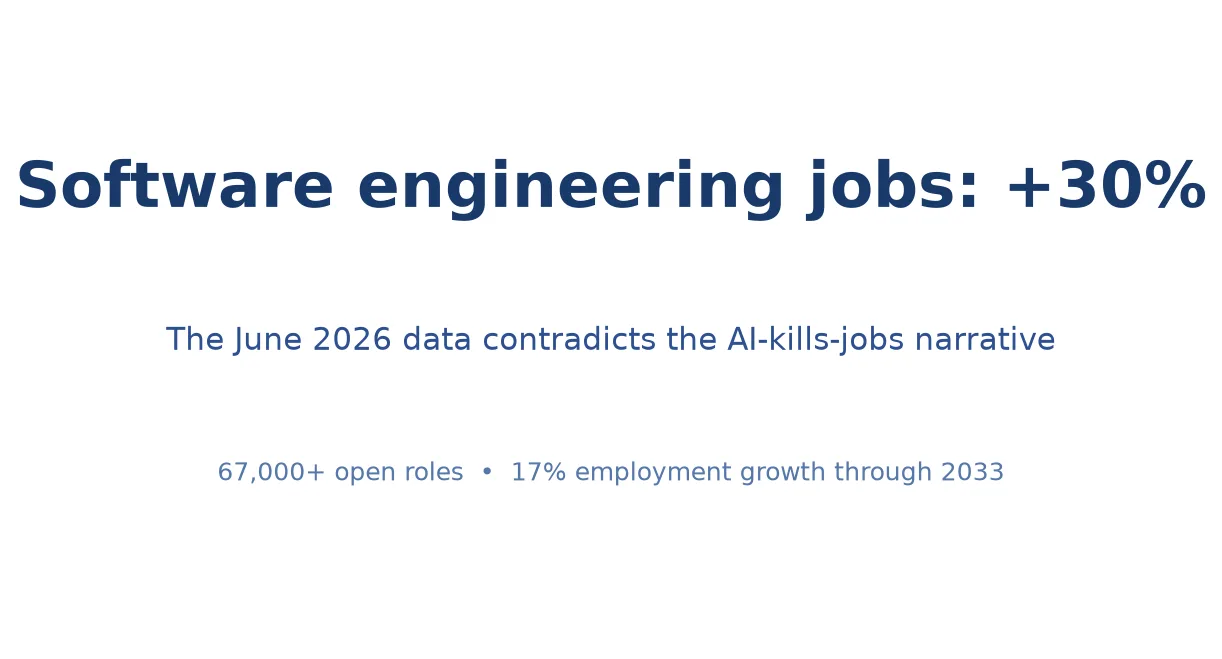
Software engineer job listings jumped 30% in 2026, with 67,000+ open roles according to Metaintro’s data from June 2026. For context, this is during a period when tech layoffs have been real and well-documented. The job market isn’t uniformly good. It’s growing overall while contracting in specific segments.
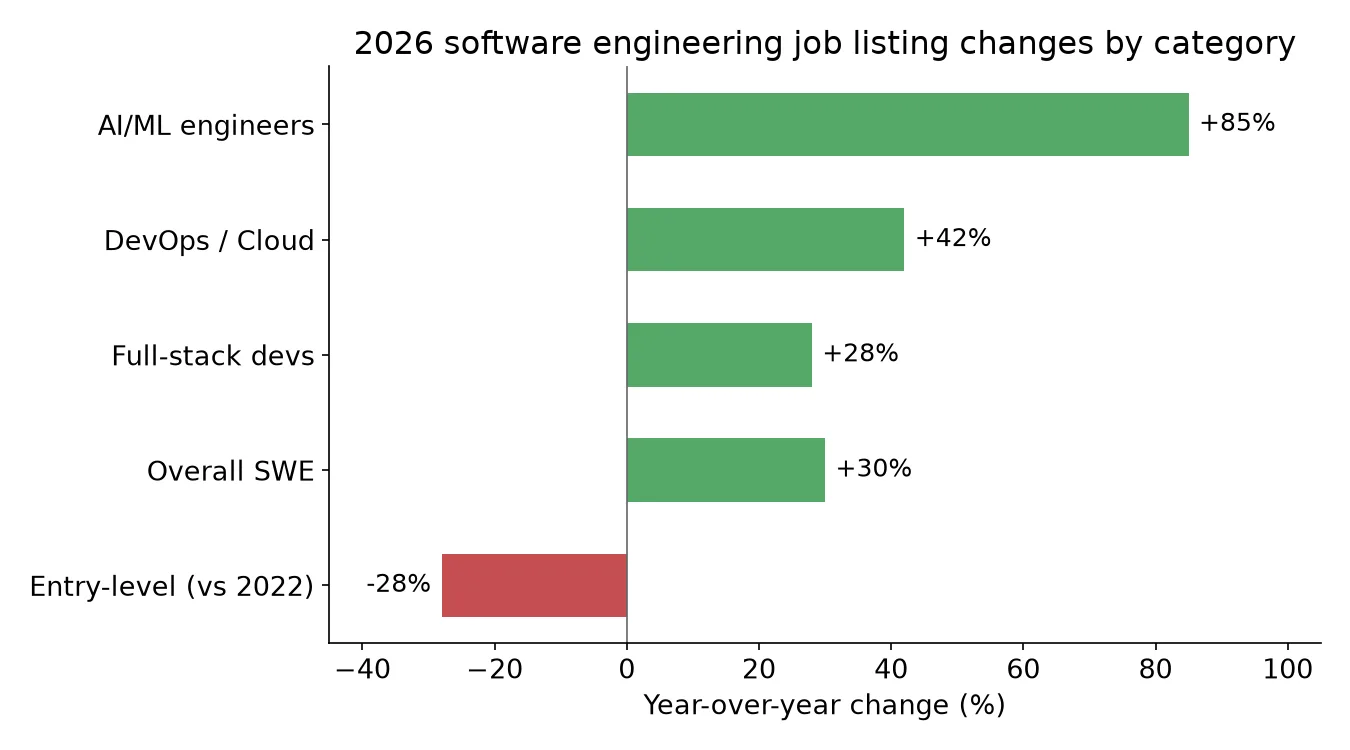
The breakdown by category shows where the growth is:
- AI/ML engineers: +85% year-over-year. This is the fastest-growing segment by far.
- DevOps/Cloud: +42%. Infrastructure and cloud roles remain in high demand.
- Full-stack developers: +28%. Roughly in line with the overall market.
- Entry-level (vs 2022 peak): -28%. This is the segment that contracted.
The Bureau of Labor Statistics projects 17% employment growth in software development through 2033. That’s 327,900 new US jobs. The 17% figure puts software development among the faster-growing occupations. For comparison, overall occupational growth across all jobs is projected around 4%.
Why entry-level is different
The entry-level contraction is the real story inside the overall growth numbers. Junior engineers are being hired for fewer routine tasks because AI tools have automated more of that work, code that an intern would have written in 2022 is often AI-generated and reviewed by a mid-level engineer today.
This is a structural shift in how engineering work is distributed, not a reduction in total employment. Companies are hiring more senior engineers who can direct AI tools, design systems, and review generated code. They’re hiring fewer junior engineers for pure implementation work.
IBM is one notable exception, they announced tripling entry-level hiring in the US, betting that junior engineers with AI tools can now handle work that previously required experienced developers. That’s the other side of the same structural shift: AI raises the floor of what a junior can produce, which can make junior hiring more attractive at companies willing to invest in it.
The practical implication: if you’re a new graduate or early in your career, the path is not “find the same jobs that were available in 2022.” It’s developing AI tool fluency faster and taking on tasks that are slightly above the AI-can-do-this threshold.
What 42% AI skill requirements actually means
In 2022, about 8% of software job descriptions mentioned AI skills. In 2026, that number is 42%. The shift is real, and it’s showing up in interviews.
The important distinction is that “AI skills” in most job descriptions doesn’t mean “build LLMs from scratch.” It means:
- Using AI coding tools (Copilot, Cursor, Continue) effectively in a professional context
- Having enough ML literacy to integrate AI APIs and evaluate model outputs
- Understanding enough about LLMs to scope AI features in products
- For some roles, deeper AI infrastructure knowledge: fine-tuning, RAG, vector databases, evals
The 42% figure includes all of these. A mid-level web developer applying for a React position at a company that uses Copilot internally will encounter the AI skill question. The 8% → 42% shift means it’s now a default expectation in most roles, not a specialist requirement.
If you’re interviewing for software roles and not using AI tools daily in your workflow, that gap is visible.
The categories growing fastest
Breaking down the 67,000+ open roles:
AI/ML and data engineering is the largest growth area. Job postings for AI/ML engineers specifically are up 85% year-over-year. This includes both applied ML roles (building and deploying models) and AI infrastructure roles (the hardware, serving, and tooling that make inference work at scale). The share of AI/ML jobs in tech went from 10% in 2023 to 50% of new postings in 2025-2026.
DevOps and cloud engineering is the second fastest-growing area. Infrastructure is more complex than it was, not less. Kubernetes, observability, cost management, and security are all growth areas inside the ops discipline.
Backend engineering continues to grow, particularly for teams building AI-powered products that need reliable data pipelines, APIs, and systems to hang AI features on.
Frontend and mobile grew more slowly than other categories, but still grew. Framework consolidation (Svelte, TanStack Start, and Next.js capturing most new project starts) has concentrated demand around engineers fluent in those specific tools.
The salary picture
Average software engineer salaries increased 4% year-over-year, after a period of stagnation in 2024. AI/ML specialists are seeing 20-30% salary increases. Senior engineers at companies that are actively building AI products are seeing compensation pressure upward as supply of experienced AI-literate engineers remains tight relative to demand.
Entry-level salaries held roughly flat or declined slightly in some markets, consistent with the contraction in posting volume. The leverage is at the senior end of the market in 2026.
What this means for hiring decisions
For engineering managers and teams doing hiring: the market for senior AI-literate engineers is competitive. The candidates who combine strong fundamentals with real experience building AI-powered features are being recruited aggressively.
For the entry-level market, the scarcity is more at the mid-senior level. Junior engineers who can demonstrate AI tool fluency and take on tasks above the “AI can do this alone” threshold are more compelling than they would have been two years ago. The old model of hiring a batch of juniors for implementation work and letting them learn on the job is harder to justify when the routine implementation work is increasingly handled by tools.
If your organization is hiring developers or evaluating whether to grow the team, the 2026 guide to hiring vetted software developers covers the full screening process in the current market context.
The honest summary
Software engineering employment is more resilient than the layoff headlines suggest. The overall market grew, long-term projections are strong, and AI created entirely new engineering categories that didn’t exist three years ago.
But it’s not the same market it was. Entry-level is harder. AI skills are table stakes. The specific tasks that junior engineers used to do have partly shifted to AI tools. Teams are spending more on fewer, more senior engineers rather than larger junior cohorts.
The 30% listing growth is real. The 85% AI/ML growth is real. The -28% entry-level contraction is also real. All three things are true simultaneously, and the picture that emerges is a market growing at the top and reshaping at the bottom, driven by the same technology that’s generating the growth.
The TechCrunch report from June 24 covers the full data: AI was supposed to kill engineering jobs, but new data suggests they’re the most resilient.
Frequently asked questions
- Is the software engineering job market good or bad in 2026?
- It depends on your role and experience level. Overall listings are up 30% and long-term projections remain strong. But entry-level postings are down 28% from 2022 peaks, and AI is reshaping which tasks junior engineers are hired for. Senior engineers with AI fluency are in high demand. The market is better than the headlines suggest, but worse at the entry level than it was two years ago.
- Will AI replace software engineers?
- The 2026 data says no, at least not net-negative. Job listings are up, headcount at tech companies is growing, and the BLS projects 17% employment growth through 2033. What is changing: AI is handling more routine coding tasks, which changes what engineers spend their time on. The roles being created — AI engineering, ML infrastructure, AI integration — require engineers who can work with AI tools, not engineers who work instead of AI tools.
- What skills are employers actually looking for in 2026?
- AI skills appear in 42% of software job descriptions, up from 8% in 2022. Beyond AI, demand is strongest for cloud/DevOps, full-stack web development, and data engineering. TypeScript, Python, and Go remain in strong demand. Rust usage is growing but still a relatively small slice of job postings.
- Why are entry-level postings down if the overall market is growing?
- Companies are hiring fewer junior engineers for routine coding tasks because AI tools handle more of that work. They're hiring more mid-to-senior engineers who can direct AI tools, review AI-generated code, and work on the harder problems that AI doesn't solve reliably. It's a restructuring of how work is distributed within engineering teams, not a net reduction in engineering employment.
Sources
- TechCrunch: AI was supposed to kill engineering jobs, but new data suggests they're the most resilient (June 24, 2026)
- Metaintro: Software engineer job listings spike 2026
- FinalRound AI: Software Engineering Job Market 2026
- Boundev: Software Engineer Job Market 2026
- Pragmatic Engineer: State of the job market 2026
Sponsored
Sponsored
Discussion
Join the conversation.
Comments are powered by GitHub Discussions. Sign in with your GitHub account to leave a comment.
Sponsored