Cybersecurity · Vulnerability Management
SonicWall SMA1000 Zero-Days: What to Patch Today
Two chained SMA1000 flaws, an unauthenticated CVSS 10.0 SSRF and a post-auth code injection, are under active attack. Affected firmware and the fix.

Prathviraj Singh
4 min read
Sponsored
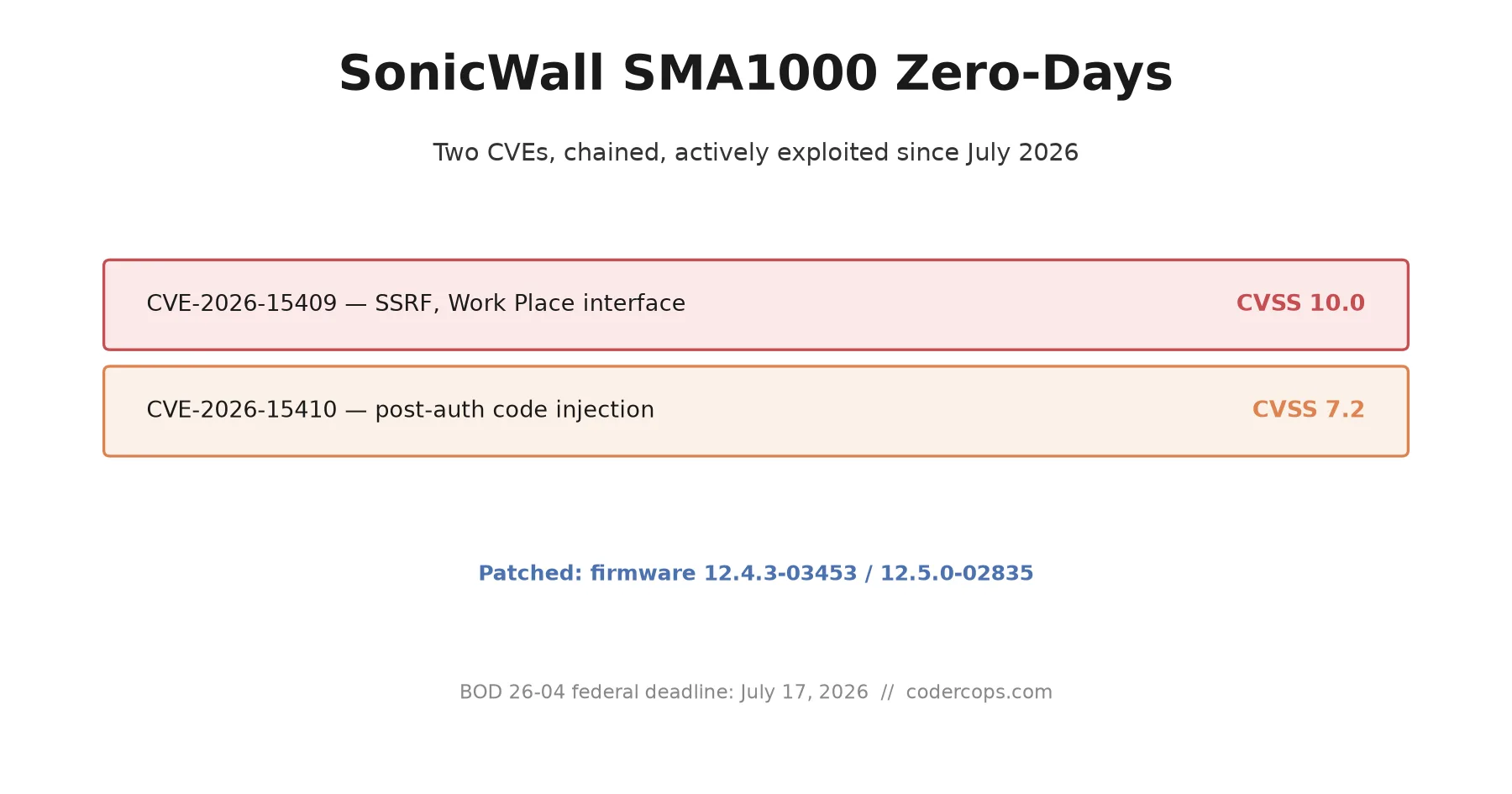
If your organization runs a SonicWall SMA1000 appliance for remote access, this is the week to stop reading the changelog and go patch it. Two vulnerabilities, CVE-2026-15409 and CVE-2026-15410, are under active exploitation right now, and they’re not being used independently. SonicWall, Rapid7, and multiple other researchers have confirmed attackers are chaining them together for full compromise.
The chain, in order
CVE-2026-15409 is a server-side request forgery flaw in the SMA1000 Work Place interface, CVSS 10.0. It’s unauthenticated and remotely exploitable with no user interaction, which is what pushes it to the top of the CVSS scale even though SSRF bugs don’t always sound as dramatic as remote code execution. An attacker uses it to make the appliance itself issue requests to locations of their choosing, typically the opening move for reaching internal resources the appliance can see but an outside attacker normally can’t.
CVE-2026-15410 is a post-authentication code injection flaw in the SMA1000 Management Console, CVSS 7.2. On its own, “post-authentication” would normally lower the urgency, since it implies an attacker needs valid credentials first. That’s exactly where the chain matters: CVE-2026-15409 supplies the access that CVE-2026-15410 requires. Used together, an unauthenticated attacker reaches the Work Place interface, pivots through the SSRF to the Management Console, and then executes arbitrary operating system commands.
What attackers are actually doing once they’re in
This isn’t smash-and-grab activity. SonicWall’s own investigation and outside researchers describe a consistent post-compromise pattern: extracting stored credentials, pulling the appliance’s active session database, and grabbing TOTP multi-factor authentication seed configurations. Taken together, that’s a persistence playbook, not a one-time data theft. Stolen session tokens let an attacker skip re-authentication entirely, and stolen TOTP seeds mean MFA stops being a meaningful barrier on any account whose seed was exposed, since the attacker can generate valid codes going forward.
That’s the detail worth flagging to whoever owns identity and access at your organization: if you find evidence of exploitation, a password reset alone doesn’t close this. Any TOTP secrets that could have been read off the appliance need re-enrollment, not just rotation.
Affected hardware and the fix
| Detail | Value |
|---|---|
| Affected products | SMA6210, SMA7210, SMA8200v |
| Vulnerable firmware | 12.4.3-x builds through 03434; 12.5.0-x builds through 02800 |
| Patched firmware | 12.4.3-03453 or 12.5.0-02835 |
| Where to get it | mysonicwall.com |
| Not affected | SMA100 series (separate codebase) |
If you manage these appliances directly, the patch is the fix, but it’s not the whole remediation. Because credential and session theft are already confirmed in the wild, treat any unpatched appliance that’s been internet-facing during the exploitation window as potentially compromised until you’ve reviewed logs, not just patched and moved on.
What to do this week
- Patch to 12.4.3-03453 or 12.5.0-02835 now, before anything else on your security backlog this week.
- Review Work Place interface and Management Console logs for requests from unexpected sources predating the patch.
- Rotate credentials and force MFA re-enrollment for any accounts with access through a potentially compromised appliance, don’t just reset passwords.
- Note the July 17, 2026 deadline. That’s when CISA’s Binding Operational Directive 26-04 requires U.S. federal agencies to remediate or disconnect. It’s not a federal-only concern given the confirmed exploitation, it’s the honest floor for anyone running this hardware.
If vulnerability triage like this keeps landing as an unplanned fire drill instead of a routine part of your patch cycle, that’s usually a sign the underlying infrastructure and access review is overdue, not that this particular CVE was unusually bad luck. This one just happened to be chained, unauthenticated, and already in active use, which is a combination worth treating as the norm to plan for rather than the exception.
Frequently asked questions
- What does CVE-2026-15409 actually let an attacker do?
- It's a server-side request forgery vulnerability in the SMA1000 Appliance Work Place interface, rated CVSS 10.0 because it requires no authentication and no user interaction. An attacker can force the appliance itself to make network requests to locations of their choosing, which is typically the first step in reaching internal services or extracting credentials the appliance has access to but the attacker doesn't.
- Why is a 7.2 CVSS bug (CVE-2026-15410) just as urgent as the 10.0 one?
- Because SonicWall and researchers have confirmed the two are being exploited together, not independently. CVE-2026-15409 gets an attacker unauthenticated access to the appliance; CVE-2026-15410, a post-authentication code injection in the Management Console, then lets them execute arbitrary operating system commands. The SSRF bug supplies the authentication CVE-2026-15410 otherwise requires. Patching only the higher-scored CVE and leaving the other unpatched still leaves the chain intact if an attacker finds another way to the console.
- What should I actually check for if I think I've been compromised?
- SonicWall's guidance, and the pattern researchers observed, points to credential extraction, theft of the active session database, and extraction of TOTP MFA seed configurations, all aimed at maintaining long-term access rather than a one-time breach. Review logs for unexpected Work Place interface requests and Management Console access from unfamiliar sources, and treat MFA seeds on the appliance as compromised, meaning re-enrollment, not just a password reset, if you find evidence of exploitation.
- Which SonicWall products are affected, and what's the fix?
- The affected hardware is the SMA1000 series: SMA6210, SMA7210, and SMA8200v. Vulnerable firmware includes the 12.4.3-x and 12.5.0-x branches up through builds 12.4.3-03434 and 12.5.0-02800. The fix is hotfix firmware 12.4.3-03453 or 12.5.0-02835, available through mysonicwall.com. This does not affect SonicWall's separate SMA100 series, which uses a different codebase.
- Is there a compliance deadline I should know about even if I'm not a federal agency?
- CISA's Binding Operational Directive 26-04 sets July 17, 2026 as the deadline for U.S. federal civilian agencies to remediate or disconnect affected appliances. That's a regulatory floor for one sector, not a general safety margin. Given confirmed active exploitation and credential-theft behavior already observed, any organization running SMA1000 hardware should treat the same date as its own deadline, not a government-only concern.
Sources
Sponsored
More from this category
More from Cybersecurity
Sponsored
Discussion
Join the conversation.
Comments are powered by GitHub Discussions. Sign in with your GitHub account to leave a comment.
Sponsored