Industry News · Fintech
Stripe and Advent's $53B PayPal Bid: What It Means
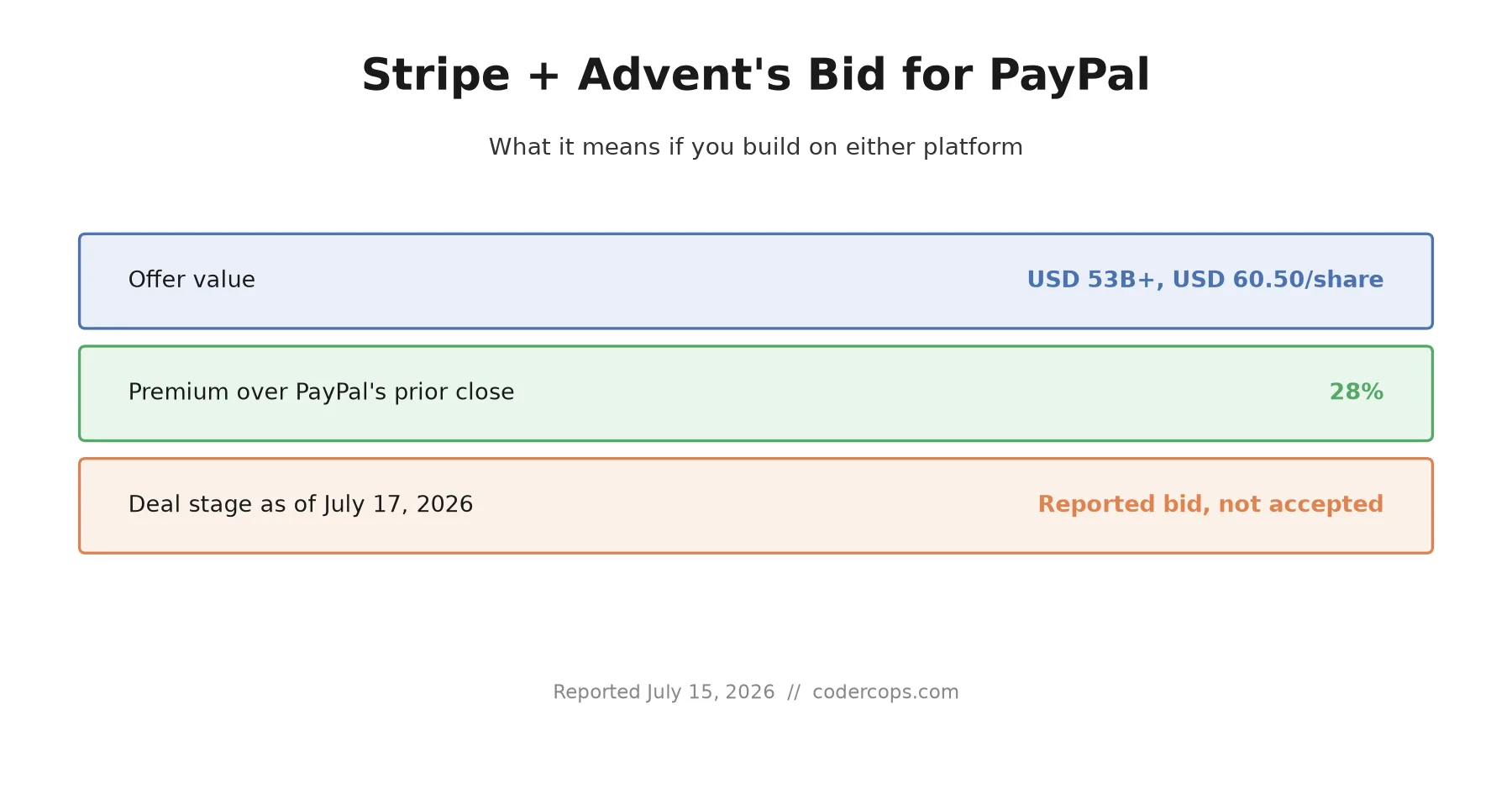
Stripe and Advent offered $60.50 a share, over $53 billion, for PayPal. It's a reported bid, not a deal. The realistic timeline, and what to do now: little.

Anurag Verma
4 min read
Sponsored
A $53 billion bid for PayPal from Stripe and a private equity firm is the kind of headline that generates a lot of “should we worry about our checkout integration” questions from clients and engineering leads. The honest answer, for now, is no. Here’s what’s actually confirmed, what the realistic timeline looks like, and the one thing worth doing regardless of how this plays out.
What’s actually confirmed
Stripe and Advent International submitted a joint offer to acquire PayPal at $60.50 per share, reported at more than $53 billion, a 28% premium over PayPal’s closing price the day before the news broke. PayPal shares jumped 17% on the report. PayPal’s board has brought in Goldman Sachs and Evercore as financial advisors, which is the standard move for evaluating any serious acquisition offer, not a signal that the board intends to accept it.
If the deal happened as structured, Stripe and Advent would hold PayPal jointly in equal stakes. That’s an unusual structure on its own: it would be the largest fintech acquisition ever recorded, and a rare instance of a venture-backed private company (Stripe, valued around $159 billion) acquiring a public, S&P 500-listed company, rather than the far more common pattern of a public acquirer buying a private startup.
None of that means the deal happens. A reported offer is the opening move in a process that includes board evaluation, shareholder considerations, financing confirmation, and, if it proceeds, regulatory review. Every one of those steps can stall or kill a deal this size before it closes.
Why the realistic timeline is long
Stripe and PayPal are, between them, two of the payment processors most web and mobile applications actually integrate with, whether directly or through a platform like Shopify or Squarespace that sits on top of one of them. A combination of that scale would draw close antitrust attention in essentially any jurisdiction that reviews payments-sector mergers, and payments regulators have not historically moved fast on deals of this size. Expect a review process measured in quarters if the offer is even accepted, not weeks.
That’s worth internalizing before making any integration decisions in response to this news. We’ve written before about the mechanics of building subscription billing and webhooks on Stripe; nothing in that guide changes based on this bid, and it won’t change soon even in the scenario where the acquisition eventually closes.
What would actually change for developers, eventually
If a deal like this ever closes, the near-term developer impact is unlikely to be API-breaking. Large payment and fintech acquisitions tend to leave the acquired platform’s product and API surface running independently for a long stretch, since ripping out billing infrastructure that businesses depend on is exactly the kind of migration risk acquirers try to avoid triggering. The more realistic multi-year question is roadmap convergence: two overlapping sets of checkout APIs, subscription tooling, and payout systems eventually need to either merge or one gets sunset, and that’s the kind of change worth planning for on a multi-year horizon, not a multi-month one.
The more immediate structural question, if a deal like this reduces the number of major independent payment processors, is competitive pressure on pricing and features. Fewer large independent processors generally means less incentive to compete aggressively on processing rates, which is a fair thing for any team negotiating a payments contract to keep in mind over the next few years, deal or no deal.
What to actually do about it right now
Nothing urgent, and that’s the honest, useful answer. But this is a reasonable prompt to check something worth checking regardless of merger news: how tightly coupled is your payment flow to a single processor with no fallback path? Processor outages, account holds, and regional payment-method gaps are real operational risks independent of any acquisition, and a checkout or billing system with zero abstraction between your application logic and a specific vendor’s SDK is harder to migrate under pressure later, whichever direction “later” ends up meaning.
If you’re building or auditing payment infrastructure and want a second opinion on that abstraction layer, that’s the kind of scoping conversation worth having as part of a broader fintech product build rather than bolting it on after a vendor surprise forces the issue. Watch the deal for news of an actual signed agreement or a formal rejection. Until then, this is a story to track, not one to build a migration plan around.
Frequently asked questions
- Is the Stripe/PayPal deal actually happening?
- Not yet, and not necessarily. What's confirmed is that Stripe and Advent International submitted a joint offer, reported around $53.4 billion at $60.50 per share, and that PayPal's board is evaluating it with Goldman Sachs and Evercore as advisors. That's the standard first step for any board response to an unsolicited or newly submitted offer, and it does not mean the offer will be accepted, let alone that the deal will clear regulators. Treat this as a reported bid under evaluation, not a signed agreement.
- Should I stop building on Stripe or PayPal because of this news?
- No. Even in a scenario where the deal is accepted, a combination of the two largest payment processors most consumer and B2B apps rely on would face substantial antitrust review, likely stretching across multiple quarters. Nothing about your integration, your API keys, or your checkout flow changes today, and nothing is likely to change for a meaningful stretch of time even under an optimistic timeline for the acquirers.
- What would a combined Stripe-PayPal actually mean for developers, if it closes?
- The most concrete near-term change would likely be product and roadmap consolidation risk: two overlapping API ecosystems, two sets of SDKs, two developer support organizations, all needing to converge eventually. History with large payment and fintech mergers suggests that process is slow and that acquired platforms often continue operating independently for years before any real API-level consolidation. The bigger long-term question is competitive: fewer major independent payment processors generally means less pricing and feature pressure on the survivors, which matters for teams negotiating processing rates.
- What should an engineering team actually do right now?
- Treat this as a prompt to audit payment vendor concentration risk, not to react to this specific bid. If your checkout flow, subscription billing, or payout system depends entirely on one processor with no fallback path, that's a real operational risk independent of any acquisition news, since processors have outages and account holds regardless of ownership structure. Building an abstraction layer that could support a second processor, even if you never activate it, is the practical response, and it's good practice whether or not this deal ever closes.
- Has a deal this large in payments happened before?
- Not quite like this one. If it closes, it would be the largest fintech acquisition on record, and unusually, a venture-backed private company (Stripe, alongside private equity firm Advent) acquiring a public S&P 500 company (PayPal) rather than the more typical direction of a public acquirer buying a private company. That structure alone is part of why analysts expect a long, closely-watched regulatory process rather than a routine approval.
Sources
Sponsored
More from this category
More from Industry News
Sponsored
Discussion
Join the conversation.
Comments are powered by GitHub Discussions. Sign in with your GitHub account to leave a comment.
Sponsored