AI Integration · AI-Assisted Development
Spec-Driven Development in 2026: A Practical Guide
Spec-driven development treats a written spec, not code, as the artifact an AI agent builds from. How Spec Kit, Kiro, and BMAD differ, and when it's worth it.

Anurag Verma
6 min read
Sponsored
Ask an AI coding agent for a feature in one sentence and you’ll get code back in seconds. Whether it’s the right code is a separate question, and on anything beyond a small script, the gap between “compiles and runs” and “does what the team actually needed” is where most of the pain in AI-assisted development still lives. Spec-driven development is the answer a growing number of teams have converged on: write the requirements down first, review them, then let the agent build from something more solid than a one-line prompt.
What spec-driven development actually is
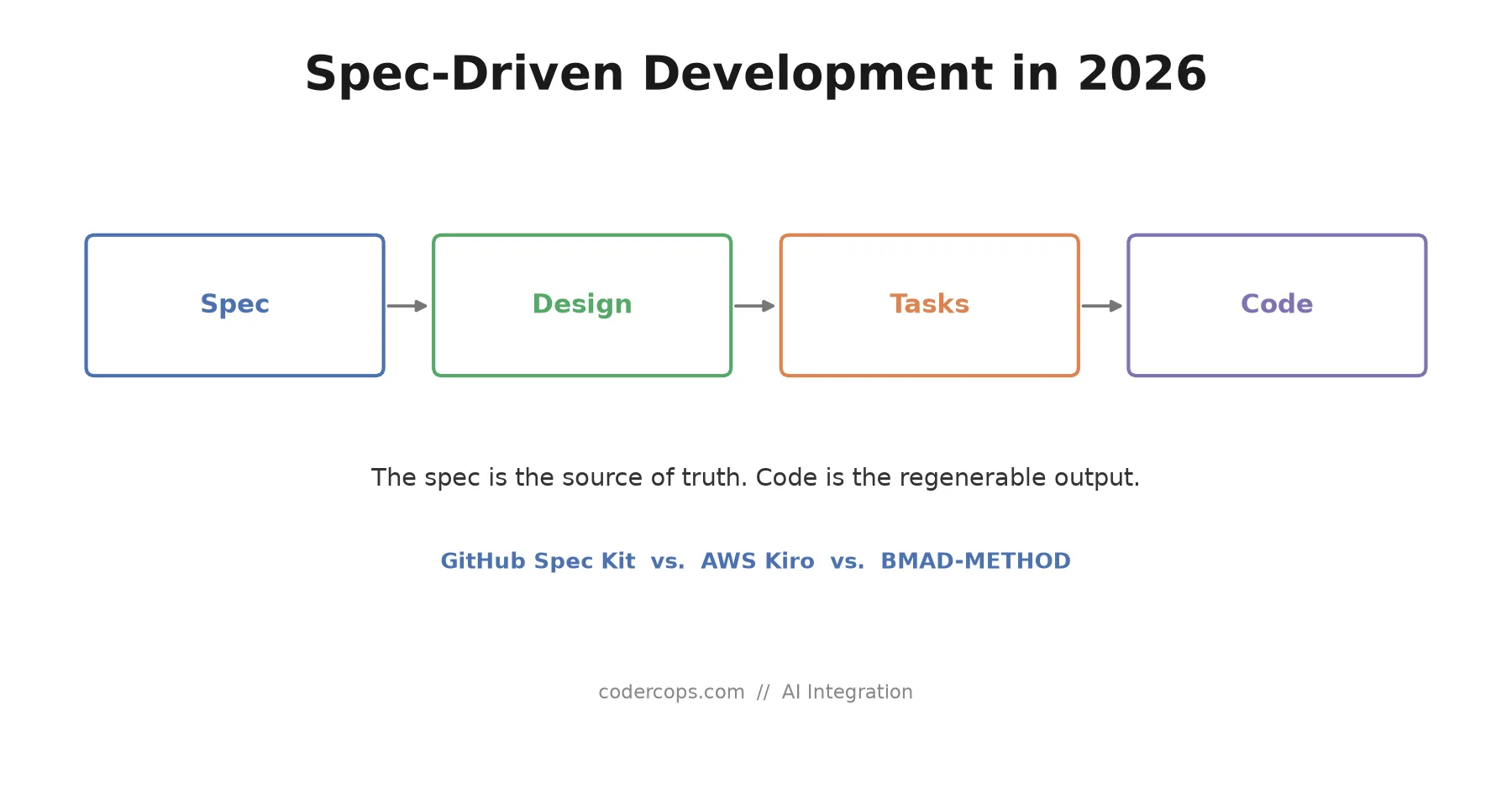
The core idea is simple. Instead of describing a feature conversationally and iterating on whatever an agent produces, you author a specification, in three layers, roughly:
- Requirements: what the feature needs to do, written as user stories or plain-language acceptance criteria.
- Technical design: how it’ll be built, which components it touches, what the data model looks like, what the API surface is.
- Task breakdown: the spec split into implementable, ideally independently reviewable, units of work.
An AI agent then implements against that spec, one task at a time, rather than generating an entire feature from a single prompt. The spec is the artifact you version, review, and update. The code becomes something closer to a compiled output: important, but derived, and in principle regenerable if the spec changes.
This puts spec-driven development at the opposite end of the spectrum from vibe coding, where the conversation with the agent is the interface and the generated code gets accepted, tweaked, and shipped without much formal review of the underlying design. Vibe coding is fast and low-friction. Spec-driven development is slower up front and trades that speed for a checkpoint where a human catches a bad assumption before it turns into a thousand lines of code built on it.
The two tools defining the category
GitHub Spec Kit is the open, bring-your-own-agent option. It’s an MIT-licensed CLI and set of templates that impose the specify-plan-tasks-implement workflow on top of whatever coding agent you already use, GitHub Copilot, Claude Code, Cursor, Gemini CLI, and others. You run its commands to generate the spec artifacts as markdown files in your repo, then hand each task off to your agent of choice.
# Initialize spec-kit in a project
uvx --from git+https://github.com/github/spec-kit.git specify init my-project

# Inside your agent (Claude Code, Copilot, Cursor, etc.), the workflow commands
# become slash-command-style prompts that operate on the generated spec files:
#   /specify   -> write requirements as user stories
#   /plan      -> generate a technical design from the spec
#   /tasks     -> break the plan into implementable units
#   /implement -> execute a task against the current spec
Because it’s just files and prompts layered onto your existing agent, Spec Kit fits into a repo you already have and a workflow your team already uses. The trade-off is that discipline is optional. Nothing stops a developer from skipping the /specify step and going straight to a vibe-coded prompt when they’re in a hurry, which is both its flexibility and its weakness.
AWS Kiro takes the opposite bet: an entire IDE, forked from VS Code, built spec-first from the start. You write a spec in Kiro’s structured format, and the IDE generates the design and task list as a guided flow rather than a set of CLI commands you invoke manually. The model, the spec, and billing all live inside the AWS ecosystem, which is a meaningful consideration if your infrastructure is already there, and a meaningful lock-in cost if it isn’t.
A third option worth knowing, BMAD-METHOD, takes a role-based approach: instead of a single spec pipeline, it simulates a small team of specialized AI agents (analyst, product manager, architect, developer) that each own a stage of the same specify-design-implement flow. It’s more opinionated about process than Spec Kit and more open than Kiro, sitting between the two.
| GitHub Spec Kit | AWS Kiro | BMAD-METHOD | |
|---|---|---|---|
| Model | Open CLI, bring your own agent | Full IDE, spec-first by design | Multi-agent role simulation |
| Lock-in | None (MIT licensed) | AWS ecosystem | None (open source) |
| Best fit | Teams with an existing agent workflow | Teams already standardized on AWS | Teams wanting explicit process roles |
When the overhead is worth it
Writing and reviewing a spec before implementation is real overhead, and it’s not free on every project. It’s worth adopting when:
- Multiple people touch the same codebase. A spec gives reviewers something concrete to approve before code exists, rather than reviewing a diff after the fact and hoping the underlying design was sound.
- The feature has a long maintenance horizon. Code that will be read and modified for years benefits from a design document that explains why it’s shaped the way it is, something a chat log with an AI agent doesn’t naturally produce.
- Requirements need sign-off from someone who isn’t writing code. A product manager or client can review a plain-language spec in a way they can’t meaningfully review a diff, which matters for technical specifications and client sign-off on agency work specifically.
- The task is genuinely complex, touching multiple systems or requiring architectural decisions an agent shouldn’t be making unsupervised.
It’s usually not worth it for a solo prototype, a one-off script, or a feature small enough that the spec would take longer to write than the implementation itself. Plain conversational iteration with an agent gets you there faster in those cases, and adding process for its own sake is its own kind of waste.
The failure mode nobody warns you about
The risk with spec-driven development isn’t that it’s too slow, it’s that the spec quietly stops being true. Someone reviews and approves a design, implementation starts, an edge case forces a change that doesn’t get reflected back into the spec document, and six months later the spec describes a system that no longer exists. At that point it’s actively worse than no spec, because new contributors trust it and get misled by it.
Treating the spec as a living artifact, updated in the same pull request as the code it describes, not a one-time planning ritual, is what keeps the workflow honest. If your team can’t commit to that discipline, a lighter-weight version, a short design note reviewed before a nontrivial feature starts, gets most of the benefit without the maintenance burden of a formal spec pipeline.
Spec-driven development isn’t a replacement for good engineering judgment, it’s a structure that makes that judgment visible before code gets written instead of after. For the right kind of project, that’s a genuinely useful trade.
Frequently asked questions
- What is spec-driven development?
- It's a workflow where a written specification, covering requirements, a technical design, and a task breakdown, is authored and reviewed before an AI coding agent generates any implementation. The spec is treated as the source of truth; the code is a regenerable output derived from it, similar in spirit to how a compiled binary is derived from source code.
- How is spec-driven development different from vibe coding?
- Vibe coding is conversational: you describe what you want in natural language and iterate on whatever the agent produces, often without reading the generated code closely. Spec-driven development front-loads that conversation into a structured document, requirements, design, acceptance criteria, that gets reviewed before implementation starts. It trades speed for traceability and review-ability.
- What's the difference between GitHub Spec Kit and AWS Kiro?
- Spec Kit is an open-source, MIT-licensed CLI and template set you add to an existing workflow; it works with GitHub Copilot, Claude Code, Cursor, Gemini CLI, and other agents you already use. Kiro is Amazon's own IDE, forked from VS Code, with spec-driven development built into the core experience rather than bolted on, and it keeps the spec, the model, and billing inside AWS.
- Does spec-driven development actually produce better code than vibe coding?
- It produces more reviewable and more predictable code, which is a different claim than 'better.' Because the spec is a checkpoint before generation, a team can catch a misunderstood requirement or a bad architectural assumption before thousands of lines get written, which is exactly the failure mode vibe coding is prone to on anything beyond a small, low-stakes script.
- Is spec-driven development worth adopting for a small team?
- For a solo developer or a two-person team shipping a prototype, the overhead of writing and reviewing a formal spec for every feature usually isn't worth it, plain vibe coding or a lighter version of the workflow gets you there faster. It starts paying off once you have enough contributors, or enough at stake in getting a feature's edge cases right, that a review step before implementation saves more time than it costs.
Sources
Sponsored
Sponsored
Discussion
Join the conversation.
Comments are powered by GitHub Discussions. Sign in with your GitHub account to leave a comment.
Sponsored