Web Development · Real-time
WebTransport Explained: A Real WebSocket Alternative Now
WebTransport hit Baseline in March 2026 when Safari 26.4 shipped it. Here's what it actually does, how it differs from WebSockets, and when to reach for it.

Abhishek Gupta
6 min read
Sponsored
Safari shipped WebTransport in version 26.4 this March, and with that the API quietly crossed into Baseline: every current browser engine now supports it, no flag, no polyfill. Nobody threw a launch party, because “the last browser caught up to a spec from 2022” isn’t a headline. But it’s the thing that turns a nice API into one you can actually ship.
If you’ve never used it, WebTransport is easy to mistake for “WebSockets, but newer.” It isn’t. It solves a different problem, and understanding the difference tells you exactly when it’s worth the extra complexity.
What WebSockets can’t do
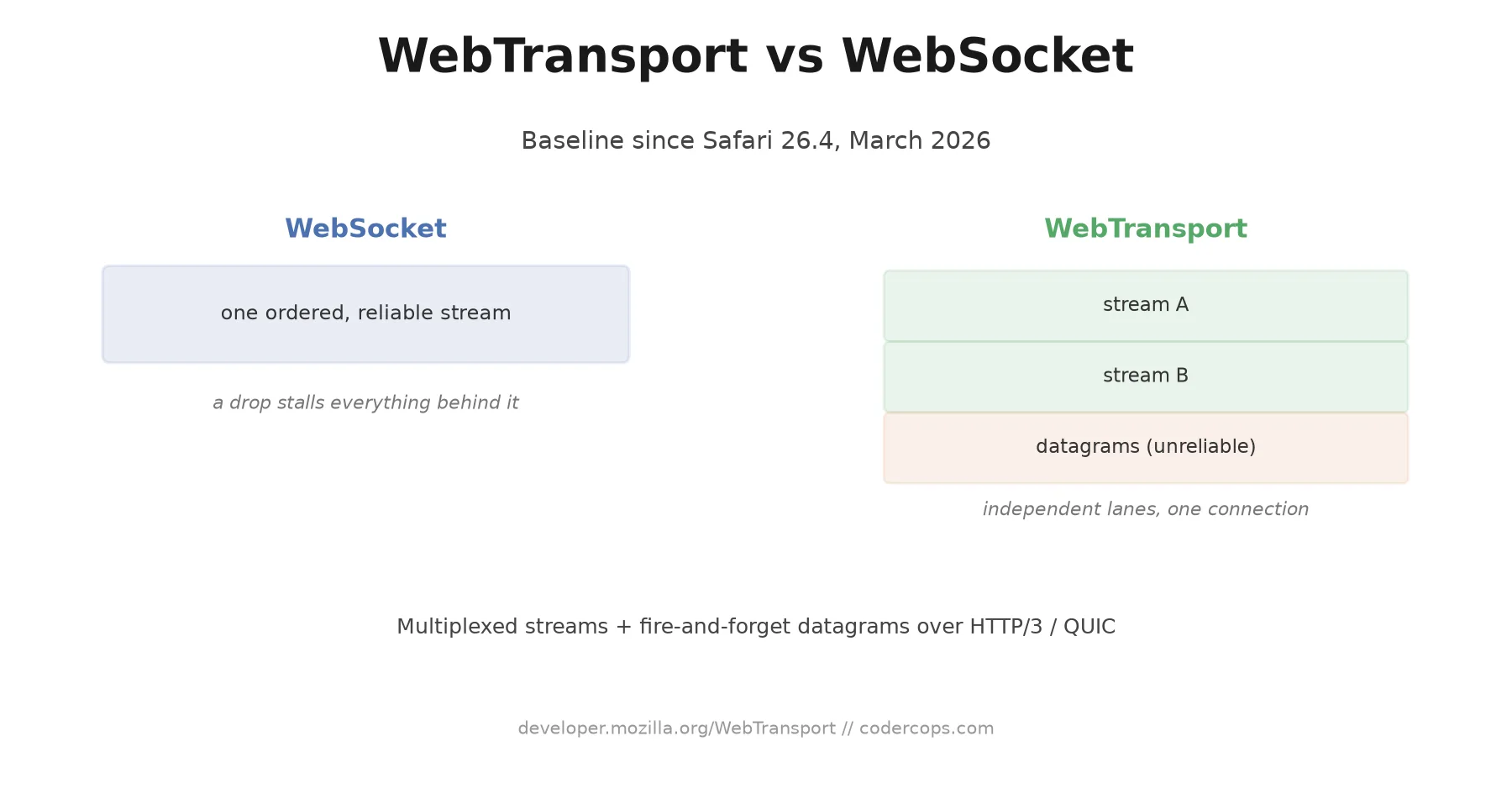
A WebSocket is one ordered, reliable stream over one TCP connection. Every message arrives in the order you sent it, and every message arrives, period, because TCP retransmits anything that gets lost. That’s exactly what you want for a chat message or an account update.
It’s exactly wrong for two things web apps increasingly need: sending multiple independent kinds of data at once without one blocking the other, and sending data you don’t actually need retransmitted if it’s late. A single TCP connection means head-of-line blocking: if one packet drops, everything behind it in that stream waits, even data that has nothing to do with what dropped.
What WebTransport actually gives you
WebTransport runs over HTTP/3, which runs over QUIC instead of TCP. That one layer change buys two capabilities WebSockets structurally cannot offer:
Multiple independent streams. You can open several reliable, ordered streams over a single WebTransport connection, and a dropped packet on one stream doesn’t stall the others. Send game-state updates on one stream and chat messages on another; a lag spike in chat won’t freeze the game state.
Unreliable datagrams. You can also send data with no delivery guarantee at all, no retransmission, no ordering. That sounds like a downside stated as a feature, until you think about what a stale packet actually costs you in a real-time app. A three-frames-old player position isn’t useful once a newer one exists; retransmitting it just delays the update that matters. WebSockets can’t do this. TCP guarantees delivery whether the application wants it or not.
A minimal client example
const transport = new WebTransport("https://example.com:4433/session");
await transport.ready;

// Reliable, ordered: open a bidirectional stream
const stream = await transport.createBidirectionalStream();
const writer = stream.writable.getWriter();
await writer.write(new TextEncoder().encode("player-join"));
writer.releaseLock();

// Unreliable, unordered: send a datagram
const datagramWriter = transport.datagrams.writable.getWriter();
await datagramWriter.write(new TextEncoder().encode(JSON.stringify({ x: 128, y: 64 })));
datagramWriter.releaseLock();

// Read incoming datagrams
const datagramReader = transport.datagrams.readable.getReader();
while (true) {
  const { value, done } = await datagramReader.read();
  if (done) break;
  console.log("position update:", new TextDecoder().decode(value));
}
Notice the shape: you pick reliable-and-ordered or unreliable-and-fast per message, in the same connection. With WebSockets that choice doesn’t exist. Every message gets the same guarantee whether it needs it or not.
The server side is the actual gap
The browser API is ready. The server ecosystem isn’t. Node.js has no built-in WebTransport support, and neither does Deno, as of this writing. The library filling that gap is @fails-components/webtransport, a C++ binding to Cloudflare’s libquiche, maintained largely by one person. It works, and projects like the Colyseus game server build on it, but it’s a narrower dependency than the battle-tested ws package you’d reach for with WebSockets.
npm i @fails-components/webtransport @fails-components/webtransport-transport-http3-quicheA minimal server looks like this once installed:
import { Http3Server } from "@fails-components/webtransport";
import fs from "node:fs";

const server = new Http3Server({
  port: 4433,
  host: "0.0.0.0",
  secret: "change-me",
  cert: fs.readFileSync("./cert.pem"),
  privKey: fs.readFileSync("./key.pem"),
});

server.startServer();

(async () => {
  const sessionStream = server.sessionStream("/session");
  const sessionReader = sessionStream.getReader();
  while (true) {
    const { done, value: session } = await sessionReader.read();
    if (done) break;
    await session.ready;
    // handle bidirectional streams and datagrams on `session` here,
    // mirroring the client API shown above
  }
})();
That’s meaningfully more setup than new WebSocketServer({ port }). It’s also why a lot of teams that experiment with WebTransport keep WebSockets as the fallback path for browsers or networks where QUIC gets blocked, rather than replacing the transport outright on day one.
If your team already treats protocol choice as an architecture decision worth documenting, weigh that dependency risk against the WebSocket alternative’s maturity before committing a production service to it. A go/no-go table helps make that concrete:
| Need | WebSocket | WebTransport |
|---|---|---|
| Simple bidirectional messaging | Yes, and simpler | Overkill |
| Multiple independent data streams, no cross-blocking | No (single stream) | Yes |
| Fire-and-forget data (game state, live position) | No (always reliable) | Yes, via datagrams |
| Node.js server library maturity | Mature (ws, socket.io) | Early (@fails-components/webtransport) |
| Works through all corporate proxies today | Generally yes | Less consistent; QUIC/UDP gets blocked more often |
That last row is worth taking seriously before you commit to WebTransport as your only transport. QUIC runs over UDP, and a meaningful number of corporate firewalls and captive portals still block or throttle UDP traffic on non-standard ports while letting TCP through without a second thought. WebSockets, riding on top of an HTTP upgrade, essentially never hit that wall. If your users include anyone on a locked-down enterprise network, plan for a WebSocket fallback from the start rather than discovering the gap in a support ticket after launch.
Where it’s actually worth using in 2026
Real-time multiplayer games are the clearest case: position updates that benefit from being unreliable, chat and match state that need reliability, all multiplexed over one connection instead of juggling a WebSocket plus a separate UDP-like channel. Live audio and video signaling is the second: WebRTC still owns peer-to-peer media, but WebTransport is a cleaner fit than WebSockets for the client-server media relay case, where you want datagram semantics without standing up a full WebRTC stack.
For most CRUD apps, dashboards, and chat features, stick with WebSockets or server-sent events. Baseline support means the browser will no longer stop you from using WebTransport. It doesn’t mean your use case needs it. Reach for it when you can name the specific problem it solves for your app, not because it’s the newer API in the room.
Frequently asked questions
- Is WebTransport a replacement for WebSockets?
- Not usually. For a chat app, a notification feed, or anything where every message matters and order matters, WebSockets are simpler and just as fast. WebTransport earns its place when you need multiple independent data streams over one connection, or when you'd rather drop a stale update than wait for a retransmit, which WebSockets structurally cannot do.
- Does WebTransport work in all browsers now?
- Yes, as of March 2026. Chrome, Edge, Opera, and Samsung Internet have supported it since 2022, Firefox since 2023, and Safari added it in 26.4, which made it Baseline: every current browser engine supports it without a flag or a polyfill.
- What are datagrams, and why would I want unreliable delivery?
- A datagram is a packet WebTransport sends without guaranteeing it arrives or arrives in order. That sounds like a downside until you have data that's worthless if it's late: a player position update in a game, a video frame. Waiting for a retransmitted three-frames-old position is worse than just dropping it and sending the current one.
- Can I use WebTransport on the server today with Node.js?
- Not natively. Node.js and Deno haven't shipped built-in support yet. The working option is @fails-components/webtransport, a C++ binding to Cloudflare's libquiche that several frameworks, including the Colyseus game server, already build on.
- Do I need to migrate off WebSockets now that WebTransport is Baseline?
- No. Baseline support removes the browser-compatibility excuse, not the case against migrating. If WebSockets already do the job, a migration adds a QUIC-aware server dependency for no measurable gain. Reach for WebTransport when you're building something new that specifically needs multiple streams or unreliable delivery.
Sources
Sponsored
More from this category
More from Web Development
Sponsored
Discussion
Join the conversation.
Comments are powered by GitHub Discussions. Sign in with your GitHub account to leave a comment.
Sponsored