Business · Risk Management
How IP Actually Leaks: The Apple-OpenAI Suit
Apple sued OpenAI on July 10 alleging trade secret theft through hired-away staff. The allegations read like a checklist of gaps in hiring and offboarding.

Anurag Verma
5 min read
Sponsored
Apple filed a federal lawsuit against OpenAI on July 10 alleging systematic trade secret theft, and the allegations are worth reading past the headline, because almost none of them describe anything as dramatic as hacking. They describe interview questions, laptop access after a resignation, and a shared document about how to avoid a standard offboarding step. If you run a team of any size, that’s the uncomfortable part: the mechanisms Apple is describing aren’t exotic, they’re gaps that exist in most companies’ hiring and offboarding process by default.
What Apple actually alleges
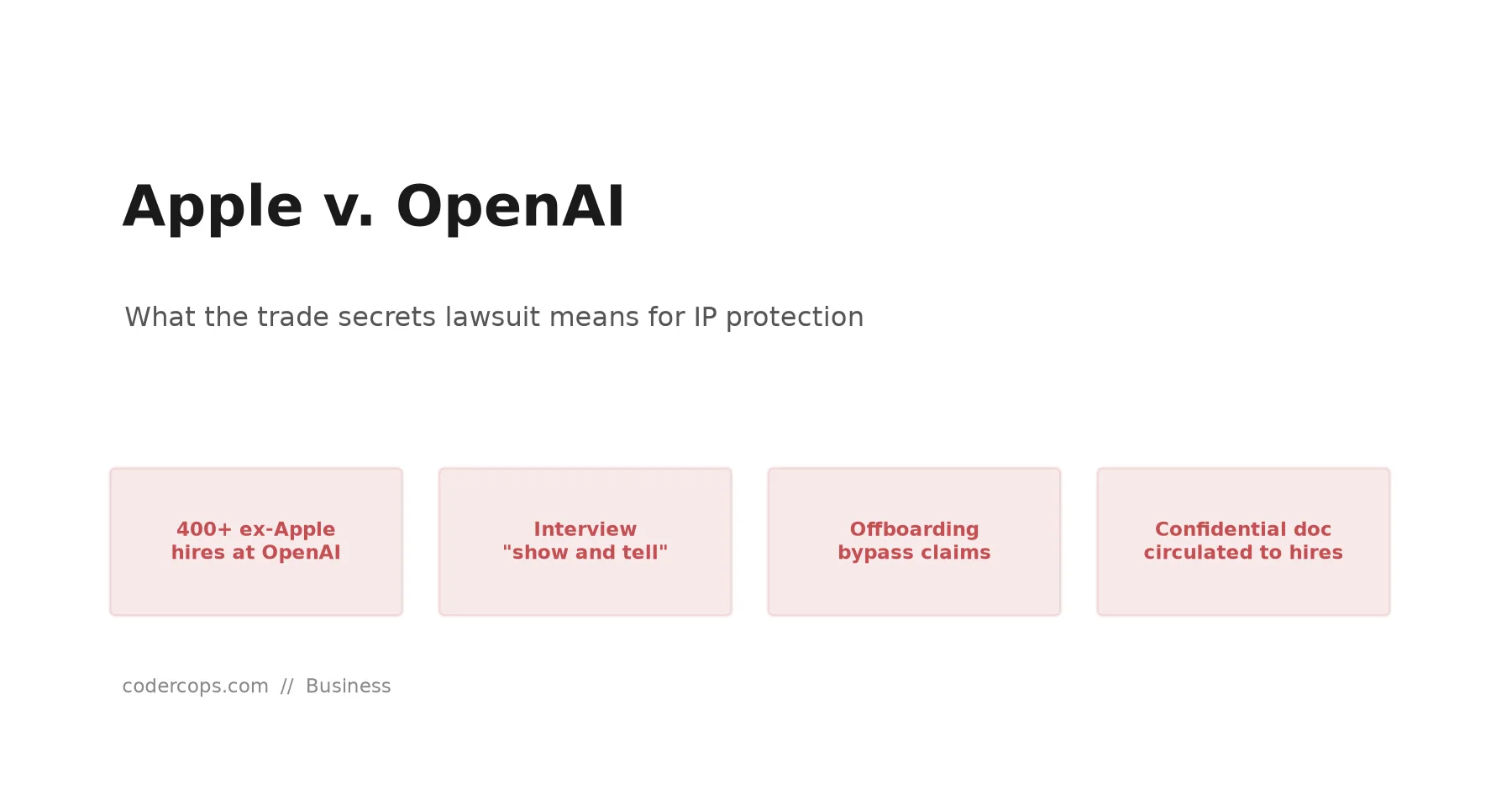
The complaint, filed in the Northern District of California, states that OpenAI has been “stealing Apple’s trade secrets and confidential information” at every level, “from members of its Technical Staff to its Chief Hardware Officer.” That Chief Hardware Officer is Tang Tan, a former Apple vice president. Apple alleges Tan directed job candidates who were still employed at Apple to bring “actual parts” from Apple to their interviews, for “show and tell” sessions where he and his team could draw out further confidential detail.
A second named individual, Chang Liu, is alleged to have accessed Apple’s internal network storage after leaving the company, from a colleague’s still-active Apple-issued computer, exploiting an authentication bug. Apple also alleges OpenAI circulated an internal Apple document, marked “Need to know,” to new hires, containing guidance on how to avoid Apple’s standard immediate-offboarding process, sometimes referred to internally as the “walkout,” which normally cuts off a departing employee’s access the moment they give notice.
Apple’s complaint puts the scale of hiring at over 400 former Apple employees now working at OpenAI. The lawsuit doesn’t allege all 400 did anything wrong. It alleges a pattern across specific individuals large enough that ordinary safeguards, interview norms, offboarding checklists, NDA enforcement, apparently didn’t hold.
Why this reads as a process failure, not a security failure
Every mechanism named in the complaint routes through something a security team wouldn’t normally flag: a job interview, a resignation, a document shared between new colleagues. None of it looks like an attack while it’s happening. That’s a structurally different problem from a breach, where the goal is detecting an intrusion. Here, the goal is designing processes that don’t quietly leak information through completely ordinary human interactions, which is a much easier bar to fail without anyone involved feeling like they did something wrong.
That’s also why this case generalizes well past Apple and OpenAI. Most companies have some version of each gap: interview processes that don’t specify what a candidate can bring or discuss, especially one coming from a direct competitor; offboarding that takes a day or two to fully revoke access rather than happening the moment notice is given; and NDAs or IP assignment agreements that exist on paper but were never actually reviewed for what they cover, because nobody expected to need them.
What actually closes these gaps
None of this requires legal muscle you don’t have. It requires specific process changes, the kind that are cheap to implement and easy to skip until an incident makes them obviously necessary in hindsight.
- Set an explicit interview policy for candidates from competitors or client-adjacent companies. Define what’s off-limits to ask or bring, in writing, and make sure whoever’s conducting technical interviews knows it. “Show and tell with actual parts” is a specific, avoidable failure mode once someone names it as a policy rather than assuming good judgment will catch it in the moment.
- Make offboarding same-day, not a checklist that runs over several days. Account access, device access, and repo or storage permissions should be cut the moment notice is given, not queued behind an IT ticket. The Apple complaint’s “walkout” avoidance allegation only works because offboarding wasn’t instantaneous to begin with.
- Know what your agreements actually say before you need them. NDAs, IP assignment clauses, and contractor agreements are worth a real read, not a template you copied once. If you’re working with outside contractors or an agency, this is doubly true, since contractor network capacity usually means more people touching client IP with less institutional oversight than a full-time hire.
- Treat scale as risk, not just headcount. If a competitor or new hire pool has absorbed a large number of people from one place, formal or informal knowledge transfer becomes statistically more likely even without anyone intending misconduct. That’s worth accounting for in how you structure onboarding for hires from a direct competitor, not just how you handle departures.
Most of this litigation will take years to resolve, and the outcome doesn’t change the lesson available today. The allegations describe ordinary process gaps at a company with more security resources than almost anyone reading this has. If Apple’s hiring and offboarding processes had room for this, it’s worth an honest look at whether yours do too, especially if you’re a smaller team or agency handling client IP where a single quiet leak is harder to detect and more consequential per incident. For teams evaluating whether their compliance posture holds up to real scrutiny, our SOC 2 compliance guide covers the adjacent controls worth auditing at the same time.
Frequently asked questions
- What is Apple actually alleging against OpenAI?
- Apple's complaint, filed July 10, 2026 in federal court in Northern California, alleges that OpenAI engaged in trade secret theft 'at every level, from members of its Technical Staff to its Chief Hardware Officer,' aimed at building competing consumer hardware. Specific allegations include OpenAI's hardware chief directing job candidates still employed at Apple to bring physical Apple parts to interviews, a former Apple employee accessing Apple's internal network storage after leaving the company, and an internal Apple document about avoiding the company's standard immediate-offboarding process being circulated to new OpenAI hires.
- Is this really about hacking, or something else?
- Something else, and that's the part worth paying attention to. None of the core allegations describe technical intrusion. They describe interview practices, departing-employee behavior, and information sharing between new colleagues, the kind of ordinary workplace interactions that don't trigger any security alert because they don't look like an attack. That's exactly why they're a harder problem to defend against than a firewall gap.
- How many people are actually involved here?
- Apple's complaint states that more than 400 former Apple employees now work at OpenAI. The lawsuit doesn't claim all 400 were involved in wrongdoing, it names specific individuals and specific incidents, but the scale is the context: when a competitor has hired hundreds of people from one company, the odds that informal knowledge transfer happens somewhere in that population go up sharply, whether or not anyone intends misconduct.
- What should a company actually do differently because of this?
- Three concrete things translate directly from the allegations: set an explicit policy on what candidates can bring to or discuss in interviews, especially with team members who came from a competitor; make offboarding same-day for account and device access rather than a multi-day process an outgoing employee can work around; and know what your NDAs, IP assignment agreements, and contractor agreements actually say before a departure happens, not after. All three are process fixes, not legal ones, and none of them requires a lawsuit-sized budget to implement.
- Does this apply to smaller companies and agencies, or just Apple-scale operations?
- It applies more, not less, at smaller scale. Apple has a legal and security team built to detect and litigate this kind of pattern; most agencies and smaller companies don't, and lose institutional knowledge just as easily through informal channels, a departing contractor keeping repo access, a new hire from a competitor casually sharing client processes in their first week. The stakes per incident are smaller, but so is the capacity to catch it, which roughly cancels out the risk difference.
Sources
Sponsored
Sponsored
Discussion
Join the conversation.
Comments are powered by GitHub Discussions. Sign in with your GitHub account to leave a comment.
Sponsored