Web Development · Frameworks
Axum vs Actix-web vs Rocket: Rust Frameworks in 2026
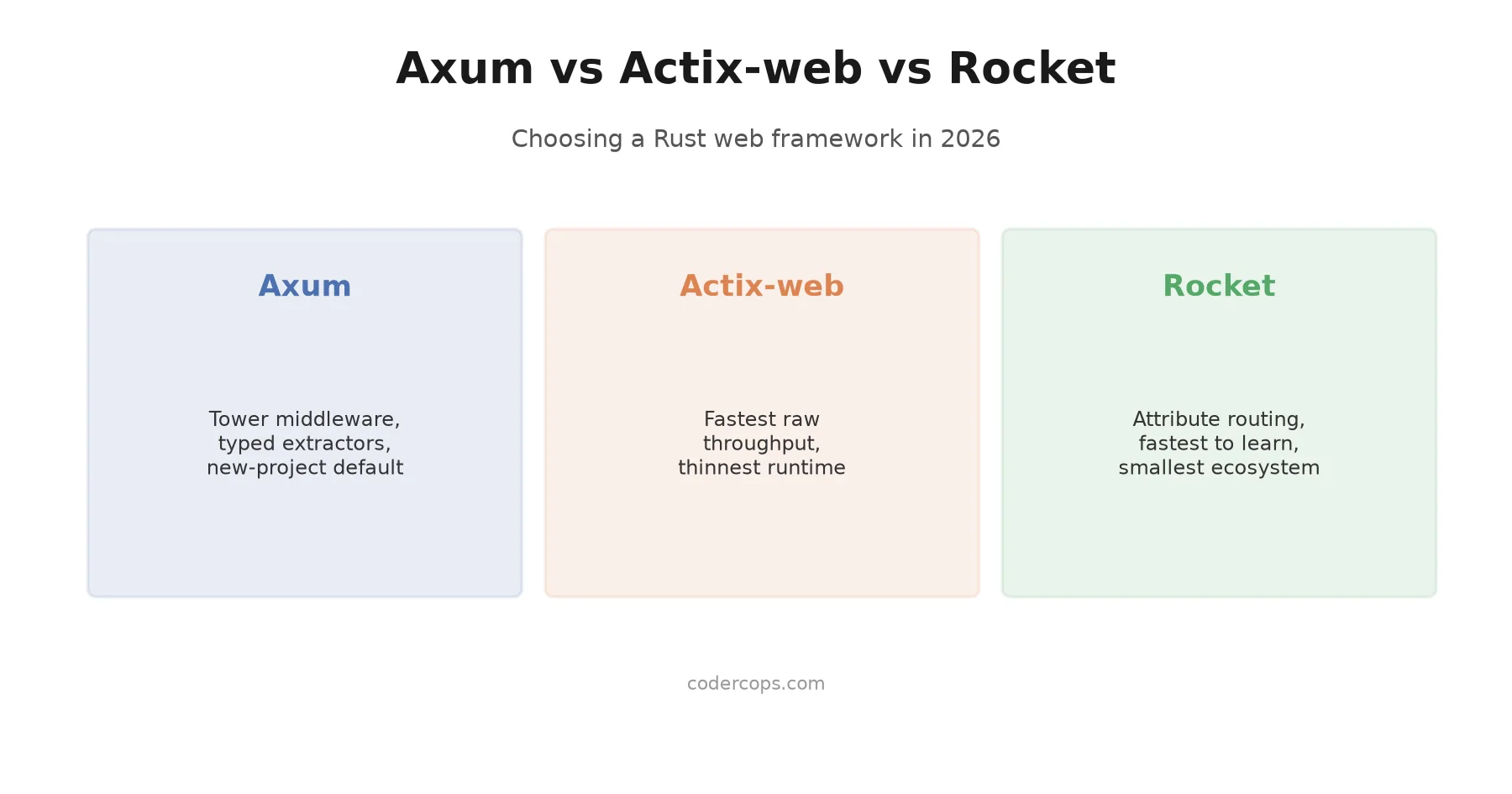
Axum is the default for new Rust APIs in 2026, Actix-web wins on raw throughput, and Rocket wins on ergonomics. Here is which one fits your team.

Abhishek Gupta
10 min read
Sponsored
If you’re starting a new Rust web service today, use axum unless you already have a specific reason not to. That’s the short version. The longer version is that “specific reason” covers real cases: Actix-web when raw throughput is the actual constraint, Rocket when a small team needs to ship something this week and nobody on it has written async Rust before. All three frameworks are production-grade in 2026. The question isn’t which one is good enough, it’s which tradeoff matches what you’re actually building.
The quick verdict
Choose Axum if:
- You’re starting a new service and don’t have a reason to pick something else
- Your team already uses Tower middleware elsewhere (gRPC services, other Axum apps) and wants it to compose
- You want the largest current pool of tutorials, crates, and Stack Overflow answers to pull from when you get stuck
Choose Actix-web if:
- You’ve profiled a real bottleneck and it’s genuinely in the HTTP layer, not the database or an upstream call
- You’re running at request volumes where a 10-15% routing overhead difference shows up on your bill
- Your team already knows it well and the migration cost to Axum isn’t worth the theoretical upside
Choose Rocket if:
- Developer ergonomics matter more than squeezing out throughput, and your team is new to async Rust
- You want request guards and form validation handled for you instead of wired up by hand
- You can live with a smaller ecosystem and a slower release cadence in exchange for a gentler learning curve
Axum, Actix-web, and Rocket at a glance
| Axum | Actix-web | Rocket | |
|---|---|---|---|
| Current stable version | 0.8.9 | 4.15.0 | 0.5.1 |
| Built on | Tokio, Hyper, Tower | Tokio (direct) | Tokio |
| Routing style | Function handlers + Router | Attribute macros or App::route | Attribute macros |
| Middleware model | Tower Service (shared across the Rust ecosystem) | Actix-specific traits | Fairings |
| Raw throughput | Strong, slightly behind Actix-web | Historically the fastest of the three | Competitive, trails slightly |
| Async support | Native, always has been | Native since v2.0 | Native since 0.5 (Nov 2023); sync before that |
| Lifetime crates.io downloads | ~462M | ~80M | ~13M |
| Best documented for | New projects, general use | High-throughput services | Teams new to Rust |
Rocket’s version number looks stagnant next to the other two, and it more or less is: 0.5.1 shipped in May 2024 and nothing has replaced it since. That’s not necessarily a red flag (Rocket 0.5 itself was a stable, mature release that took the ecosystem from sync to async), but it does mean fewer people have hit the framework’s edge cases in the last two years compared to Axum, which ships new 0.x versions regularly and had a breaking change as recently as 0.8.
Hello world, three ways
The differences show up immediately in how each framework wants you to wire a route.
Axum:
use axum::{routing::get, Router};

#[tokio::main]
async fn main() {
    let app = Router::new().route("/", get(|| async { "Hello, World!" }));
    let listener = tokio::net::TcpListener::bind("0.0.0.0:3000").await.unwrap();
    axum::serve(listener, app).await.unwrap();
}
Actix-web:
use actix_web::{get, App, HttpServer, Responder};

#[get("/")]
async fn hello() -> impl Responder {
    "Hello, World!"
}

#[actix_web::main]
async fn main() -> std::io::Result<()> {
    HttpServer::new(|| App::new().service(hello))
        .bind(("0.0.0.0", 3000))?
        .run()
        .await
}
Rocket:
#[macro_use] extern crate rocket;

#[get("/")]
fn hello() -> &'static str {
    "Hello, World!"
}

#[launch]
fn rocket() -> _ {
    rocket::build().mount("/", routes![hello])
}
Axum treats routes as plain async functions passed into a router. Actix-web and Rocket both lean on attribute macros to declare the route directly above the handler. If you’ve used Flask or Express, Rocket’s style will feel the most familiar. If you’ve used any Tower-based gRPC service, Axum’s will.
A real route: path param plus a typed response
Hello-world doesn’t tell you much. Here’s a route that pulls an ID out of the URL and returns typed JSON, which is closer to what you’ll actually write.
Axum (note the {id} syntax — axum 0.8 switched from :id to match matchit 0.8 and OpenAPI conventions, and the old syntax now panics at startup instead of silently misrouting):
use axum::{extract::Path, routing::get, Json, Router};
use serde::Serialize;

#[derive(Serialize)]
struct User {
    id: u32,
    name: String,
}

async fn get_user(Path(id): Path<u32>) -> Json<User> {
    Json(User { id, name: format!("user-{id}") })
}

#[tokio::main]
async fn main() {
    let app = Router::new().route("/users/{id}", get(get_user));
    let listener = tokio::net::TcpListener::bind("0.0.0.0:3000").await.unwrap();
    axum::serve(listener, app).await.unwrap();
}
Actix-web:
use actix_web::{get, web, App, HttpServer, Responder};
use serde::Serialize;

#[derive(Serialize)]
struct User {
    id: u32,
    name: String,
}

#[get("/users/{id}")]
async fn get_user(path: web::Path<u32>) -> impl Responder {
    let id = path.into_inner();
    web::Json(User { id, name: format!("user-{id}") })
}

#[actix_web::main]
async fn main() -> std::io::Result<()> {
    HttpServer::new(|| App::new().service(get_user))
        .bind(("0.0.0.0", 3000))?
        .run()
        .await
}
Rocket (note the <id> syntax — unlike Axum, Rocket never changed this):
#[macro_use] extern crate rocket;
use rocket::serde::{json::Json, Serialize};

#[derive(Serialize)]
#[serde(crate = "rocket::serde")]
struct User {
    id: u32,
    name: String,
}

#[get("/users/<id>")]
fn get_user(id: u32) -> Json<User> {
    Json(User { id, name: format!("user-{id}") })
}

#[launch]
fn rocket() -> _ {
    rocket::build().mount("/", routes![get_user])
}
Three frameworks, three path-parameter syntaxes, and none of them agree with each other. That’s a small thing, but it’s the kind of small thing that decides how fast a new hire stops looking things up and starts shipping.
Axum’s extractor pattern (Path<u32> as a function argument) is the part worth paying attention to. It’s not axum-specific: the same FromRequestParts trait that powers it is the same shape Tower services use elsewhere, so a team that’s already writing Tower middleware for a gRPC service gets a router that speaks the same language. That’s the actual argument for Axum over “it’s popular.” Its type-safety comes from the same trait the rest of your Tokio stack already uses, not from a framework-specific macro DSL.
Performance: what actually differs, and when it matters
Actix-web’s name is a holdover from its actor-model origins, but its HTTP layer has run directly on Tokio, without requiring actors, since v2.0. What’s left is a thin async runtime with less abstraction sitting between your handler and the socket than Axum’s Router-plus-Tower stack, and that’s most of why Actix-web keeps a routing-overhead edge in synthetic benchmarks. Rocket, built on more macro and type machinery at request-guard resolution time, has generally trailed both by a small margin.
Here’s the part that gets skipped in most of these comparisons: that gap is routing overhead, measured on a route that does almost nothing else. A production handler that queries Postgres, calls a third-party API, or serializes a large payload spends orders of magnitude more time waiting on those things than on which router matched the path. If your framework’s overhead is 200 microseconds and your database round trip is 8 milliseconds, you optimized the wrong 2.5%.
Framework choice does matter, just not usually where people assume:
- Sustained request volumes in the tens of thousands per second per instance, where routing overhead compounds across every request and shows up directly in your infrastructure bill.
- Memory-constrained deploys — containers running at 64-128MB, or embedded targets — where a leaner runtime buys you real headroom rather than a rounding error.
- A team that will maintain this service for years, where the deciding factor isn’t throughput at all, it’s how many engineers already know the framework and how much documentation exists when something breaks at 2am.
TechEmpower’s FrameworkBenchmarks project, the closest thing the industry had to a standardized cross-language throughput comparison, was archived on GitHub in March 2026 and is now read-only. Whatever numbers you find quoting a specific round are a snapshot from before that date, not a live measurement, and they’re worth treating that way: directionally useful, not gospel for a framework version that’s since moved on. Rust itself keeps shipping faster than any of these frameworks do; Rust 1.94’s default linker change shaved real seconds off compile times this year, which affects your iteration speed regardless of which web framework sits on top.
Ecosystem depth and who you can actually hire
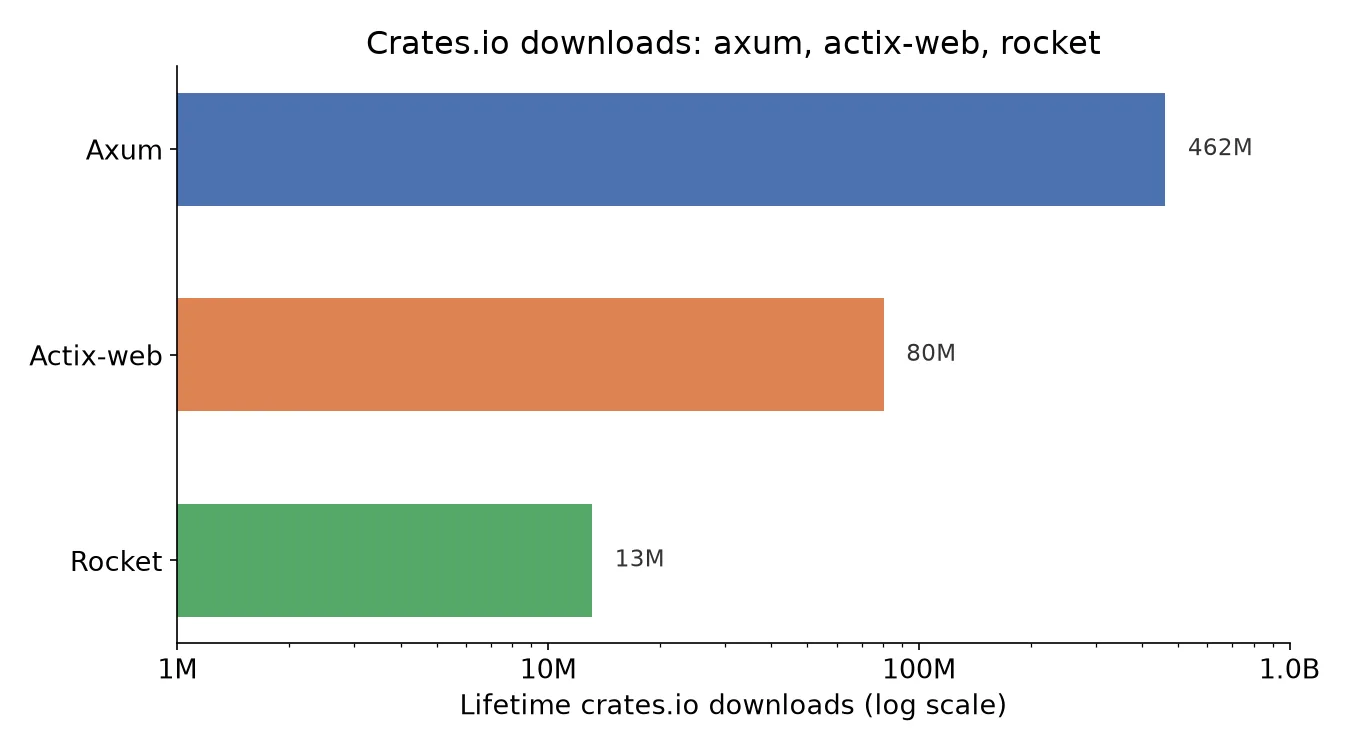
Crates.io’s download counts aren’t a popularity contest, they’re a decent proxy for which framework a Rust developer has actually pulled into a Cargo.toml recently. As of this writing, axum sits at roughly 462 million lifetime downloads, actix-web at about 80 million, and Rocket at about 13 million. That 35-to-1 gap between Axum and Rocket is wide enough to matter when you’re screening candidates, not just when you’re picking a crate.
In practice this means a job posting for “Rust backend engineer, Axum experience preferred” pulls from a noticeably deeper pool than the same posting written around Rocket. It doesn’t mean Rocket engineers are worse, it means there are fewer of them who’ve touched it in the last year, and onboarding someone from Axum or Actix-web into a Rocket codebase costs a week or two they wouldn’t spend on a framework they already know. If you’re screening for this, the same rubric we use to vet Rust developers generally still applies before you get anywhere near framework-specific questions: ask a candidate to walk through a real pull request and explain a decision they’d make differently now, not to recite trait bounds from memory. Whether you fill the role through an agency’s vetted bench or by posting it directly to a marketplace, that fundamentals screen should come before the framework question, not after it.
If Rust itself isn’t a settled choice yet and you’re still weighing it against a faster-to-hire-for stack, the tradeoff is the same one we walk through at the language level in our honest comparison of DRF and FastAPI: raw performance rarely wins the argument on its own once you account for how long it takes to build and staff the team that has to maintain the thing.
The verdict, again
Start with Axum. It’s the framework most new Rust tutorials teach in 2026, it has the deepest hiring pool by a wide margin, and its Tower-based middleware means what your team builds for this service is reusable the next time they’re writing anything else on Tokio. Reach for Actix-web only after you’ve measured a real bottleneck in the HTTP layer itself, not before, because that measurement is rarer than the benchmark posts make it sound. Reach for Rocket when the team writing the code matters more than the code’s throughput ceiling, and you’re comfortable with an ecosystem that moves slower than the other two. None of these are wrong choices. Picking one without a reason is the only mistake on this list.
Frequently asked questions
- Is Axum production-ready in 2026?
- Yes. It's maintained by the Tokio team, built directly on hyper and Tower, and has been running in production services for years. The crate is still versioned below 1.0, which is a Rust ecosystem convention around API-surface commitments, not a signal that it's immature -- Tokio itself followed the same pattern for a long time.
- Is Actix-web faster than Axum?
- On synthetic routing benchmarks, usually yes, and it has held that edge since it stopped requiring the actor runtime for HTTP handling back in v2.0. In a real service, that gap is almost always smaller than the latency added by a single database round trip, so it rarely decides the outcome on its own.
- Which Rust framework should a team with no Rust experience start with?
- Axum, in most cases. It has the largest current body of tutorials, Stack Overflow answers, and example repos, so a team that gets stuck unblocks itself faster. Pick Rocket instead only if your team is optimizing hard for onboarding speed over raw throughput and the request volume genuinely doesn't matter yet.
- Does Rocket support async?
- Yes, since Rocket 0.5 shipped in November 2023. Before that, Rocket was a synchronous, thread-per-request framework. The async rewrite runs on Tokio underneath, the same runtime Axum and Actix-web use.
- Can I use Tower middleware with Actix-web or Rocket?
- Not natively. Tower's Service trait is specific to Axum's ecosystem advantage: middleware written against it works across any Tower-based Rust service, not just web servers. Actix-web has its own middleware trait, and Rocket has fairings. None of the three share a middleware interface with each other.
Sources
Sponsored
More from this category
More from Web Development
Sponsored
Discussion
Join the conversation.
Comments are powered by GitHub Discussions. Sign in with your GitHub account to leave a comment.
Sponsored