Cybersecurity · Vulnerability Management
CVE-2026-20349: Cisco ASA and FTD VPN Flaw, Patch Deadline Is Today
A single unauthenticated HTTP request can reload Cisco ASA and FTD devices with remote-access VPN enabled. CISA gave federal agencies until August 14 to patch. Here's what's affected, what fixes it, and what to do if you can't patch today.

Prathviraj Singh
5 min read
Sponsored
Cisco disclosed CVE-2026-20349 on August 11 with an admission most vendors avoid making at disclosure time: they already knew someone was exploiting it. Three days later, that’s today, CISA’s remediation deadline for federal agencies runs out. If you run ASA or FTD with remote-access VPN turned on anywhere in your infrastructure, this is the one to check before anything else on your list.
What the bug actually does
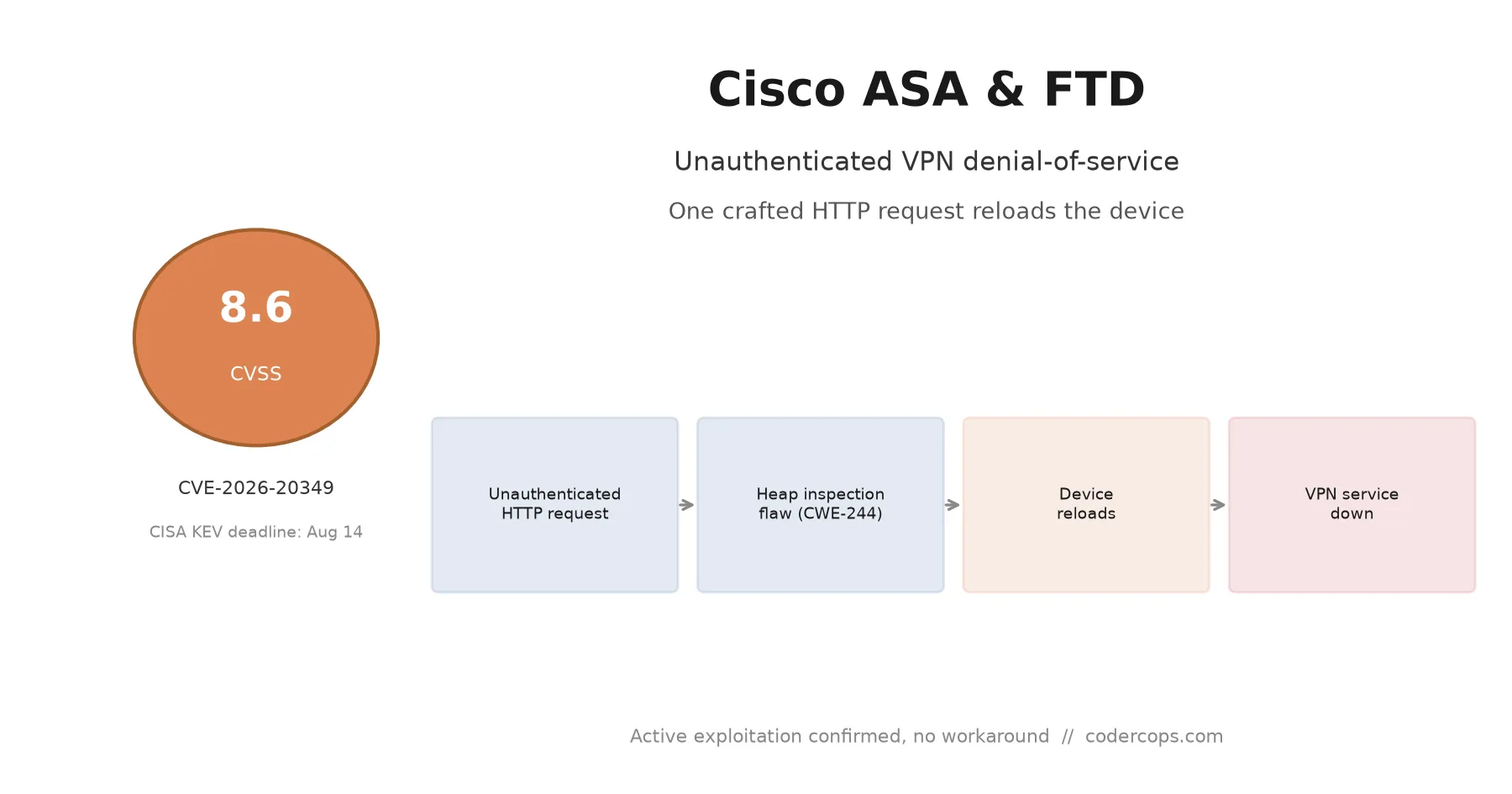
CVE-2026-20349 is a heap inspection flaw, tracked as CWE-244, in the code that handles HTTP requests for Cisco Secure Firewall ASA and FTD’s remote-access VPN services. An unauthenticated attacker sends one specially crafted HTTP request. Insufficient error checking in how the device processes it triggers a memory handling fault, and the device reloads. No credentials, no session, no user interaction required.
The CVSS score is 8.6, high but not maximum, because the impact is availability rather than code execution or data exposure. That distinction matters for triage, but it shouldn’t lower your urgency much. A VPN gateway that keeps rebooting isn’t a minor inconvenience: it’s the single device your remote workforce, your branch offices, and often your third-party contractors depend on to reach anything behind your perimeter.
# The exploit path in one line:
# unauthenticated HTTP request -> heap inspection error in VPN request handler -> device reload -> DoS
Who’s actually exposed
This is the detail worth checking before you assume you’re affected, or before you assume you’re not. The flaw only triggers through specific remote-access VPN features:
| Feature | Platform | Exposed? |
|---|---|---|
| IKEv2 remote access VPN with client services | ASA and FTD | Yes |
| SSL VPN | ASA and FTD | Yes |
| Zero Trust Network Access (ZTNA) | FTD only | Yes |
| Site-to-site VPN only, no remote access | ASA and FTD | No |
| Firewall with no VPN services enabled | ASA and FTD | No |
If your ASA or FTD appliances are running purely as site-to-site VPN endpoints or straight firewalls with no remote-access services turned on, this specific bug doesn’t reach you, even on an unpatched version. If any of the three services above are enabled, an internet-facing appliance is reachable by anyone who can send it a crafted request, not just people who already have a foothold on your network.
Why this one skipped the usual disclosure lag
Most CVE advisories describe a flaw first and confirm exploitation later, if at all. Cisco’s PSIRT statement here went the other way: they said they became aware of exploitation attempts before publishing the fix, which is the strongest possible signal that this isn’t a theoretical bug sitting in a research report. CISA’s own KEV entry, added the same day as Cisco’s advisory, exists specifically because there was already evidence of real attacks, not because a 8.6 CVSS score crossed some automatic threshold. The KEV catalog only lists vulnerabilities with confirmed active exploitation; it’s not a severity ranking.
That combination, disclosed and already-exploited on the same day, with a three-day remediation window, is why this one is worth treating as urgent even if you triage CVEs by CVSS score under a general rule of “patch critical, schedule high.” An actively exploited 8.6 belongs ahead of most theoretical 9s on your list this week.
Fixed versions
Cisco shipped hotfixes across both the ASA and FTD release trains:
| Platform | Fixed releases |
|---|---|
| FTD | 7.0.9.1-1, 7.2.11.1-2, 7.4.7.1-1, 7.6.4.1-2, 7.7.11.1-2, 10.0.0.1-2 |
| ASA | 9.16.89.18.4.50, 9.18.89.18.4.50, 9.20.4.235, 9.22.3.191, 9.23.1.211, 9.24.1.221 |
Cisco has not published a configuration workaround that closes the hole while keeping the affected VPN services running. The only way to remove the exposure without patching is to disable IKEv2 remote access with client services, SSL VPN, and FTD ZTNA outright, which for most organizations means cutting off remote access entirely. That’s rarely tenable for more than a short maintenance window, which is exactly why the patch itself is the real fix here, not a stopgap you can live with for weeks.
What to check today
Pull your ASA and FTD inventory and cross-reference software versions against the fixed-release table above, not just against “did we patch something Cisco-related this month.” A device running an older build with none of the three affected services turned on is a lower priority than a fully current build that happens to have SSL VPN enabled for a dozen remote employees. Prioritize by exposure, not just by version number.
If you’re running FMC-managed FTD deployments, this is also worth cross-checking against the CVE-2026-20079 authentication bypass we covered earlier this month. That’s a different bug in a different Cisco product (FMC, not ASA/FTD directly), but if your team manages both, this is a reasonable week to run one consolidated Cisco patch sweep instead of chasing each advisory separately.
The pattern across Cisco’s last several disclosures this year has been the same: VPN and firewall management surfaces, unauthenticated attack paths, and a KEV entry landing within days of the advisory. If your organization is still triaging these one at a time as they arrive, rather than treating “internet-facing Cisco VPN infrastructure” as a standing watch list, that process gap is worth fixing before the next one shows up. Teams we’ve worked with through security-focused engagements tend to close this gap by tying vendor advisory feeds directly into their patch management SLAs, so a KEV addition triggers a same-day review instead of waiting for the next scheduled maintenance window.
Frequently asked questions
- What is CVE-2026-20349?
- It's a denial-of-service vulnerability in Cisco Secure Firewall Adaptive Security Appliance (ASA) and Firewall Threat Defense (FTD) software. An unauthenticated remote attacker sends a specially crafted HTTP request to an affected VPN service, which triggers a heap memory handling error and forces the device to reload.
- Which Cisco devices are affected?
- Any ASA or FTD appliance with IKEv2 remote access VPN with client services, SSL VPN, or (on FTD) Zero Trust Network Access enabled. Devices without these remote-access VPN features turned on are not exploitable through this specific flaw, even if they're running an affected software version.
- Is CVE-2026-20349 being actively exploited?
- Yes. Cisco's Product Security Incident Response Team said it became aware of attempts to exploit this vulnerability before it published the advisory on August 11, 2026. CISA confirmed active exploitation when it added the flaw to the Known Exploited Vulnerabilities catalog.
- What is the patch deadline?
- CISA set August 14, 2026, as the remediation deadline under Binding Operational Directive 26-04 for U.S. federal civilian agencies. That's today. Cisco has not published a workaround, so the only ways to close the exposure are to apply the hotfix or disable the affected VPN services until you can.
- Is there a way to mitigate this without patching immediately?
- Disabling IKEv2 remote access VPN with client services, SSL VPN, and FTD ZTNA removes the exploitable surface, but that also takes down remote access for anyone depending on that VPN, which is rarely acceptable for more than a few hours. Cisco has not published a configuration-level workaround that keeps the service running while closing the hole, so patching is the real fix.
Sources
Sponsored
More from this category
More from Cybersecurity
 R.01
R.01 CVE-2026-59309 and 59310: VMware vCenter Bugs Attackers Hit in Five Days
 R.02
R.02 The Ceva Logistics Breach Shows Why Your Vendor's Vendor Is Your Problem
 R.03
R.03 CVE-2026-62878: The Wormable Windows DNS Server Bug You Need to Patch Now
Sponsored
Discussion
Join the conversation.
Comments are powered by GitHub Discussions. Sign in with your GitHub account to leave a comment.
Sponsored