Cybersecurity · Vulnerability Management
SonicWall SMA1000's Second Zero-Day Chain: Patch Now
CVE-2026-83548 (SSRF, CVSS 10.0) and CVE-2026-83549 (OS command injection) hit SMA1000 appliances again, seven weeks after the last chain. Affected models and the fix.

Prathviraj Singh
5 min read
Sponsored
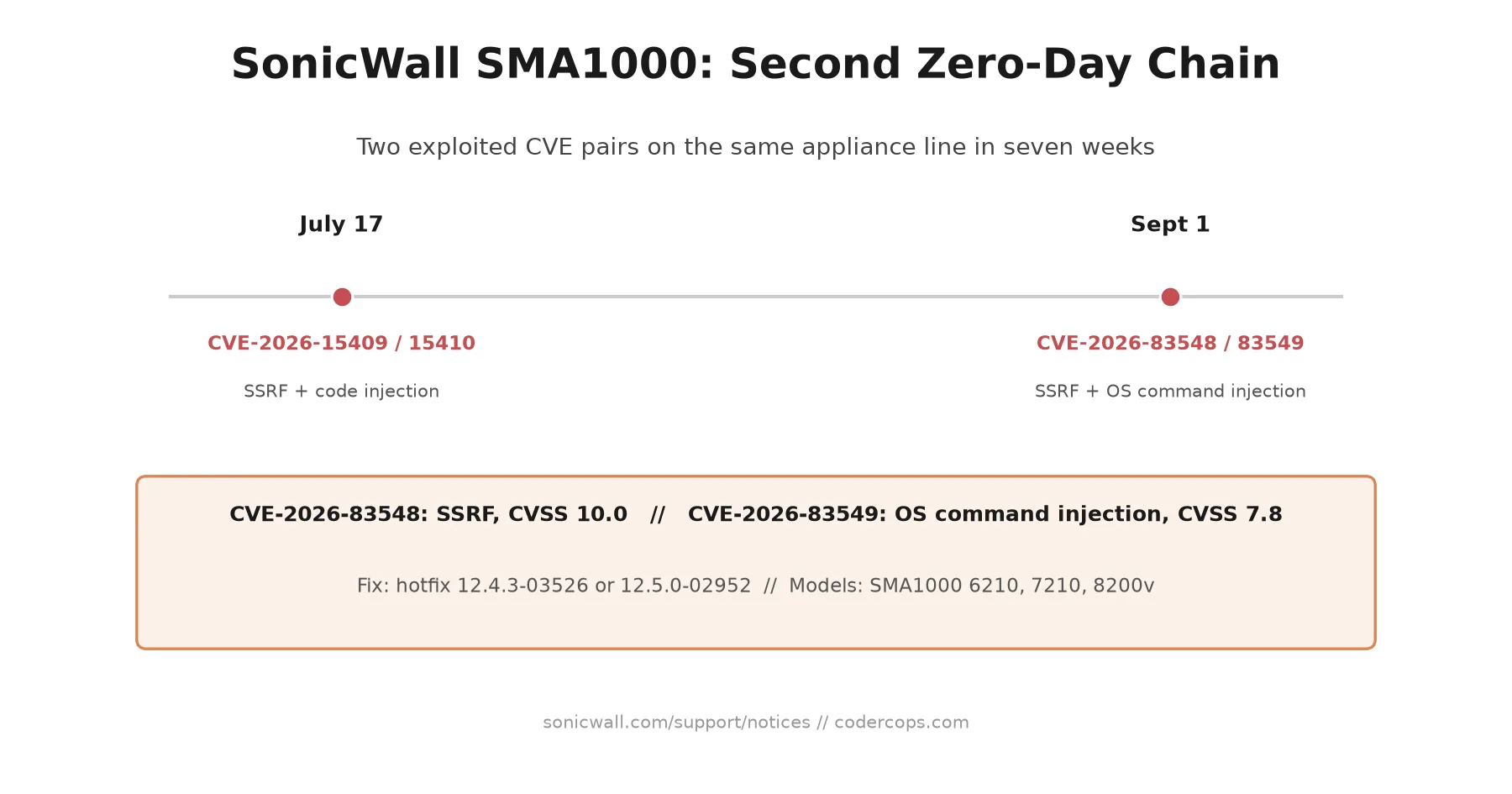
Seven weeks. That’s how long it took SonicWall’s SMA1000 line to produce a second unauthenticated-SSRF-plus-remote-code-execution chain after the last one in July. Different CVEs, same shape of attack, same product family, and the same conclusion: if you run this hardware, you don’t get to patch once this year and stop checking.
SonicWall disclosed CVE-2026-83548 and CVE-2026-83549 on September 1, 2026, and didn’t soften the announcement. Both were already being exploited before the fix shipped.
The two bugs
CVE-2026-83548 is a server-side request forgery vulnerability in the SMA1000 Appliance Work Place interface. It needs no authentication, which is why it sits at the ceiling of the CVSS scale, 10.0. An attacker who reaches it can make the appliance issue requests on their behalf, typically the opening move toward whatever internal systems or credentials the appliance can see.
CVE-2026-83549 is an OS command injection flaw in the Appliance Management Console, rated 7.8, and it requires authentication on its own. Paired with CVE-2026-83549, that requirement disappears: attackers use the SSRF bug to get in, then the command injection bug to run arbitrary commands. Sound familiar? It’s structurally the same escalation path as July’s CVE-2026-15409/15410 pair, an unauthenticated foothold combined with a post-auth execution bug, just through different code.
That repetition is the actual story here, more than either bug individually. Two separate zero-day chains against the same product line, same attack shape, in under two months, says something about where the SMA1000’s remaining attack surface sits: the Work Place interface and the Management Console keep producing exploitable gaps faster than a single patch cycle closes them.
What to check right now
Affected hardware: SMA1000 series models 6210, 7210, and 8200v, running firmware 12.4.3-03453, 12.5.0-02835, or earlier. The fix is hotfix 12.4.3-03526 or 12.5.0-02952, whichever branch you’re on, available now through mysonicwall.com.
# Check your current firmware build against the fixed versions
# via the SMA1000 Central Management Console or CLI:
show version

# Compare against:
#   12.4.3-03526 or later (12.4.3 branch)
#   12.5.0-02952 or later (12.5.0 branch)
If your build number is lower than either fixed version for your branch, treat this as already exploitable, not theoretically vulnerable, since SonicWall confirmed active attacks before the patch existed. CISA added both CVEs to its Known Exploited Vulnerabilities catalog on September 2 with a September 5 remediation deadline for federal civilian agencies under Binding Operational Directive 26-04. That three-day window is a compliance floor for one sector, not a real-world safety margin for anyone else; if attackers had it before the vendor did, three days is generous by comparison.
Rapid7’s write-up on the exploitation notes the same pattern their team saw in July: attackers moving quickly from initial SSRF access to persistence, rather than a quick smash-and-grab. If your SMA1000 was internet-facing and unpatched at any point between September 1 and whenever you applied the hotfix, the incident-response posture, not just the patch, is what closes the gap.
Don’t assume July’s patch covers you
The detail worth repeating to whoever owns this appliance at your organization: patching CVE-2026-15409 and CVE-2026-15410 in July did nothing for this pair. They’re unrelated vulnerabilities in different code paths within the same interfaces. If your process was “we patched SMA1000 in July, it’s handled,” that assumption needs to be retired. Check the actual build number against 12.4.3-03526 / 12.5.0-02952, not against whether you remember doing a SonicWall update this summer.
For teams managing vulnerability response as an ongoing discipline rather than a per-incident scramble, this is also a case for tracking what a security incident actually costs against the cost of a patch-management process that catches vendor advisories the day they land, not the week a customer or auditor asks about it. Two exploited zero-day chains on one appliance line in one quarter is the kind of pattern that argues for the latter.
Why remote-access gateways keep landing here
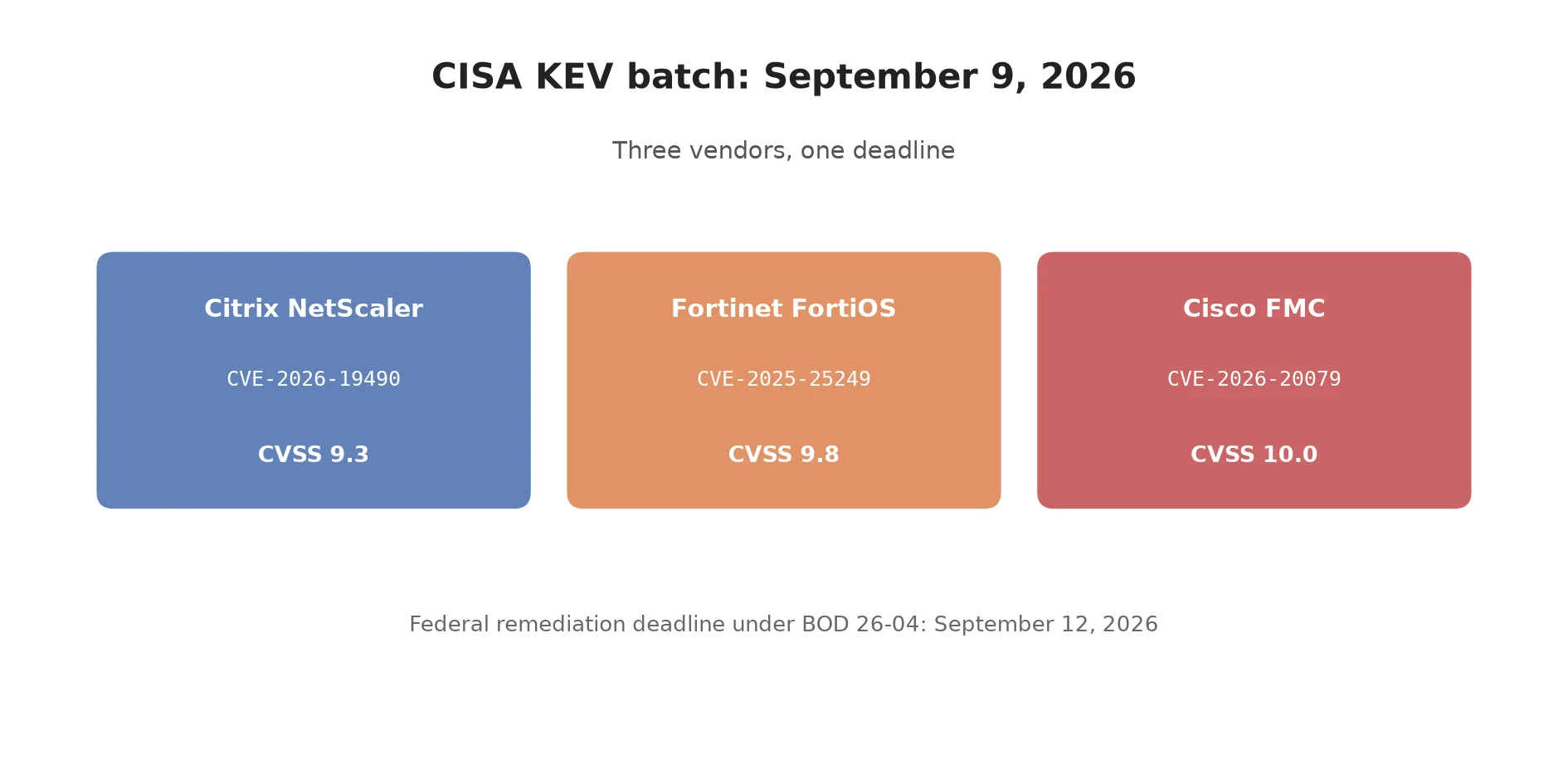
SMA1000 isn’t unusual in getting hit twice in one year. Internet-facing remote-access gateways, the appliances whose entire job is accepting connections from outside the network, have been the most consistently exploited device class in 2026 across vendors, not just SonicWall. Citrix NetScaler, Fortinet’s FortiOS line, and Cisco’s Firewall Management Console have all had their own actively exploited CVEs land in CISA’s KEV catalog this year. The pattern is structural, not vendor-specific: a device built to be reachable from the public internet has a permanently exposed attack surface, and any bug in the interfaces handling that traffic is immediately reachable by anyone who finds it, no phishing or lateral movement required first.
That’s the argument for treating SMA1000, and any comparable remote-access appliance, as needing faster advisory monitoring than an internal system would, not a one-time hardening pass. The two chains this year are seven weeks apart. There’s no reason to assume the next one is further out.
Assume compromise, don’t just assume patched
Because SonicWall confirmed active exploitation before the fix existed, patching alone isn’t the end of the response for anyone who was running vulnerable firmware between disclosure and hotfix. Pull Work Place interface and Management Console access logs for that window and look for requests from IP ranges you don’t recognize, unexpected outbound connections initiated by the appliance itself (the tell for SSRF abuse), and any Management Console session that doesn’t map to a known administrator. If you find anything, treat credentials and session tokens tied to the appliance as burned and rotate them, the same way you would after any confirmed intrusion, rather than assuming the hotfix alone closes the door behind an attacker who already got in.
Frequently asked questions
- Is this the same vulnerability as the one from July?
- No. CVE-2026-83548 and CVE-2026-83549 are distinct from July's CVE-2026-15409 and CVE-2026-15410. The attack shape is nearly identical, an unauthenticated SSRF in the Work Place interface chained with a post-authentication code execution bug in the Management Console, but they're different code paths that both needed separate patches. Fixing July's pair does nothing for this one.
- What does CVE-2026-83548 let an attacker do on its own?
- It's a server-side request forgery flaw in the SMA1000 Appliance Work Place interface that needs no authentication, which is why it carries the maximum CVSS score of 10.0. On its own it lets an attacker force the appliance to make requests on their behalf. Chained with CVE-2026-83549, it becomes the entry point for unauthenticated remote code execution.
- Was this actively exploited before the patch shipped?
- Yes. SonicWall disclosed both CVEs on September 1, 2026 and confirmed active exploitation in the wild at disclosure, meaning attackers had these before defenders had a fix. CISA added both to its Known Exploited Vulnerabilities catalog the following day.
- What firmware do I need, and which models are affected?
- The affected models are SMA1000 6210, 7210, and 8200v, on firmware 12.4.3-03453 or 12.5.0-02835 and earlier. The fix is hotfix 12.4.3-03526 or 12.5.0-02952, whichever matches your current branch, available through mysonicwall.com.
- If I already patched the July zero-days, am I covered?
- No, and that's the point worth flagging to anyone who checked this off their list in July. These are different vulnerabilities in the same product line. Confirm your firmware build number against 12.4.3-03526 / 12.5.0-02952 specifically; being current as of July's hotfix does not cover this pair.
Sources
Sponsored
More from this category
More from Cybersecurity
Sponsored
Discussion
Join the conversation.
Comments are powered by GitHub Discussions. Sign in with your GitHub account to leave a comment.
Sponsored