AI Integration · Developer Tools
GitHub Copilot AI Credits: What It Actually Costs
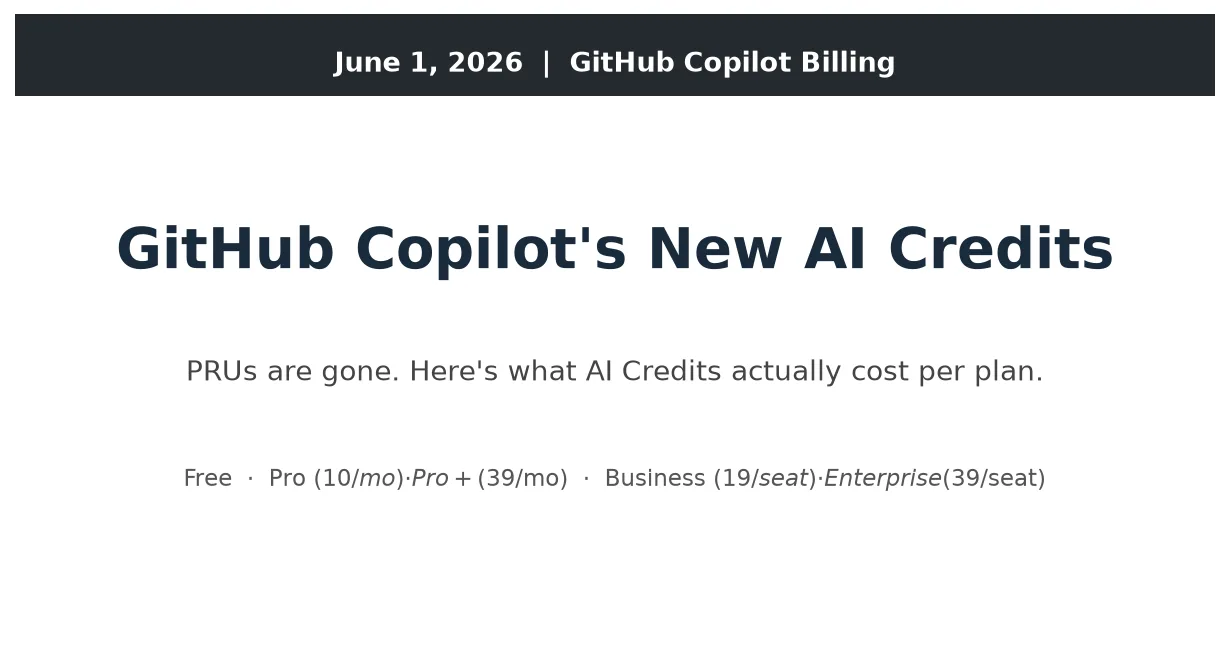
Copilot swapped Premium Request Units for AI Credits on June 1, 2026. Completions stay unlimited; chat, review, and PR summaries draw from a credit pool.

Anurag Verma
6 min read
Sponsored
GitHub quietly changed how Copilot bills for premium features on June 1, 2026. Premium Request Units are gone. AI Credits are in. The mechanics are similar (both measured premium feature usage), but credits are tied directly to token consumption per model, which means costs are more predictable if you understand what you’re using.
Before getting into the numbers, the most important thing to know: code completions don’t cost credits. The inline suggestions that appear as you type, and Next Edit Suggestions, the predictive multi-cursor edit feature, are unlimited on all paid plans. The credit system applies only to the more interactive features: chat, code review, PR summaries, and agent mode.
What AI Credits are
One AI Credit equals $0.01. Credits are consumed whenever you use a feature that processes significant amounts of context with a premium model. The amount consumed per action depends on three variables:
- Which model you’re using. GPT-4o mini is cheaper than GPT-4o, which is cheaper than o3 or Claude Sonnet. GitHub publishes a per-model rate card.
- How much context is involved. A quick chat question about a function costs fewer credits than asking Copilot to review a 500-line pull request.
- Which feature you’re using. Code review and PR summaries tend to use more context than targeted chat messages.
GitHub doesn’t publish a precise “credits per request” figure because it varies by request. The practical implication: use the lighter models for lightweight tasks, reserve heavier models for the work where the quality difference justifies the cost.
What each plan includes
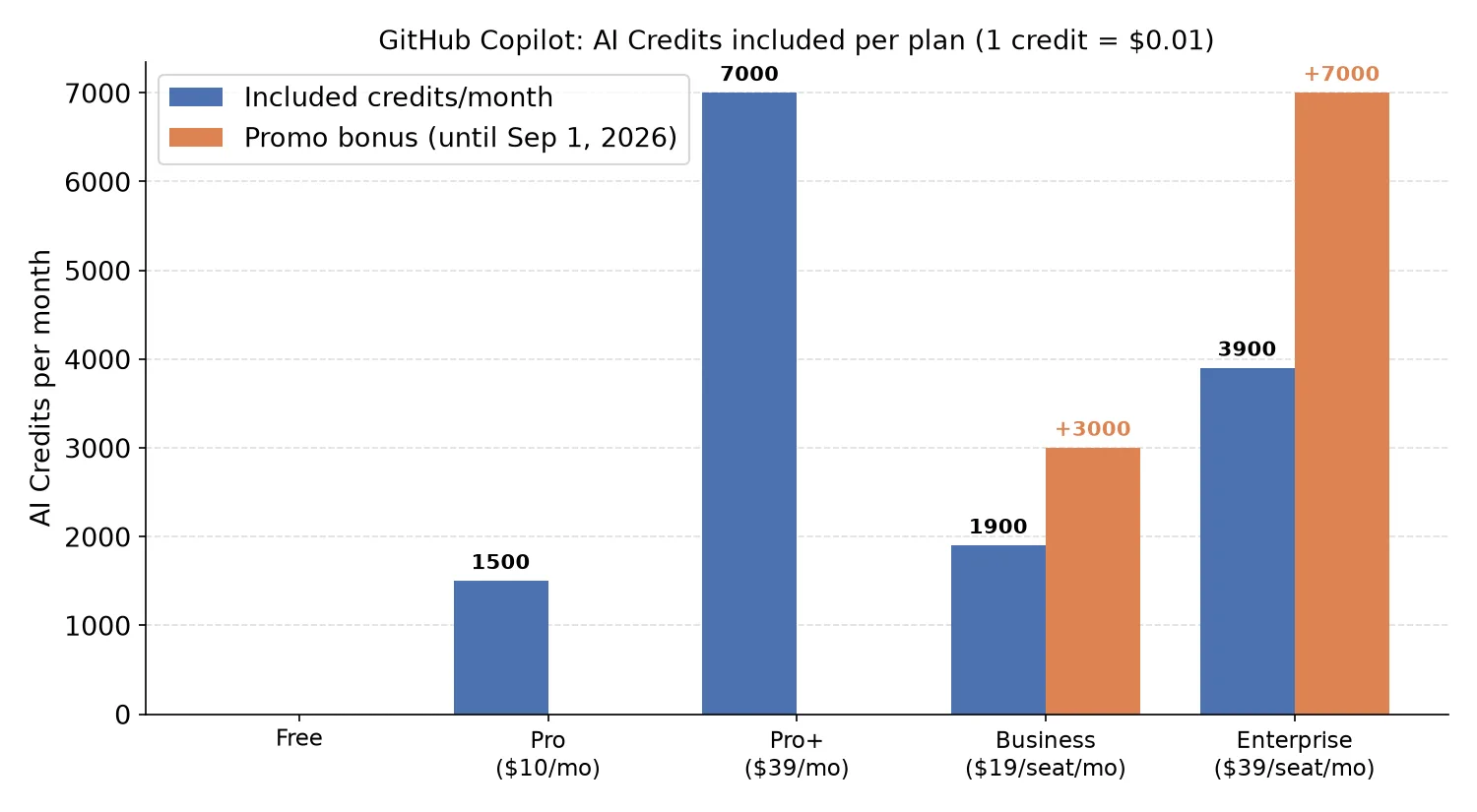
| Plan | Monthly price | Credits/month | Promo (until Sep 1) | Completions |
|---|---|---|---|---|
| Free | $0 | None (50 chat msgs cap) | — | 2,000/month |
| Pro | $10 | 1,500 | — | Unlimited |
| Pro+ | $39 | 7,000 | — | Unlimited |
| Business | $19/seat | 1,900/seat | 3,000/seat | Unlimited |
| Enterprise | $39/seat | 3,900/seat | 7,000/seat | Unlimited |
Credits are pooled at the organization level for Business and Enterprise. If one developer uses fewer than their seat’s share, that surplus is available to others in the same organization.
Unused credits do not carry over month to month. Going over your allowance costs $0.01 per additional credit.
What actually costs credits
Here’s what draws from your monthly pool:
- Copilot Chat (in the IDE, on GitHub.com, in the mobile app)
- Code review: Copilot reviews a PR or provides inline review suggestions
- Pull request summaries
- Agent mode (multi-step tasks, file edits across multiple files)
- Copilot Workspace tasks
- Ask Copilot on search results
Here’s what doesn’t:
- Inline code completions: the core feature, still unlimited
- Next Edit Suggestions: the multi-cursor prediction feature
- Copilot CLI completions
- Basic GitHub.com Copilot interactions that don’t involve large context processing
If your primary Copilot usage is inline completions while you code, you will not notice this billing change at all. The credits system matters most for teams that have adopted Copilot Chat heavily, use PR summaries in code review workflows, or are building on agent capabilities.
How to read your actual consumption
GitHub provides a usage dashboard at Settings > Billing > Copilot. The dashboard shows credit consumption per feature and per seat (for Business/Enterprise). Running this for a week before the promotional rates end on September 1 will give you the data you need to decide whether to upgrade or cap usage before that date.
For individual developers on Pro ($10/month, 1,500 credits), rough benchmarks help calibrate expectations:
- A quick chat question on a single function: 1-5 credits
- A medium chat session with file context: 10-30 credits
- A PR summary for a 200-line PR: 15-40 credits
- A code review pass on a mid-sized PR: 30-80 credits
- An agent mode task that edits multiple files: 50-200+ credits
At those rates, 1,500 credits covers everyday chat usage comfortably. It gets consumed faster if you run frequent code reviews or use agent mode regularly, which is the pull toward Pro+ for developers who have moved Copilot into the core of their review workflow.
Choosing the right plan
For individuals:
If you mostly use inline completions and occasional chat, Pro ($10/month, 1,500 credits) is enough. The completions are unlimited regardless of plan, and 1,500 credits covers moderate daily chat usage without problem.
If you use Copilot Chat heavily throughout the day, use agent mode to scaffold features, or generate PR summaries on everything you merge, the math starts to favor Pro+ ($39/month, 7,000 credits). The $29 premium pays for roughly 4.6x more premium feature usage.
For teams:
Business and Enterprise credits are pooled, so usage patterns vary less than individual plans. The promotional rates (3,000 credits/seat for Business through September 1), are generous, use the next two months to baseline your team’s actual consumption, then decide whether the standard 1,900 credits/seat is enough or whether you need to plan for overages.
The comparison to Cursor Pro ($20/month, 500 Claude requests) and Claude Code’s per-use billing depends heavily on workflow. For teams where the primary workflow is completion-heavy and interactive, Copilot’s unlimited completions plus a credit pool is often better value. For teams doing more long-form agentic tasks, the economics shift. The Cursor vs. Copilot comparison covers that tradeoff in more detail.
What to watch before September 1
The Business and Enterprise promotional credit boosts (3,000 and 7,000 per seat) expire September 1, 2026. Teams on Business will drop from 3,000 to 1,900 credits per seat. Teams on Enterprise will drop from 7,000 to 3,900.
Before that date:
- Pull your usage data from the billing dashboard to see where credits are going
- Identify which features drive most consumption (often code review or agent mode)
- Decide whether to adjust plan tiers, set per-seat caps, or shift usage patterns
GitHub lets Business and Enterprise admins set spending caps so overages don’t silently accumulate. Setting a cap now, before the promotional rates expire, gives you a clearer baseline of what normal usage actually costs.
The billing change is not a price increase for most developers, code completions are still unlimited, and the credit pool replaces PRUs without dramatically changing the effective cost for moderate users. But it does mean paying attention to which features you’re leaning on, and September 1 is the point where that attention pays off.
Frequently asked questions
- What is an AI Credit in GitHub Copilot?
- An AI Credit is GitHub's billing unit for Copilot's premium features. 1 credit equals $0.01. Credits are consumed when you use features like Copilot Chat, pull request summaries, code review, or agent mode — based on the amount of input and output processed and the model selected. Code completions and Next Edit Suggestions are not billed in credits and remain unlimited on paid plans.
- What happened to Premium Request Units (PRUs)?
- Premium Request Units were GitHub Copilot's previous billing unit. They were replaced by AI Credits on June 1, 2026. The concept is similar — both counted premium feature usage — but AI Credits are directly tied to token consumption and published API rates per model, making them more predictable. If you were on a plan with a PRU allowance, your plan was automatically migrated to the equivalent AI Credit allowance.
- Does GitHub Copilot Free still exist after this change?
- Yes. GitHub Copilot Free is still available and includes 2,000 code completions and 50 chat messages per month. Free users do not get an AI Credit pool — the 50 chat messages are a hard cap rather than credit-based billing. Free accounts cannot access code review, PR summaries, or agent features.
- Can I control which model Copilot uses to manage credit consumption?
- Yes. In Copilot Chat, you can switch between models — GPT-4o mini uses fewer credits than GPT-4o, which uses fewer than o3 or Claude Sonnet 4.6. For routine questions and code completions (which are free), the lighter models work fine. Save heavier models for complex architectural questions or long-context tasks where the quality difference is worth the credit cost.
- When do the promotional credit allowances end?
- Business and Enterprise plans received temporary promotional credit boosts starting June 1, 2026. Business plans got 3,000 credits per seat per month (vs. the normal 1,900), and Enterprise plans got 7,000 (vs. the normal 3,900). These promotional rates end September 1, 2026, after which plans revert to their standard credit allowances.
Sources
Sponsored
More from this category
More from AI Integration
Sponsored
Discussion
Join the conversation.
Comments are powered by GitHub Discussions. Sign in with your GitHub account to leave a comment.
Sponsored