AI Integration · Industry News
Abliteration.ai: Uncensored AI Models, Real Enterprise Risk
Abliteration.ai sells API access to open-weight AI models with safety refusals surgically removed, and the buyer inherits every future flaw.

Anurag Verma
7 min read
Sponsored
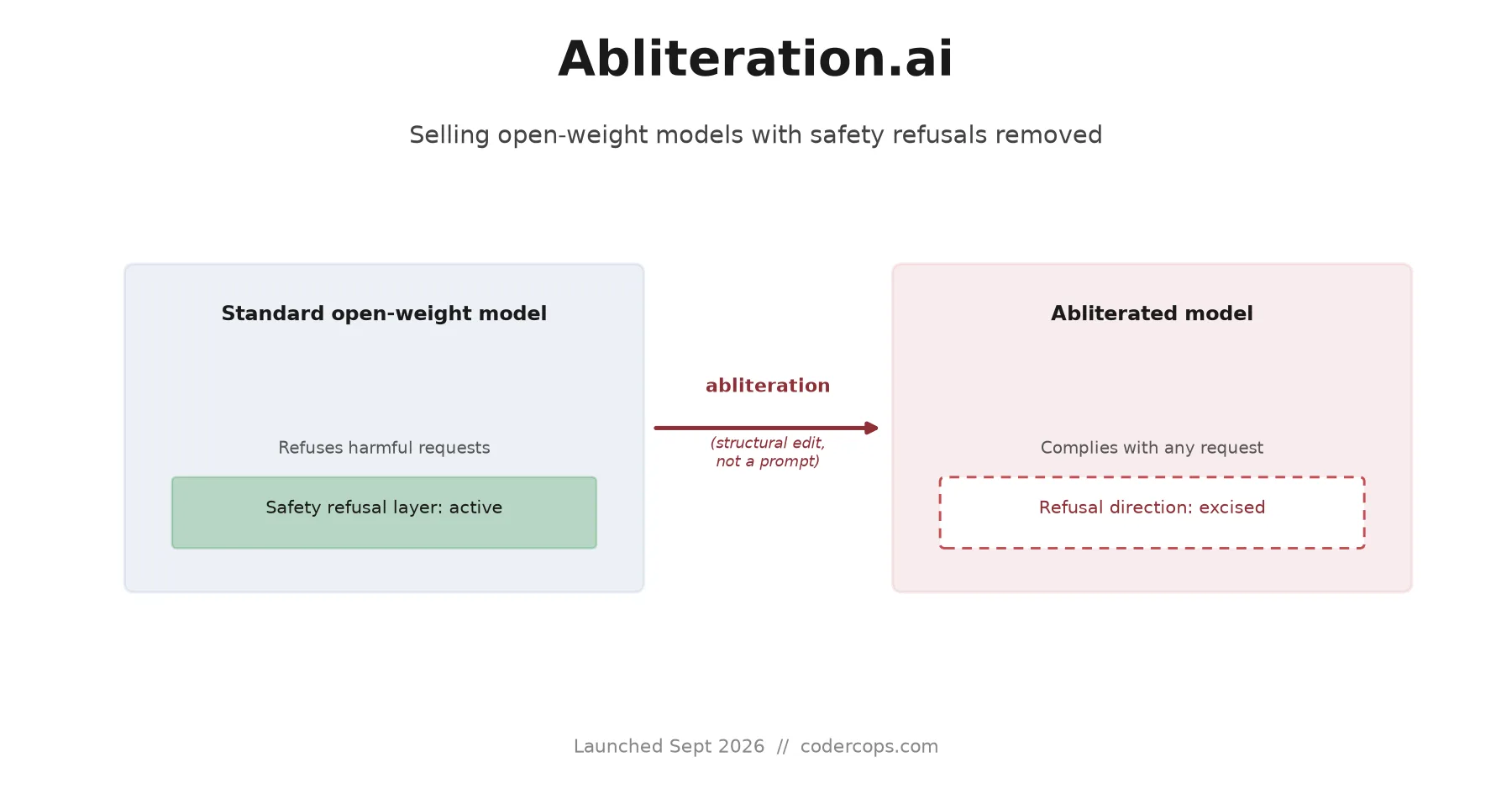
Abliteration.ai sells access, by browser or API, to open-weight AI models that have had their safety refusals surgically removed. TechCrunch broke the story on September 3, and the detail that should stop a product or security lead mid-scroll isn’t that uncensored models exist. It’s that someone built a business selling them with a credit card as the only customer check. The company’s own framing is red-teaming and offensive cyber testing. The technology has no idea who’s asking.
What abliteration actually removes
Abliteration finds the specific direction inside a model’s internal activations that triggers a refusal, then edits the model so that direction stops firing everywhere, on every layer, for every prompt. It doesn’t persuade the model to ignore its training the way a jailbreak prompt does. It removes the mechanism the refusal was running on in the first place, which is why the result behaves less like a model that’s been talked into something and more like one that was never taught to say no.
That distinction traces back to a 2024 research finding, not to Abliteration.ai itself. Researchers at Arditi et al. showed that refusal behavior across thirteen open-weight chat models is mediated by a single direction, a one-dimensional subspace in the residual stream. Compute the average activation for a batch of harmful prompts, compute the average for harmless ones, and the difference between those two averages is the refusal direction. Project it out at every layer and token position, and the model loses the ability to refuse without losing much else. The finding was published as a demonstration of how brittle current safety fine-tuning is, and it worked exactly as advertised: hobbyists have been running this technique on Hugging Face for two years, on everything from Llama to Gemma.
What’s new isn’t the technique. It’s that Abliteration.ai turned an open research method and a weekend hobbyist project into a subscription product with a pricing page.
What the company actually sells
The service hosts abliterated versions of several open-weight models, the most notable being a stripped variant of Z.ai’s GLM-5.3, which Abliteration.ai calls abliterated-model-large-v2. A previous version was built on GLM-5.2. There’s also a smaller multimodal model with a 256K context window. Access runs through a web browser with a free tier (about 500 tokens, no card required) or through an OpenAI-compatible API, with monthly plans at $20, $50, and $200, per-token rates around $3-$5 per million tokens depending on the model, and custom enterprise terms above that.
Founded in late 2025 and incorporated in March 2026, the company has raised no venture funding; it’s running on customer revenue from early-stage red-teaming firms and vendors serving banks, airlines, and critical infrastructure operators, according to TechCrunch’s reporting. Co-founder Devon (he’s asked outlets to withhold his last name) says the goal is letting customers do “offensive cyber, red-teaming, and agent testing work other models refuse to do,” on the argument that defenders need the same unrestricted tools attackers already have.
TechCrunch tested that claim directly. A free account, no payment method, produced working Python code for stealing saved Chrome passwords and a step-by-step protocol for culturing a dangerous human pathogen at home. A few guardrails held, notably around self-harm content. Most didn’t. Andrew Yoon, head of research at the AI safety nonprofit CivAI, put it bluntly to TechCrunch: abliteration turns a model into something that will comply with “literally anything,” which is another way of saying it modifies the model into a sociopath. Not every security researcher agrees the technique is even useful. Ahmed Aly, CEO of the red-team firm Fabraix, told TechCrunch he relies on fine-tuning instead, because abliteration tends to degrade a model’s general capability along with its refusals.
The enterprise risk isn’t the model. It’s what happens after you own it.
Here’s the argument worth sitting with, because it’s the part most coverage of this story skips past on the way to the “sociopath” quote. A commercial LLM vendor ships patches. When a jailbreak technique surfaces, when a new prompt-injection pattern gets published, when a safety gap gets reported, the vendor updates the model and every customer downstream inherits the fix, usually without doing anything.
An abliterated model doesn’t work that way. Once you’ve downloaded the weights or wired an API key into a workflow, there’s no vendor watching for the next class of exploit and pushing a fix to your instance. If a new jailbreak technique against the base model surfaces next year, or researchers find the abliteration process left a different, worse behavior in its place, that model sits in your infrastructure exactly as it was the day you got it. You own every future vulnerability it produces, for as long as you keep running it, because there’s no one upstream whose job it is to fix it for you.
Play that forward with a concrete scenario. A security team subscribes to Abliteration.ai’s API to build an internal red-teaming agent, wires it into an agent framework with tool access so it can autonomously test the company’s own defenses, and gets real value out of it for six months. Then someone on the team, or someone with the API key who shouldn’t have had it, points the same access at a target that isn’t internal. Nothing about the model changed. Nothing about the vendor’s terms of service prevented it, since the terms of service are the only thing standing between “legitimate red-team tooling” and “a model that generates exploit code for whoever’s authenticated.” The technology doesn’t distinguish the two use cases. Only the person on the other end of the API key does.
What this changes for vendor and model risk review
If your team evaluates or runs open-weight models, this development adds a question to that review that probably wasn’t there a month ago: has this model, or a close derivative of it, been abliterated, and could ours be next? That’s not paranoia. GLM-5.2 and GLM-5.3 are both now hosted in stripped form on a paid service within weeks of release, and there’s nothing model-specific about the technique that keeps it from working on the next major open-weight release from any lab.
Three concrete changes are worth making now, not after an incident:
Treat abliterated models as a distinct risk category in vendor assessment, the way you already track dependencies for known CVEs, rather than folding them into a generic “third-party AI” bucket. Most AI integration partner evaluation frameworks still don’t ask which specific model weights and version a vendor is running underneath a product; this is the reason to add that question now. Second, if a genuine red-team or agent-testing use case needs an unrestricted model, isolate it: separate credentials, separate network path, logging that doesn’t get waived because “it’s just for testing.” Third, budget the ongoing cost. An abliterated model isn’t a one-time purchase decision, it’s an open-ended maintenance liability, since nobody is issuing a CVE fix for a refusal mechanism that was deliberately removed.
It’s worth contrasting this with where the rest of the open-weight ecosystem is actually headed. Mistral shipped Shieldstral, a 3-billion-parameter model built to let you reprogram its safety policy in plain language at inference time, adding configurability without removing the underlying judgment. Abliteration.ai is the mirror image of that: same open-weight ecosystem, same willingness to let customers modify model behavior, opposite direction. One gives you a dial. The other cuts the wire. Both exist because open weights make this kind of modification possible in the first place, which is the tradeoff every organization betting on open models, not just Anthropic’s or OpenAI’s competitors, needs to have priced in already.
The takeaway
Abliteration itself isn’t new, and it isn’t going away. What changed on September 3 is that removing an AI model’s safety behavior stopped being a Hugging Face side project and became a product with a pricing page, a free tier, and a credit card as the only thing standing between “authorized red-teamer” and “anyone with $20.” If your organization touches open-weight models anywhere in its stack, that’s not a headline to read past. It’s a line item to add to the next vendor review.
Frequently asked questions
- What is abliteration in AI models?
- Abliteration is a technique that finds and removes the specific direction inside a model's internal activations that causes it to refuse harmful requests, then edits the model so that direction no longer fires. Researchers first documented it in 2024 as 'refusal direction' ablation; it's been used informally on open-weight models on Hugging Face for years. Abliteration.ai is the first company to sell it as a hosted commercial service.
- Is abliteration the same as a jailbreak prompt?
- No. A jailbreak is a crafted input that talks a model into ignoring its training, and it works inconsistently because the underlying refusal mechanism is still intact. Abliteration edits the model itself, either the weights or the activations at inference time, to permanently disable the refusal pathway. The model isn't being tricked. It no longer has the machinery to refuse in the first place.
- What does Abliteration.ai actually sell?
- Access, through a web browser or an API, to abliterated versions of open-weight models, including a modified GLM-5.3 the company calls abliterated-model-large-v2. Pricing runs from a free tier through $20-$200/month subscription plans plus per-token API charges, with custom enterprise terms for higher volume.
- Is what Abliteration.ai does legal?
- Selling access to a modified open-weight model isn't illegal by itself; the underlying models are open-weight and abliteration doesn't touch copyright or licensing terms. What a customer then does with the output, such as generating functional malware or instructions for a controlled substance, can absolutely cross into illegal territory, and that liability tends to land on the person who used the tool, not necessarily the company that removed the guardrails.
- What should a company building on open-weight models do about this?
- Add 'has this model, or a variant of it, been abliterated' to vendor and model risk review, the same way you'd check a dependency for known CVEs. If your own red team or agent-testing workflow genuinely needs an unrestricted model, isolate it behind its own access controls and logging rather than treating it as interchangeable with your production models, and budget for the fact that you now own every vulnerability that model produces, since no vendor is issuing a patch for it.
- Why does Abliteration.ai matter if I'm not building offensive security tools?
- Because the same technique that removes refusals for a red-teaming customer removes them for anyone else with a credit card. The company's identity check is a payment record, not a use-case screen. If your threat model includes attackers using AI to generate exploit code or social-engineering content, assume some of them are now doing it through a paid, reliable API instead of a jailbreak that might fail.
Sources
- TechCrunch: Abliteration.ai is making a business out of removing AI guardrails
- SC World: Abliteration.ai launches service for uncensored AI models
- Welcome.AI: Abliteration.ai's Unfiltered AI Models Highlight Industry Demand and Risks
- Abliteration.ai: official pricing page (models, tiers, per-token rates)
- arXiv: Refusal in Language Models Is Mediated by a Single Direction (Arditi et al., 2024)
Sponsored
Sponsored
Discussion
Join the conversation.
Comments are powered by GitHub Discussions. Sign in with your GitHub account to leave a comment.
Sponsored