AI Integration · Model Releases
Muse Spark 1.3: Same Price, 20% Fewer Tool Calls
Muse Spark 1.3 needs fewer tool calls and tokens than 1.2 to finish the same engineering work, at unchanged pricing. What actually changed, and what didn't.

Shashikant Gupta
5 min read
Sponsored
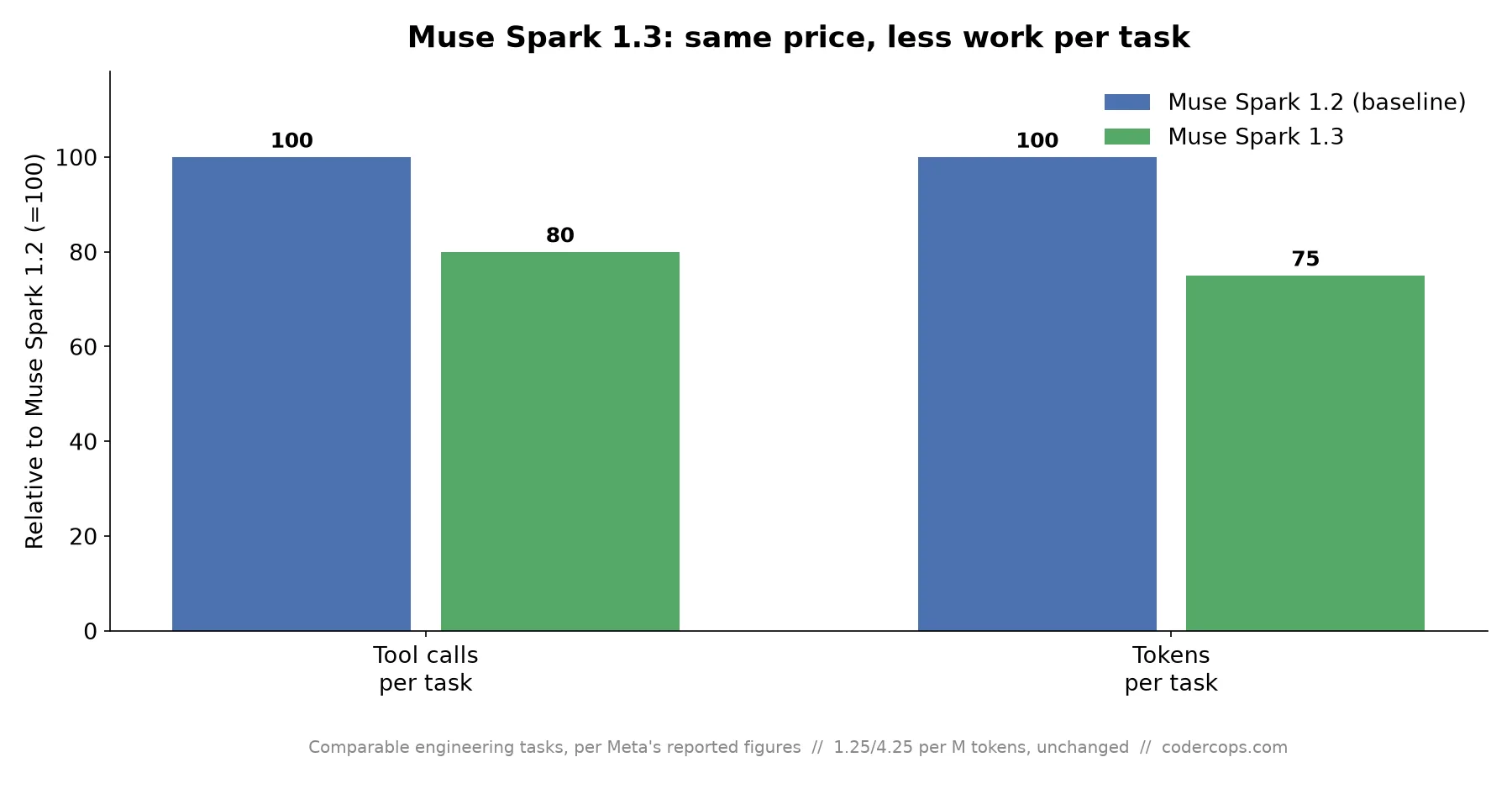
Meta shipped Muse Spark 1.3 on September 2, and the headline number isn’t a bigger context window or a new capability, it’s less work to do the same job. Meta’s own numbers put it at roughly 20% fewer tool calls and about 25% fewer tokens than Muse Spark 1.2’s predecessor line to finish comparable engineering tasks, at the same $1.25/$4.25 per-million-token pricing that’s been standing since 1.1 launched in July.
What “fewer tool calls” actually buys you
Tool-call count is an underrated metric in agentic model comparisons, because most benchmark tables lead with accuracy and leave efficiency as a footnote. But in a metered, per-token pricing model, tool-call count and token count are cost, directly. A model that gets to the same correct answer in fewer turns, with less back-and-forth clarification and fewer redundant tool invocations, costs less to run the exact same workload, independent of whether its raw accuracy moved at all.
Meta’s framing for 1.3 leans into exactly this: less verbose, fewer turns where they aren’t needed, a cleaner overall coding style. That’s a different kind of improvement than “smarter,” and arguably a more useful one for teams already running Muse Spark in production, where the bill scales with how chatty the model is, not with how impressive any single response looks in a demo.
The benchmark numbers, and what they don’t tell you
Meta reports near-perfect long-context retrieval, 98.5 and 98.1 on its internal benchmarks, and says 1.3 wins every coding row against 1.2 on Meta’s own scorecard. Both are real, specific numbers, and both come from Meta’s own evaluation, which is worth flagging plainly rather than skipping past. Vendor-reported benchmarks measure what the vendor chose to measure, on tasks the vendor chose to include. That doesn’t make them false, it makes them a starting point rather than a conclusion.
The efficiency claim, fewer tool calls and tokens for comparable tasks, is easier to independently sanity-check than an abstract accuracy score, because it’s directly observable in your own usage logs the moment you switch a workload from 1.2 to 1.3. If your team already runs Muse Spark in an agentic pipeline, that’s a genuinely fast, cheap experiment: point the same prompt set at both versions and compare the actual tool-call and token counts your own logging captures, rather than trusting Meta’s scorecard on faith or dismissing it on principle.
What didn’t change
The context window is still 1,048,576 tokens, max output still 943,718 tokens, pricing still $1.25 per million input and $4.25 per million output tokens. None of the numbers that would signal “bigger model” or “new pricing tier” moved. That’s a meaningful choice on Meta’s part: this is presented as a behavior and efficiency release layered on the same underlying scale, not a generational jump. Teams that were waiting for Muse Spark to get materially bigger or cheaper before evaluating it seriously should keep waiting; teams already running it in production get a version that reportedly does the same job for less, at the price they were already paying.
Safety got explicit attention too. Meta says 1.3 has improved resistance to adversarial inputs and prompt injection, plus a better ability to judge which operations are irreversible in complex agent tasks before taking them. That last point matters more than it might read at first glance: an agentic model that can distinguish “this action can be undone” from “this action deletes something permanently” is exactly the judgment call that turns a minor agent mistake into either an easy rollback or a real incident. Whether that improvement holds up under adversarial red-teaming from outside Meta is, like the coding benchmarks, something to watch for rather than take as settled.
Max reasoning: announced, not shipped
Meta also announced a max reasoning mode alongside 1.3, aimed at the hardest agentic and reasoning tasks, similar in intent to the high-effort or extended-thinking modes other labs have added to their flagship models this year. It wasn’t available at launch. Meta’s stated reason is additional safety testing before release, which is a reasonable thing to wait on given what a higher-effort reasoning mode typically unlocks in terms of autonomous multi-step action. If your evaluation plan for Muse Spark specifically depends on that mode, there’s nothing to test yet; the base 1.3 release is what’s actually available today.
The practical call
If Muse Spark is already in your stack, this is a low-friction version bump worth benchmarking rather than skipping: same price, and Meta’s numbers suggest a lower effective cost per completed task if the efficiency gains hold on your own workload. Run your real prompts against both versions before flipping production traffic, the same standing-evaluation-harness discipline that applies to every new model release worth taking seriously, rather than migrating on the strength of a vendor blog post alone. If Muse Spark isn’t in your stack yet, the access question, still US-only with a waitlist as of 1.1’s launch, is the thing to resolve before point-version comparisons matter at all. Teams evaluating which agentic model actually fits their codebase’s conventions, rather than which one wins the most benchmark rows, is exactly the kind of decision our team helps clients work through before they commit a production workload to one.
Frequently asked questions
- What's actually new in Muse Spark 1.3?
- Efficiency and safety, mainly. Meta reports it needs about 20% fewer tool calls and 25% fewer tokens than Muse Spark 1.2 to complete comparable engineering tasks, meaning less verbose, fewer unnecessary turns, and a cleaner overall coding style. It also posts near-perfect long-context retrieval scores (98.5 and 98.1 on Meta's internal benchmarks) and wins every coding row on Meta's own scorecard against its predecessor.
- Did the price change from Muse Spark 1.1 or 1.2?
- No. It's still $1.25 per million input tokens and $4.25 per million output tokens, the same pricing that shipped with 1.2 and that we covered when 1.1 launched in July. The efficiency gains matter precisely because the price didn't move: fewer tool calls and tokens at the same per-token rate means a lower total cost to finish the same task, not just a faster one.
- Is the context window bigger in 1.3?
- No, it's unchanged at 1,048,576 tokens input and 943,718 tokens maximum output, the same limits 1.1 and 1.2 shipped with. This release is about how efficiently the model uses its existing context and tool budget, not about extending either.
- What is max reasoning mode, and can I use it yet?
- It's a higher-effort reasoning mode Meta announced alongside 1.3 for harder agentic and reasoning tasks, similar in spirit to the extended-thinking or high-effort modes other labs have shipped. As of the 1.3 launch, it wasn't yet available, Meta said it was pending additional safety testing, so treat it as announced-but-not-shipped until Meta confirms availability.
- Should I migrate from 1.2 to 1.3 right away?
- If you're already spending real production budget on Muse Spark, yes, evaluate it: same price, reported efficiency gains, and improved adversarial-input resistance are a low-risk upgrade to test against your own prompts. If you're still on 1.1 and haven't adopted Muse Spark in production at all, the access constraints (US-only, waitlisted) that applied at 1.1's launch are the more relevant question to resolve first, not which point version to target once you're in.
Sources
Sponsored
More from this category
More from AI Integration
Sponsored
Discussion
Join the conversation.
Comments are powered by GitHub Discussions. Sign in with your GitHub account to leave a comment.
Sponsored