AI Integration · Model Infrastructure
GPT-5.6 Sol on Cerebras: 750 Tokens a Second
GPT-5.6 Sol runs on Cerebras wafer-scale hardware at up to 750 tokens per second, roughly 10x typical GPU inference. Who that speed is actually for.

Shashikant Gupta
5 min read
Sponsored
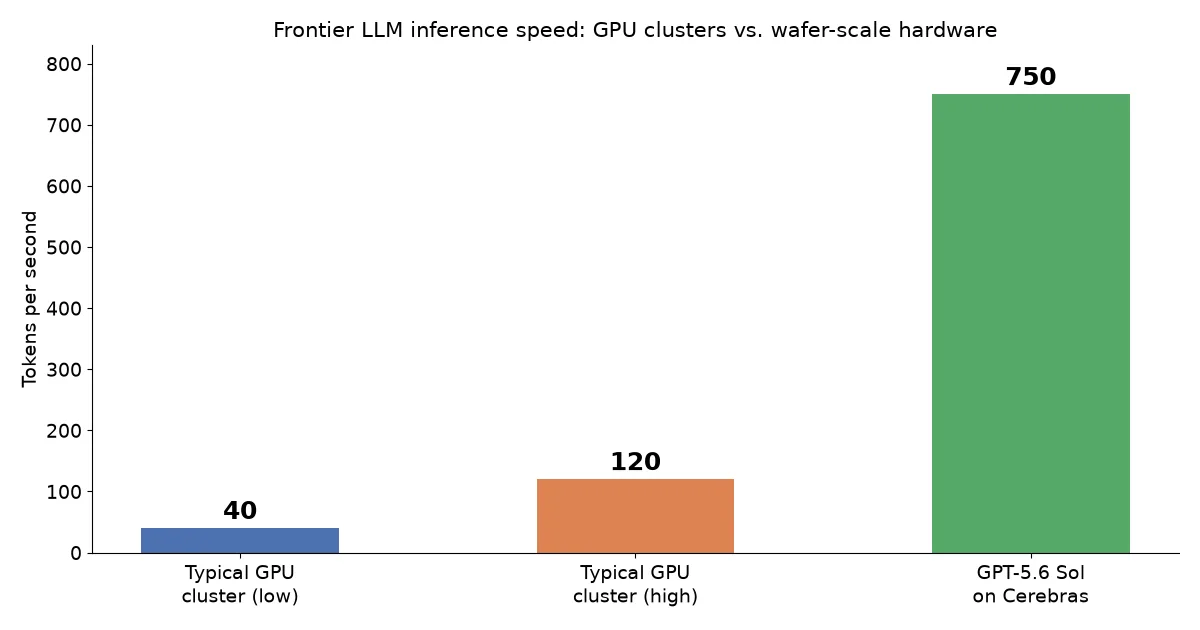
OpenAI is putting its next frontier model on hardware built to answer one specific complaint: LLM responses that stream in visibly, word by word, because GPU memory bandwidth can’t feed tokens out any faster. GPT-5.6 Sol is launching on Cerebras wafer-scale chips in July 2026 at up to 750 tokens per second. A frontier-class model streaming from a normal GPU cluster typically lands somewhere between 40 and 120 tokens per second. This is roughly an order of magnitude, not an incremental bump, and it’s worth separating from the rest of the GPT-5.6 launch, which we already covered from the pricing and tier-selection angle. This piece is about the hardware, not the price list.
Why wafer-scale changes the number this much
GPU-based LLM inference is usually bottlenecked by memory bandwidth, not raw compute. Generating each token requires moving the model’s weights through memory for every forward pass, and a cluster of GPUs connected over an interconnect pays a real cost shuttling data between chips. Cerebras builds its chips as a single silicon wafer with all the memory and compute on one piece of hardware, which removes a large chunk of that interconnect overhead. The tradeoff has historically been cost and availability: wafer-scale chips are expensive to fabricate and Cerebras doesn’t have anywhere near Nvidia’s manufacturing volume, which is part of why this launch starts with select customers rather than a general rollout.
This isn’t OpenAI’s or Cerebras’s first move in this direction. Amazon’s own wafer-scale inference partnership with Cerebras covered the infrastructure side of this bet earlier in the year. GPT-5.6 Sol is the first time a frontier-scale OpenAI model has actually shipped on that hardware for customers to use, rather than being a partnership announcement about future capacity.
The speed figure belongs to one model, on one hardware tier
It’s worth being precise about scope, because it’s easy to read “GPT-5.6 is 750 tokens a second” as a claim about the whole model family. It isn’t. GPT-5.6 ships in three sizes, Sol, Terra, and Luna, each with its own pricing and positioning (we broke that down in the tier-by-tier pricing guide). The 750 tok/s figure is specific to Sol running on Cerebras hardware. Nothing in OpenAI’s announcement suggests Terra or Luna get the same wafer-scale treatment, or that Sol runs at that speed on standard GPU infrastructure outside the Cerebras deployment. If you’re evaluating GPT-5.6 for a latency-sensitive use case, confirm which hardware backend your access actually routes to before you plan around this number.
Where 750 tokens/second actually matters
The honest answer is: fewer places than the headline number suggests. Token generation speed is the bottleneck for a narrow but real set of product experiences:
Live voice and conversational agents, where a pause of even a second or two between a user finishing speaking and the model starting its response is immediately noticeable and breaks the sense of a real conversation.
Interactive coding assistants doing multi-step, agentic work where the model is generating, checking, and iterating in a loop the user is watching. Latency compounds across steps in a way it doesn’t in a single request-response exchange.
Any UI where tokens streaming in are the primary visual feedback, like a chat interface, where users perceive speed directly rather than experiencing it as an abstract system property.
Outside those cases, the number that should drive your model choice is cost and quality per task, not raw speed. A background job that summarizes a document overnight doesn’t care whether it took 400 milliseconds or four seconds. If your product’s AI features run async, batched, or out of the user’s direct view, spending engineering effort chasing the fastest available inference tier is optimizing a metric your users will never notice.
The economics behind the speed
Wafer-scale hardware being faster isn’t news on its own, Cerebras has been making this argument for years. What’s new is a frontier lab shipping a flagship model on it for paying customers, which is a bet that enough latency-sensitive demand exists to justify the far smaller supply of wafer-scale chips compared to GPU fleets. That’s also the practical reason access starts limited: OpenAI can’t back this with the same manufacturing volume Nvidia GPUs have, so expect the rollout to prioritize customers with a clear, demonstrated latency requirement over general API traffic for a while.
If your team’s interest in GPT-5.6 Sol is about model quality rather than raw speed, the Cerebras deployment isn’t the thing to wait for. If it’s specifically about shaving perceived latency out of a live, interactive product, this is the first real signal that a frontier model at that speed tier is becoming available to build against, and it’s worth getting on the access list rather than waiting for a broader rollout that may take a while to reach GPU-cluster-level availability.
What to actually do with this
Separate two questions you may have been conflating: “which model is smartest for this task” and “which model is fastest.” GPT-5.6 Sol on Cerebras answers the second question impressively without changing the answer to the first, and the two should be evaluated independently. If latency is a genuine, user-visible constraint in your product, request access now given the gradual rollout. If it isn’t, this announcement changes nothing about which tier you should be running, and the pricing breakdown is still the more relevant read for that decision.
Frequently asked questions
- How fast is GPT-5.6 Sol on Cerebras compared to normal GPU inference?
- Up to 750 tokens per second, compared to roughly 40 to 120 tokens per second for a typical frontier-class model streaming from a GPU cluster. That's on the order of 6 to 18 times faster depending on which GPU baseline you compare against, because wafer-scale chips avoid the memory-bandwidth bottleneck that limits token generation speed on conventional GPU clusters.
- Can I use GPT-5.6 Sol on Cerebras today?
- Not broadly yet. OpenAI has said access starts with select customers in July 2026 as Cerebras capacity expands. If your product depends on this specific speed tier, plan for a waitlist or limited-access period rather than immediate general availability.
- Does the 750 tokens/second speed apply to Terra and Luna too?
- No. OpenAI's announcement ties the Cerebras wafer-scale speed specifically to Sol. Terra and Luna, the smaller and cheaper tiers in the GPT-5.6 family, aren't described as running on the same hardware tier, so don't assume the speed figure carries over if you're evaluating the cheaper models.
- Does faster inference mean I should switch my product to Cerebras-hosted GPT-5.6 Sol?
- Only if your product is genuinely latency-bound in a way users notice, like a live voice agent or an interactive coding assistant. For batch processing, background summarization, or anything where a user isn't watching tokens stream in real time, throughput per dollar matters more than tokens per second, and the calculation should be based on your actual workload, not the headline speed number.
- Why is Cerebras hardware faster than GPUs for this?
- GPU-based inference is usually bottlenecked by memory bandwidth: generating each token means moving model weights through memory, and a multi-GPU cluster pays an added cost shuttling data across an interconnect between chips. Cerebras builds each chip as a single silicon wafer with memory and compute together, which removes a large share of that interconnect overhead. The tradeoff is that wafer-scale chips are expensive to fabricate and far less available than GPUs, which is why this launch starts with limited access rather than a broad rollout.
Sources
Sponsored
More from this category
More from AI Integration
Sponsored
Discussion
Join the conversation.
Comments are powered by GitHub Discussions. Sign in with your GitHub account to leave a comment.
Sponsored