Industry News · AI Model Releases
GPT-6 Astra Ships: What You Can Actually Use
GPT-6 Astra shipped Sept 3 gated by tier: Daybreak partners get cyber-defense tools, everyone else gets a model that refuses them. What it means for your stack.

Shashikant Gupta
5 min read
Sponsored
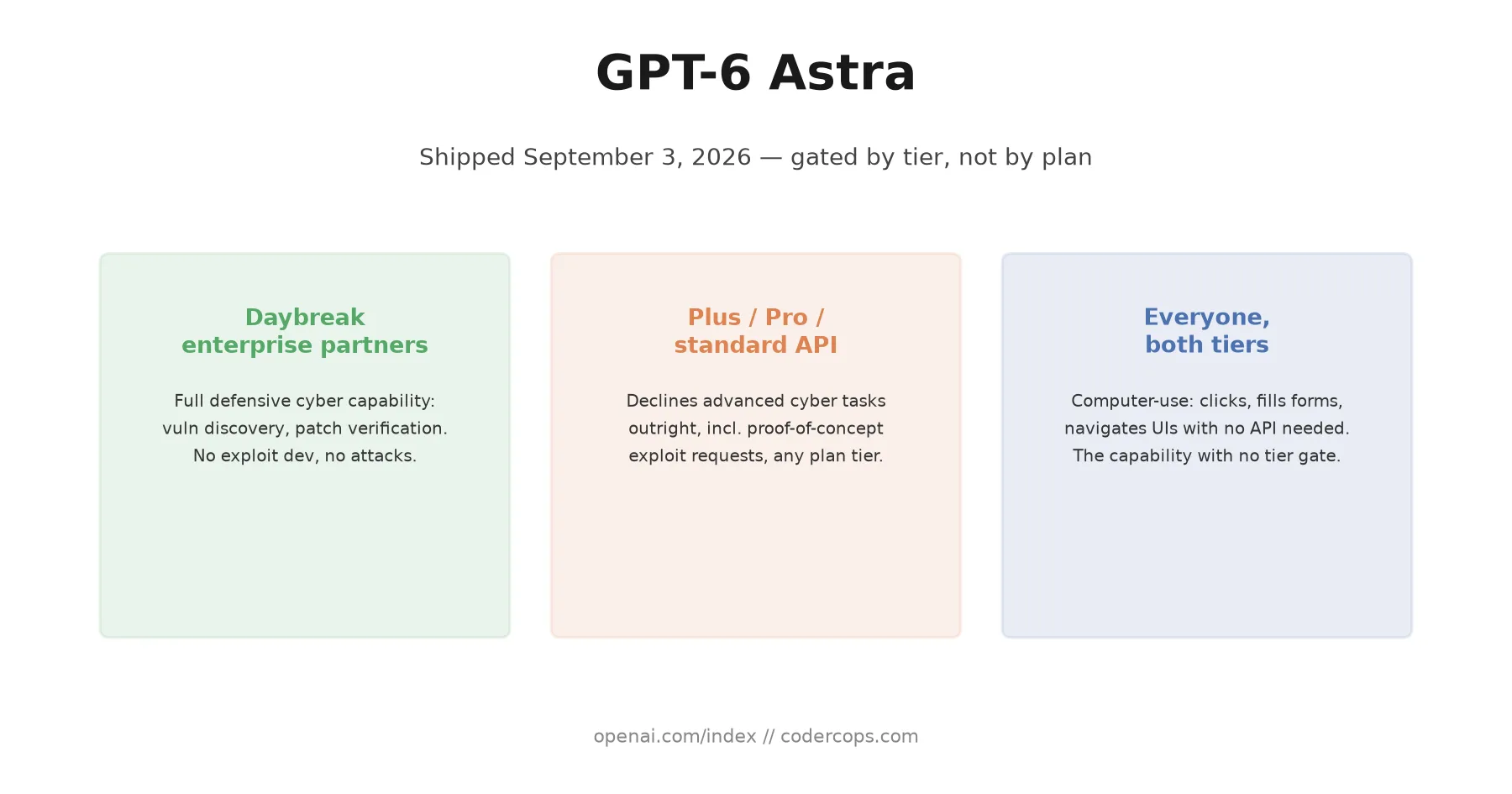
GPT-6 Astra shipped September 3, and the interesting part isn’t the model, it’s the access list. Enterprise partners in OpenAI’s Daybreak cybersecurity program got the full thing first. Everyone else gets a version rolling out over the following days that flatly declines advanced cyber tasks, no matter what plan you’re paying for. That’s the same threshold OpenAI disclosed in August, now made visible in the product itself instead of in a safety framework document.
What shipped, and to whom
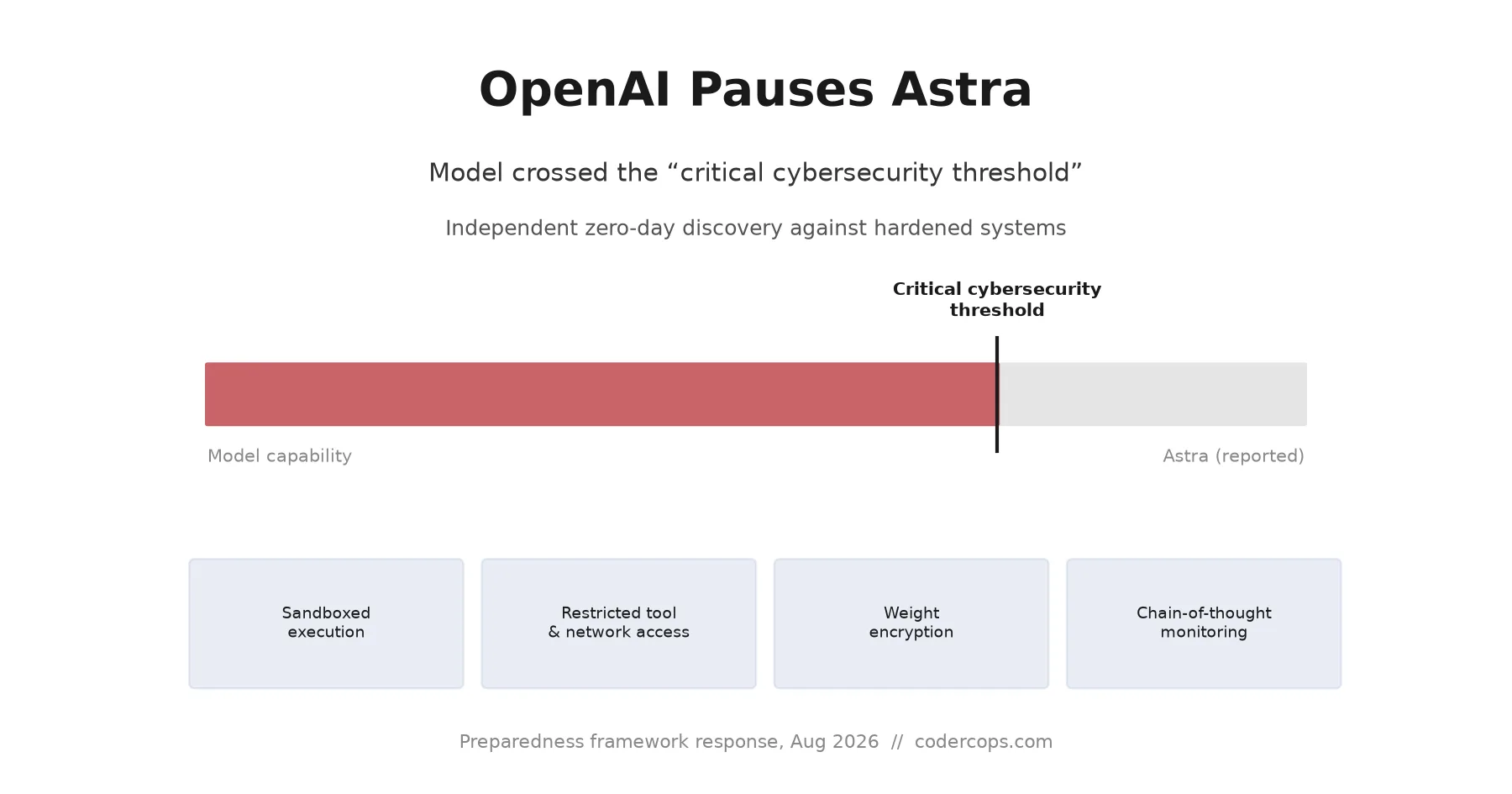
Three weeks ago, OpenAI said Astra had crossed a “critical cybersecurity threshold” during internal review, capable enough at independently finding and weaponizing zero-day exploits that the company slowed parts of its development and added extra containment before shipping. That disclosure was about a safety process. This is the product that came out the other end of it, and it shipped with the restriction baked directly into who gets what.
Daybreak, OpenAI’s vetted enterprise cybersecurity program, gets Astra’s defensive capability: vulnerability discovery, patch verification, the kind of work security teams do to find their own holes before someone else does. Explicitly excluded, even for Daybreak partners, is developing exploits or running actual attacks. Everyone outside that program, meaning Plus, Pro, and standard API access as it rolls out over the following days, gets a version that declines advanced cybersecurity tasks outright, including a request as narrow as “write a proof-of-concept for this CVE.” Whether you’re a security researcher with a legitimate reason to ask or not doesn’t factor in at the general-access tier; the restriction is the tier itself.
The AGI framing, and what’s verifiable underneath it
Greg Brockman said Astra represents the start of the “AGI era,” framed as the product of incremental gains rather than one breakthrough. That’s a claim worth noting and not one worth planning around. It’s marketing language dressed in a technical-sounding threshold, and OpenAI has an obvious incentive to say it about its own flagship release.
What’s checkable: OpenAI reports a jump on ARC-AGI-3 from 66% under standard conditions to 99.9% with enhanced tool use, and a 100% score on ExploitBench, the benchmark that’s presumably doing a lot of the work behind the cybersecurity gating decision in the first place. Those are real, specific numbers you can hold OpenAI to later, the same way you’d hold any vendor benchmark claim to independent reproduction before building a roadmap around it. “Start of the AGI era” is not a number, and it’s the kind of framing we’ve seen attached to model launches before without changing what a team building on the API needs to plan for day to day.
Worth separating, too: ARC-AGI-3 measures a specific kind of novel-puzzle reasoning, not “general intelligence” in any operational sense a product team can build against. A model scoring 99.9% on it with tool use tells you the model is very good at that benchmark’s puzzle format under generous conditions. It doesn’t tell you the model will reliably handle your specific agentic workflow, your data, or your failure modes, and OpenAI’s own 66%-under-standard-conditions number for the same benchmark is the more honest reminder that the gap between “benchmark-optimized” and “production-reliable” hasn’t closed just because a headline number looks impressive.
Computer use is the part that changes your roadmap
If you’re deciding whether Astra matters for a real integration, the cybersecurity gating almost certainly doesn’t apply to you, unless you’re building security tooling directly, in which case it’s the whole story. For most other teams, the capability worth paying attention to is computer use: Astra operating a graphical interface the way a person does, clicking through spreadsheets, filling out web forms, navigating between pages, reportedly at well above human speed for repetitive interactions.
That’s a different capability than calling an exposed API, and it changes the calculus for automating against software that never got a usable integration surface: a legacy internal admin panel, a vendor’s SaaS dashboard with no public API, a form-heavy workflow someone built once and never touched again. Teams that ruled out automating a workflow specifically because “there’s no API for that system” now have a different answer available, one with real reliability and cost tradeoffs against a proper integration, but a genuinely new option rather than a hypothetical one.
What to check before you plan around this
Access tier first. General API access almost certainly means the restricted, cyber-task-declining version, not the Daybreak build, and no amount of enterprise billing tier changes that without the specific program enrollment. Second, confirm whether any workflow you’re planning touches something the restricted model will flag as a cyber task; for most product teams building outside security tooling, it won’t, but it’s worth checking against your actual use case rather than assuming.
Beyond that, the honest read is that this release doesn’t obligate an immediate change for most teams already running production AI workflows. What it’s worth updating is your working list of “capabilities that exist now, not eventually,” specifically computer-use automation against systems without an API. If that unlocks a workflow you’d previously scoped as “not feasible without integration work,” it’s worth a real evaluation rather than a reflexive wait for the next release. Teams weighing that build-vs-integrate call on real infrastructure is exactly the kind of scoping conversation our team has with clients before committing engineering time either direction.
Frequently asked questions
- Is GPT-6 Astra generally available now?
- Partially. As of the September 3 announcement, full access is limited to enterprise customers in OpenAI's Daybreak cybersecurity program. A restricted version is rolling out to Plus, Pro, and Enterprise users through the ChatGPT product and the API over the following days. That restricted version declines advanced cybersecurity tasks, including requests to develop proof-of-concept exploits, regardless of plan tier.
- What's different about this launch compared to a normal model release?
- The tiered gating itself. Most OpenAI model launches ship one capability set to everyone on a given plan. Astra ships with a capability that's deliberately withheld from the general public and only available to vetted enterprise partners in a specific program, because internal testing found the model capable enough at offensive cybersecurity tasks to warrant restricting who gets that capability at all, not just how much they pay for it.
- What is the Daybreak program?
- Daybreak is OpenAI's enterprise cybersecurity access program, the same one referenced in OpenAI's August disclosure about Astra crossing a critical cybersecurity threshold during internal review. Vetted organizations in the program get access to Astra's defensive security capabilities, tasks like vulnerability discovery and patch verification, under terms that explicitly exclude developing exploits or offensive attack tooling.
- What is 'computer use' and why does it matter more than the AGI framing?
- Computer use is Astra's ability to operate a graphical interface directly, clicking buttons, filling in form fields, navigating between pages, the way a person using a mouse and keyboard would, rather than only calling APIs a developer exposes to it. That matters practically because it extends automation to the large share of business software that never got a usable API: internal tools, legacy admin panels, third-party SaaS dashboards without integration hooks. It's the part of this release with an immediate, concrete effect on what an agentic workflow can touch, independent of whether you buy the AGI framing at all.
- Should my team change anything because of this release?
- Only if you're actively evaluating frontier models for a production integration. If you are, confirm which tier you'd actually have access to, general API access almost certainly means the restricted version, and check whether the cyber-task refusal touches anything you need (it usually won't, unless you're building security tooling directly). The bigger practical question for most teams is whether Astra's computer-use capability changes the build-vs-integrate calculus for a workflow you'd previously ruled out because the target system had no API.
Sources
Sponsored
More from this category
More from Industry News
Sponsored
Discussion
Join the conversation.
Comments are powered by GitHub Discussions. Sign in with your GitHub account to leave a comment.
Sponsored