Industry News · AI Coding Agents
Cognition's $40B Devin Round: What It Actually Signals for Buyers
Cognition is reportedly in talks to raise at a $40 billion valuation, up from $26 billion three months ago, on revenue nowhere near that multiple. Here's what the round says about where AI coding agent money is going, and what it means if you're evaluating one.

Anurag Verma
5 min read
Sponsored
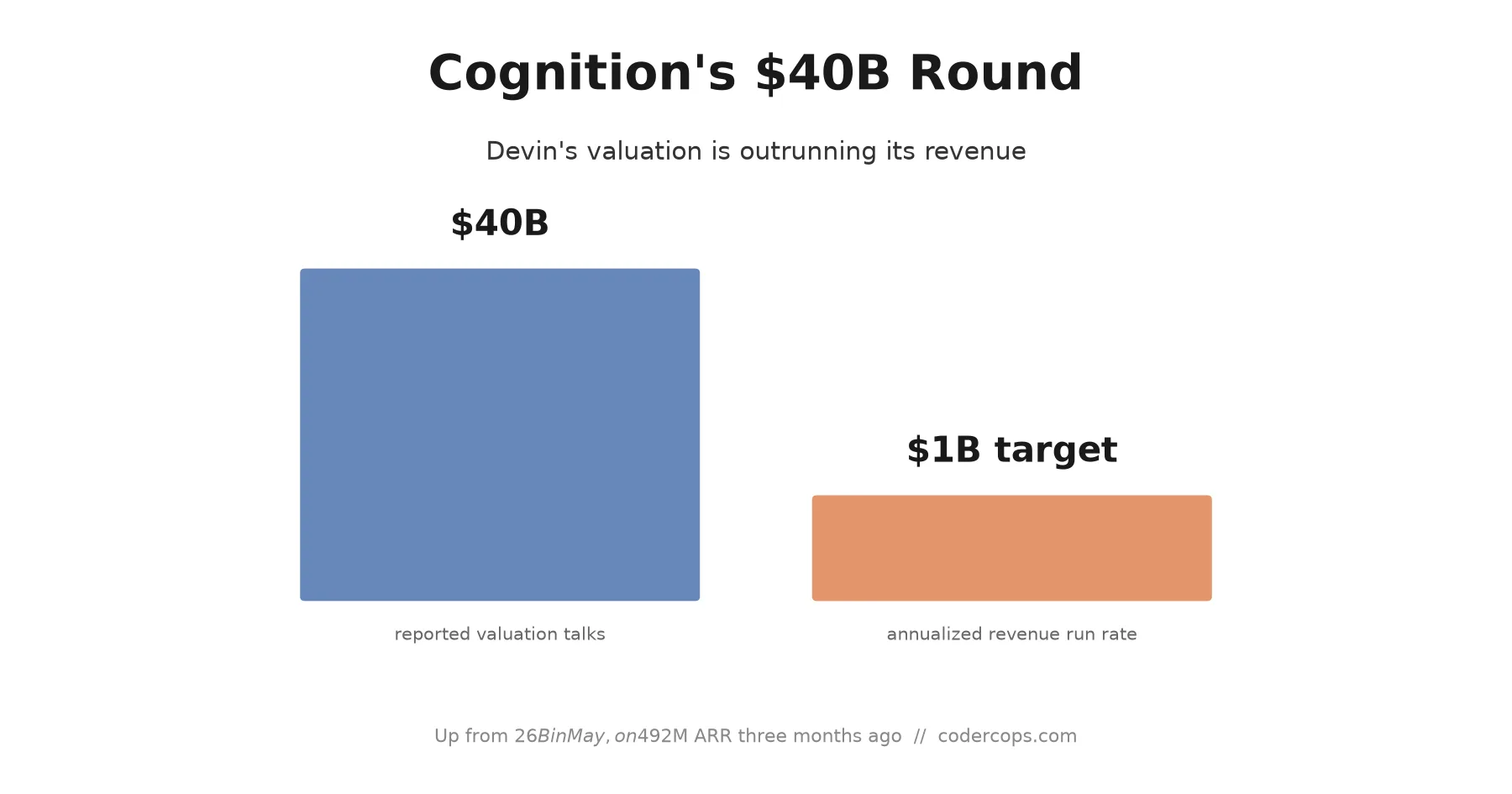
Cognition is reportedly back at the negotiating table three months after its last raise, this time talking to investors about a valuation of at least $40 billion. That’s up from $26 billion in May, on revenue that, even at its most optimistic target, doesn’t come close to justifying the multiple on trailing numbers alone. The story here isn’t really about one startup. It’s about what happens when an entire category, AI coding agents, gets priced on where investors think it’s going rather than where it currently is, and what that means if your team is one of the buyers evaluating whether to build around one.
The numbers, and the gap between them
TechCrunch reported on August 12, citing people familiar with the discussions, that Cognition is already in talks for a new round that could value the company north of $40 billion. That’s a jump of more than 50% from the $26 billion valuation it landed in May, when it raised $1 billion.
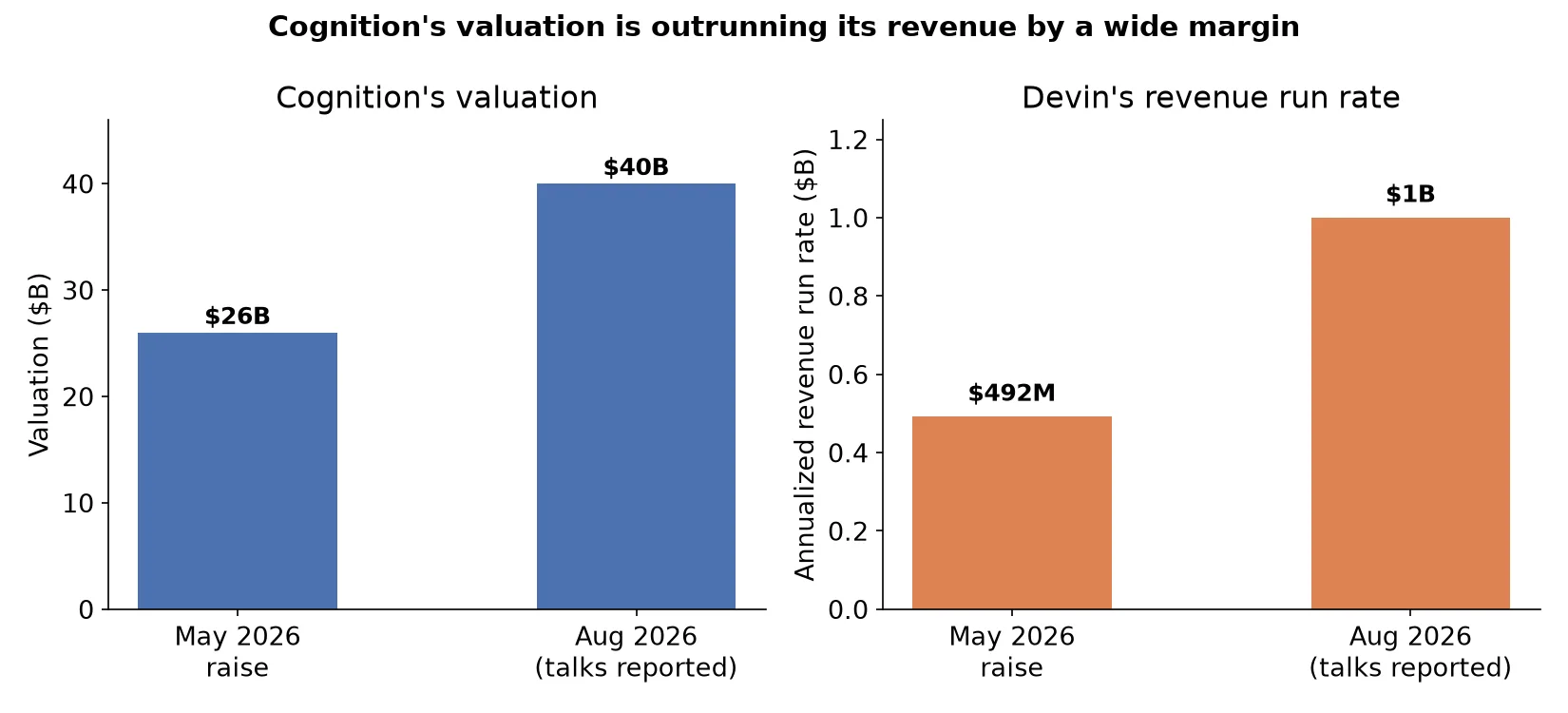
The revenue side of that story matters as much as the valuation itself. When Cognition announced the May round, CEO Scott Wu told TechCrunch the company had reached a $492 million annualized revenue run rate, with enterprise customers growing their usage of Devin by 50% month over month for six consecutive months. The new round is reportedly being discussed against a target of $1 billion in annualized run rate, roughly double where the company stood three months ago. If that target holds, Cognition would be raising at somewhere around 40 times forward revenue, and considerably more than that against revenue actually booked today.
That’s not unusual for the current AI funding environment, where growth rate substitutes for trailing profitability in a lot of these conversations. But it’s worth naming plainly: this is a bet on a trajectory continuing, not a valuation anchored to what the company has already proven it can collect.
What Devin is actually being bought for
Cognition’s own pitch is narrower than “AI replaces your engineers,” and that’s deliberate. Wu has been consistent in interviews that Devin isn’t positioned as a headcount substitute. It’s aimed at the long tail of maintenance work every engineering org accumulates and nobody particularly wants: bringing a dependency current before it becomes a security liability, moving an application off a platform that’s being deprecated, the tickets that sit at the bottom of the backlog for a year because they’re tedious rather than hard.
The customer list reported alongside the funding talks, Goldman Sachs, Mercedes-Benz, and government agencies including branches of the U.S. military, points at large organizations with exactly that kind of accumulated technical debt and the budget to pay someone (or something) to work through it systematically. That’s a real, defensible use case. It’s also a narrower one than the “coding agent that writes your product” framing that gets attached to this category in headlines, and the gap between those two framings is where a lot of buyer disappointment tends to happen.
Why the valuation matters if you’re the one evaluating a tool
A round priced this far ahead of revenue tells you something concrete about the vendor, separate from whether the product is good: the company is under real pressure to keep growing at the rate that justifies the number. That pressure shows up downstream in ways worth thinking about before you build workflow around any AI coding agent, Devin or otherwise.
| What a high forward multiple usually means | What it means for you as a buyer |
|---|---|
| Growth has to keep compounding to justify the next round | Pricing may shift, sometimes upward, once the growth story needs new levers |
| Product roadmap partly follows what impresses the next investor | Feature priorities may not track your specific workflow needs |
| The company is well-capitalized short-term | Less risk of the product disappearing mid-contract, at least for now |
| Category interest is high, so competition is real | You have leverage to negotiate, and alternatives exist |
None of that tells you whether Devin, or Cursor, or GitHub Copilot’s agent mode, or any other tool in this space will actually save your team time on your codebase. That’s a narrower, more boring question, and it only gets answered by running a real trial against real tickets, the same due diligence we’d recommend before choosing any vendor for production work, not by reading a funding headline. If your team is weighing whether AI-assisted development changes how you scope and price engineering work at all, that’s a separate but related question we’ve written about in how agencies are pricing AI-assisted development.
The takeaway
A $40 billion valuation on a $1 billion revenue target is a statement about investor appetite for the AI coding agent category, not a review of the product. Read it as evidence the category has real money and real competitive pressure behind it, which is useful context when you’re picking a vendor and want to know they’ll still be around in two years. It’s not evidence the tool will work for your specific stack, your specific backlog, or your specific team, and no funding round substitutes for actually running the trial.
Frequently asked questions
- What did Cognition actually announce?
- Nothing officially, yet. TechCrunch reported on August 12, 2026, citing sources, that Cognition is already in talks with investors for a new round that could value the company at $40 billion or more, three months after it raised $1 billion at a $26 billion valuation in May.
- How does Cognition justify a valuation that much higher than its revenue?
- On growth rate and a forward target, not trailing revenue. Cognition's CEO Scott Wu told TechCrunch in May that Devin had reached a $492 million annualized revenue run rate, with enterprise usage growing 50% month over month for six months straight. The new round is reportedly priced against a $1 billion run rate target, meaning investors are betting on that growth curve continuing, not on revenue already in hand.
- What is Devin actually used for at companies like Goldman Sachs and Mercedes-Benz?
- Cognition's own framing is maintenance and migration work, not net-new feature development: bringing outdated dependencies current, moving an application from one platform to another, the backlog tickets that pile up because no engineer wants to pick them up. It's explicitly not pitched as a headcount replacement.
- Should a smaller engineering team read anything into a $40 billion valuation?
- Treat it as information about the vendor, not the tool. A valuation that far ahead of revenue means the company is under pressure to grow fast and probably to eventually raise prices or find new revenue lines once growth slows. It says little about whether Devin, or any AI coding agent, will actually save your team time on your specific codebase, which is a question only a real trial answers.
- Is Cognition profitable?
- Public reporting doesn't indicate profitability, and a round priced on a revenue run rate target rather than trailing earnings is itself a signal the company isn't yet operating in the black. That's normal for a three-year-old startup in a fast-growing category, but it's worth knowing before you build a workflow around any vendor's roadmap.
Sources
Sponsored
More from this category
More from Industry News
 R.01
R.01 GitHub Now Lets Maintainers Cap Pull Requests From Non-Collaborators
 R.02
R.02 Apple Pushed Its Smart Glasses to 2027 Over Privacy. That's the Real Story.
 R.03
R.03 Meta's Pocket App Turns Prompts Into Mini-Games. What It Signals for Software Teams
Sponsored
Discussion
Join the conversation.
Comments are powered by GitHub Discussions. Sign in with your GitHub account to leave a comment.
Sponsored