Business · Hiring
How to Hire a Cybersecurity Engineer in 2026
Security engineer covers five genuinely different jobs. How to define the one you need, run a screen that tests real skill, and dodge the usual mistakes.

Prathviraj Singh
7 min read

Sponsored
Security hiring is difficult for a specific reason: the discipline has fragmented faster than job titles have. “Security engineer” on a job post could mean someone who does code review for vulnerabilities, someone who runs a SOC, someone who manages IAM policies on AWS, or someone who breaks into systems on purpose to find weaknesses. These are related disciplines with different skill sets and different hiring approaches. If you get this distinction wrong, the job post attracts the wrong applicants and you fill the wrong seat.
The five types of security engineer
Before posting anything, decide which of these you actually need:
Application security (AppSec) engineer. Works with development teams to find and fix security issues in code and design. Does threat modeling, code review, integrates SAST/DAST scanning into the CI/CD pipeline, and trains developers on secure coding. Requires strong development skills plus security knowledge. The hardest combination to hire because few people have both at depth.
Security operations (SecOps) / SOC engineer. Monitors systems for threats, investigates alerts, manages the SIEM (Splunk, Elastic, Sentinel), handles incident response. This role is more operational and less development-heavy. Needs experience with threat intelligence, detection engineering, and response playbooks.
Cloud security engineer. Focuses on cloud-specific security: IAM policies, network segmentation, compliance posture (CIS benchmarks, NIST, SOC 2), secrets management, and securing multi-cloud environments. Requires overlap with cloud architecture skills. AWS Security Specialty or equivalent certification is a meaningful signal here.
Penetration tester / red team. Professionally breaks things. Assesses systems, applications, and networks for vulnerabilities. Usually brought in as a contract engagement rather than hired full-time, unless your organization has regulatory reasons to maintain an internal red team.
GRC (Governance, Risk, and Compliance) engineer. Works on policy, audit evidence, risk frameworks, and compliance programs (SOC 2, ISO 27001, HIPAA). More process-oriented than hands-on technical. Often a different career background than the other roles above.
For most companies in the 50-500 person range, the right first security hire is either an AppSec engineer (if you are building software that handles sensitive data) or a cloud security engineer (if you are running significant cloud infrastructure). The SecOps function can often be covered by a managed MSSP until you have the scale to justify a full SOC.
What the screen should test
The useful screen for any security role has three components:
Scenario-based threat modeling. Give them a simplified architecture diagram (an app, a database, an API, an S3 bucket), and ask them to identify the top three threats and how they would mitigate each. You are looking for systematic thinking: data flow analysis, trust boundary identification, and the ability to prioritize by likelihood and impact. Someone who immediately jumps to “SQL injection” without looking at the data flow is pattern-matching, not reasoning.
A past incident. Ask them to describe a security incident they helped contain. What was the initial indicator? How did they scope the blast radius? What was the containment action? What was the root cause? This question surfaces both technical depth and communication skill. Security engineers who cannot explain what they did in plain language to a non-technical stakeholder are a hiring risk, because communication is a core part of the job.
A real tool question. Ask them to describe how they would use a tool they list on their resume. If they have SAST experience, ask them to describe a false positive they investigated and how they tuned the rule. If they claim Burp Suite experience for AppSec, ask what a specific type of vulnerability looks like in a proxied request. The people who listed the tool because it sounds good and the people who have actually used it are easy to separate here.
Red flags in security hiring
Fear-based framing without specifics. A candidate who talks primarily about how dangerous the threat landscape is and what terrible things happen to companies that do not invest in security is describing the market, not their work. Probe for what they specifically did on their last engagement. What vulnerabilities did they find? What did they miss? How did they communicate risk to stakeholders who did not want to hear it?
Certifications as the whole pitch. The CISSP, CEH, and even OSCP are meaningful credentials. They are not a substitute for demonstrating hands-on capability. A candidate who cannot move quickly from “I have my OSCP” to “here is a specific finding I made on an engagement” is selling a credential, not a skill.
No experience explaining risk to non-technical stakeholders. Security engineers at any level need to communicate. Bug severity means nothing if a developer ignores the ticket. A penetration test finding means nothing if leadership does not understand why it matters. Ask how they have communicated a high-severity finding that the team initially pushed back on. The story reveals a lot about how they work.
Comfort with only known-good tools. The threat landscape in 2026 is evolving fast. AI-generated phishing, supply chain attacks, and AI-powered vulnerability discovery are changing what defenders need to know. A security engineer who has not updated their toolkit or their threat model in three years is not keeping pace. Ask what they have learned recently that changed how they think about a class of attack.
The AppSec problem
AppSec is worth calling out separately because it is the hardest security hire. You need someone who can read code, understand application design, think about security implications, and communicate all of it to developers who often see security as friction. That is a rare combination.
The most reliable signal for an AppSec candidate is that they have done real code review for vulnerabilities. Ask them to walk through a vulnerable code sample and explain what they see. If they have worked in your stack before (Python, Node, Java, whatever), ask about the classes of vulnerability common in that ecosystem and why. A candidate who can walk through a server-side request forgery or a business logic flaw and explain both the technical root cause and the business impact of exploitation is worth far more than one who can recite the OWASP Top 10.
The adjacent post cybersecurity best practices for developers in 2026 is worth reading before the screen. It surfaces the vocabulary and concepts your AppSec hire should be fluent in, and it is useful reading for the development team who will be working with them.
When to hire a contractor instead
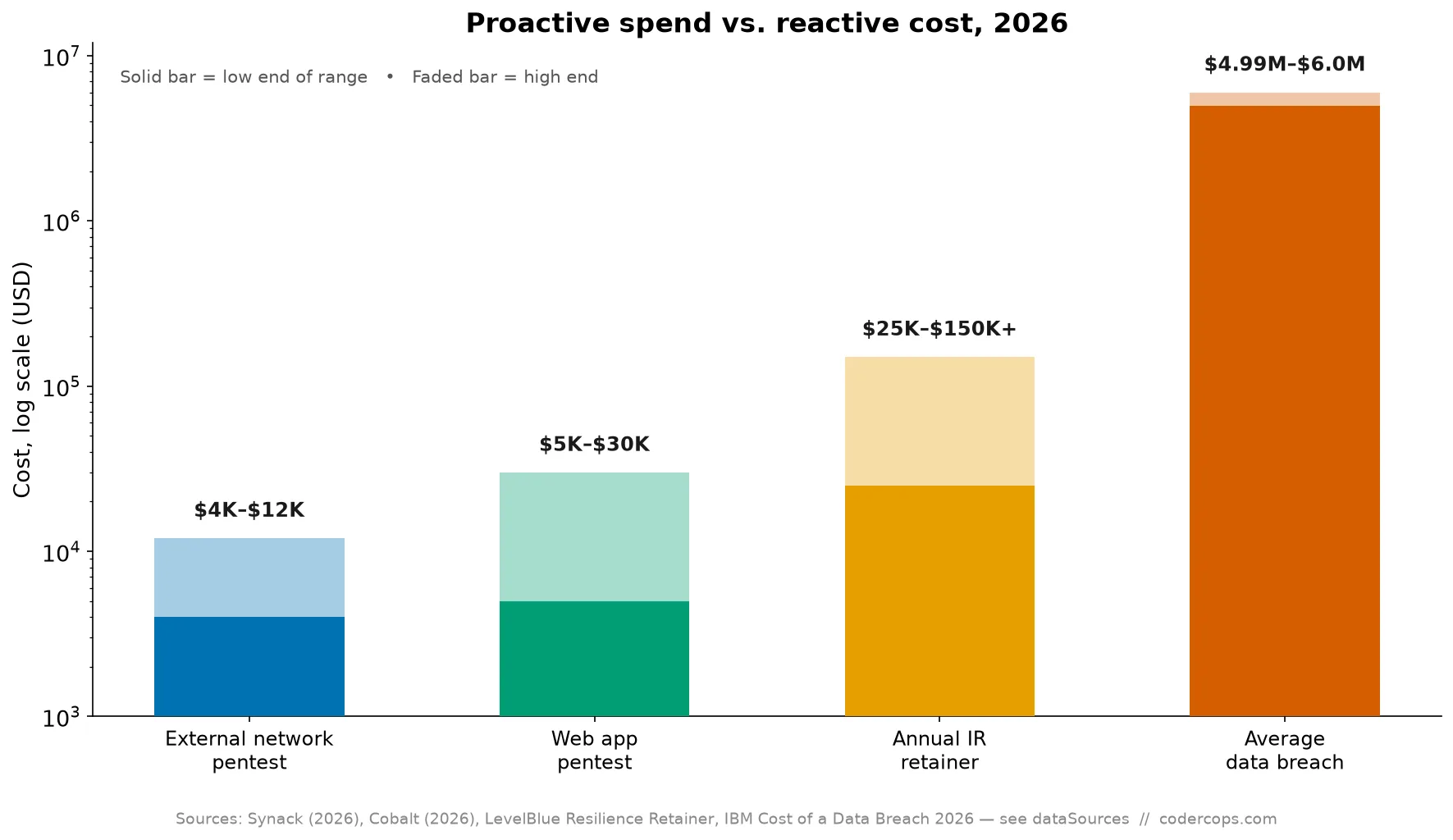
Security is one of the few engineering disciplines where a well-scoped contract engagement often delivers better value than an FTE hire at the lower end of the experience range.
A penetration test from a qualified contractor gives you a fixed-scope deliverable with clear findings. A security architecture review does the same. Compared to hiring a junior security engineer who takes six months to get oriented and another six months to start delivering meaningful findings, the economics often favor contract work for early-stage security investment.
The right time to hire a full-time security engineer is when:
- Your compliance posture requires a named security owner (SOC 2, ISO 27001, HIPAA all have this concept)
- You have more ongoing security work than a contract engagement can absorb
- You have an internal red team or product security program to build
Until those conditions are met, a quarterly penetration test plus a fractional AppSec engagement is often the more efficient path.
Pairing with the hiring cluster
The same screening principles in the vetted developer guide apply here: test for the thing that will break your project, not the thing that looks impressive on paper. For security, the thing that breaks projects is the combination of weak threat modeling and poor communication, a candidate who finds the wrong things or cannot get their findings acted on. Design your screen around those two failure modes.
Security hiring takes longer than most technical hiring because the candidate pool is genuinely thin. Plan for 8-12 weeks for a full-time hire, less for a contract engagement. Start earlier than you think you need to.
Frequently asked questions
- What is the difference between an AppSec engineer and a security engineer?
- Application security (AppSec) engineers focus on vulnerabilities in code and application design: secure code review, threat modeling, SAST/DAST tooling, OWASP Top 10, and working directly with development teams. A 'security engineer' title can mean AppSec, but it more often means SecOps (monitoring, incident response, SIEM operations) or cloud security (IAM, network segmentation, compliance). AppSec requires strong development skills in addition to security knowledge. SecOps requires deep knowledge of detection tools, threat intelligence, and response procedures.
- Is a CISSP required for a security engineer role?
- Not required, but it signals a certain depth of knowledge across security domains. The CISSP is more relevant for senior or architect-level roles than hands-on engineering. For hands-on roles, certifications like OSCP (offensive/penetration testing), AWS Security Specialty, or CEH are more directly useful. The honest view: certifications reduce screening uncertainty. They do not replace hands-on assessment.
- How do you screen a security engineer's actual skill?
- Give them a realistic CTF-style challenge or a threat modeling exercise on your architecture. Ask them to walk through a security incident they responded to and how they contained it. Ask which OWASP Top 10 vulnerability they most commonly find in code reviews and why. Ask about a CVE they investigated recently, what the actual risk was, and how they communicated it to a non-technical audience. These reveal practical skill; asking about frameworks reveals what they have studied.
- How much does a cybersecurity engineer cost?
- Security is one of the highest-comp technical disciplines. In the US, experienced security engineers in full-time roles earn between $140k and $210k in total compensation; AppSec and cloud security engineers at the senior level can exceed that. The talent shortage is real — there are more open security roles than qualified candidates. Contract penetration testers and security architects command $200-$400 per hour. For companies that need periodic assessments rather than ongoing coverage, contract engagements can be significantly more cost-effective.
Sponsored
Sponsored
Discussion
Join the conversation.
Comments are powered by GitHub Discussions. Sign in with your GitHub account to leave a comment.
Sponsored