Cloud & Infrastructure · Kubernetes
Kubernetes 1.37 Garhwal: What's Actually Stable Now
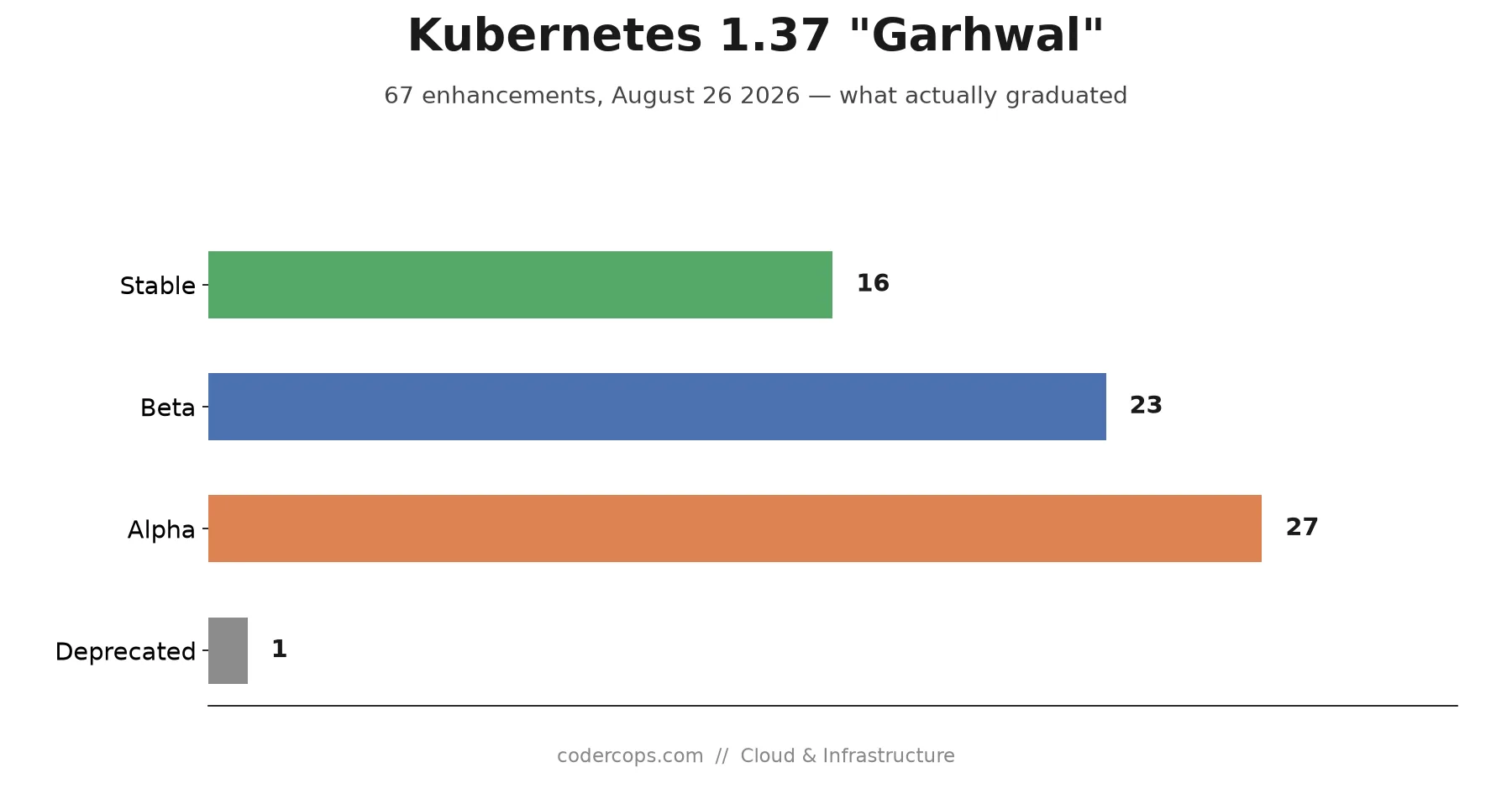
Kubernetes 1.37 shipped August 26 with 67 enhancements. What actually graduated to stable, what's worth testing in beta, and what to leave alone for now.

Abhishek Gupta
5 min read
Sponsored
Kubernetes 1.37, code-named Garhwal after the Himalayan region in Uttarakhand, shipped on August 26, 2026, with 67 enhancements attached to it. If you tried to read all 67, you’d burn an afternoon on things that don’t touch your cluster. Here’s the version that fits in your lunch break: what’s stable, what’s worth testing, and what to ignore until it matures.
What’s actually stable (the part that won’t change under you)
Sixteen enhancements graduated to stable in 1.37, and three are worth knowing about regardless of what your cluster does.
metrics.k8s.io is stable. This is the Metrics API behind kubectl top and the Horizontal Pod Autoscaler’s CPU and memory readings. It’s been reliable in practice for a long time, but formally sitting in beta meant it violated a “no beta APIs in production” policy for teams strict about that rule. If that was the only thing blocking a piece of autoscaling tooling, it isn’t anymore.
Pod certificates and Cluster Trust Bundles are stable. Pods can now request short-lived X.509 certificates and receive cluster-scoped trust anchors through a projected volume:
apiVersion: v1
kind: Pod
spec:
  containers:
    - name: app
      volumeMounts:
        - name: cert
          mountPath: /var/run/certs
  volumes:
    - name: cert
      projected:
        sources:
          - podCertificate:
              signerName: kubernetes.io/kube-apiserver-client
              keyType: ECDSAP256
              credentialBundlePath: cert.pem
That’s a meaningful shift for anyone who’s been running a sidecar or a separate cert-manager deployment purely to get short-lived, automatically-rotated mTLS certificates into pods. It doesn’t replace cert-manager for every use case, but for basic pod-to-pod mTLS, this closes a gap that used to require third-party tooling by default.
KYAML is stable. It’s a YAML dialect compatible with existing tooling that adds opinionated formatting rules to avoid the parsing ambiguities that have caused real incidents (the classic “Norway problem,” where an unquoted no gets parsed as boolean false). If you generate manifests programmatically, it’s worth a look, though most hand-written YAML doesn’t need to change.
What’s in beta and worth testing now
KEP-5343 makes nftables the default kube-proxy backend instead of iptables, and 1.37 starts logging a warning if you haven’t explicitly configured a proxy mode. iptables rule evaluation is linear and gets slower as your service count grows; nftables was designed to scale better under the same load. This is the item most likely to bite someone who upgrades without reading the changelog, because a default changing under you during a routine version bump is exactly the kind of surprise that turns into an on-call page. If you’ve never explicitly set --proxy-mode on your cluster, that’s worth finding out this week, on staging, not during your next production upgrade window.
Kubelet-in-UserNS (rootless kubelet) reaches beta after more than five years of development. It lets kubelet itself run as a non-root user on the host, which matters for organizations with strict host-hardening requirements that currently make an exception for the control-plane agent. Beta means feature-complete enough for a serious pilot on a non-critical cluster, not yet a fleet-wide rollout.
Native histogram support for Kubernetes metrics moves to beta, adding Prometheus Native Histogram support with dynamic exponential bucket boundaries. The practical benefit is roughly a 10x reduction in time series count per histogram, which is a real cost and cardinality win if you’re running Prometheus at scale and histograms are a meaningful chunk of your metrics volume.
What’s in alpha (know about it, don’t build on it yet)
Pod-level checkpoint and restore extends the Container Runtime Interface with CheckpointPod and RestorePod RPCs, aimed at fast pod migration and debugging workflows where you want to snapshot a running pod’s state. It’s early. Worth watching if you’re building tooling in that space, not something to depend on in a pipeline today.
What to actually do this week
Most teams get three useful things out of this release. First, if you rely on kubectl top or HPA in any automation that specifically avoids beta APIs, that constraint is gone. Second, check your kube-proxy mode configuration before your next upgrade, since a default shift is the one change here capable of causing an incident if it arrives unannounced. Third, if pod-level mTLS has been on your backlog behind “we’d need to stand up cert-manager for this,” the built-in pod certificate support is worth a prototype.
This follows the same pattern as Kubernetes 1.36 Haru a few months back: a handful of genuinely useful stable graduations buried in a long list of items that don’t apply to most clusters. Reading the stable list and skimming the rest is a reasonable way to spend fifteen minutes on a Kubernetes release; reading all 67 enhancements in detail rarely is. If your platform team doesn’t have a standing process for triaging releases like this one, that’s a smaller fix than it sounds, and it’s the kind of platform engineering work our infrastructure team helps clients build into a normal quarterly cadence instead of a one-off scramble.
Frequently asked questions
- Do I need to upgrade to Kubernetes 1.37 right away?
- No. Nothing in this release is a security-critical fix that forces an immediate upgrade the way a KEV-listed CVE would. Treat it like any minor version bump: read what changed, test the parts relevant to your cluster on staging, and upgrade on your normal cadence rather than rushing it.
- What actually changed with kube-proxy and nftables?
- KEP-5343 makes nftables the default backend for kube-proxy instead of iptables, and as of 1.37, kube-proxy logs a warning if you haven't explicitly set a proxy mode. iptables rule evaluation degrades as service count grows; nftables was built to scale better. If you're running a large cluster and have never explicitly configured kube-proxy's mode, this is the release to go find out what you're actually running and test the switch deliberately rather than inheriting a new default silently.
- What is metrics.k8s.io and why does stable matter?
- It's the Metrics API that kubectl top and the Horizontal Pod Autoscaler use to read CPU and memory usage. It's been functionally reliable for years but technically in beta, which matters for anyone who avoids depending on beta APIs in production tooling as a matter of policy. Now it's stable, so that objection is gone if it was the only thing holding back autoscaling work built on top of it.
- Is rootless kubelet ready for production?
- It just reached beta, which means it's feature-complete enough to test seriously but not yet the default and not without rough edges. If your organization has strict host-hardening requirements around not running control-plane components as root, it's worth piloting on a non-critical cluster now. It's not yet the thing to roll out fleet-wide.
- What should most teams actually do with this release?
- Read the stable list, since that's the part guaranteed not to change under you. Check whether you've ever explicitly set a kube-proxy mode, because the nftables default shift is the item most likely to surprise someone. Everything in alpha is worth knowing about for planning purposes but not worth spending engineering time on yet.
Sources
Sponsored
More from this category
More from Cloud & Infrastructure
Sponsored
Discussion
Join the conversation.
Comments are powered by GitHub Discussions. Sign in with your GitHub account to leave a comment.
Sponsored