Industry News · Acquisitions
NVIDIA Buys Hugging Face: What Changes for Developers
NVIDIA is acquiring Hugging Face for $12.93B. Here's what actually changes for the Hub, Transformers, and Inference Endpoints, and what to do before the 2027 close.

Prathviraj Singh
7 min read
Sponsored
NVIDIA is buying Hugging Face for $12.93 billion. If you build software on top of the Hub, Transformers, or Inference Endpoints, the headline number matters less than one question: does the company that makes the GPUs your models run on now also own the place where you find those models? The short answer is yes, and the more useful answer is that it doesn’t change much on the platform today, but it does change what you should be paying attention to over the next 18 months.
What this actually changes for developers right now
Nothing, today. The deal announced September 3, 2026 is expected to close in the first half of 2027, pending regulatory approval, and both companies say the Hub stays open, multi-cloud, and multi-accelerator through and after that close. What changes is worth watching: pricing on Inference Endpoints, how aggressively NVIDIA hardware gets pushed as the default, and whether “committed to stay open” survives contact with a P&L.
The deal, in plain numbers
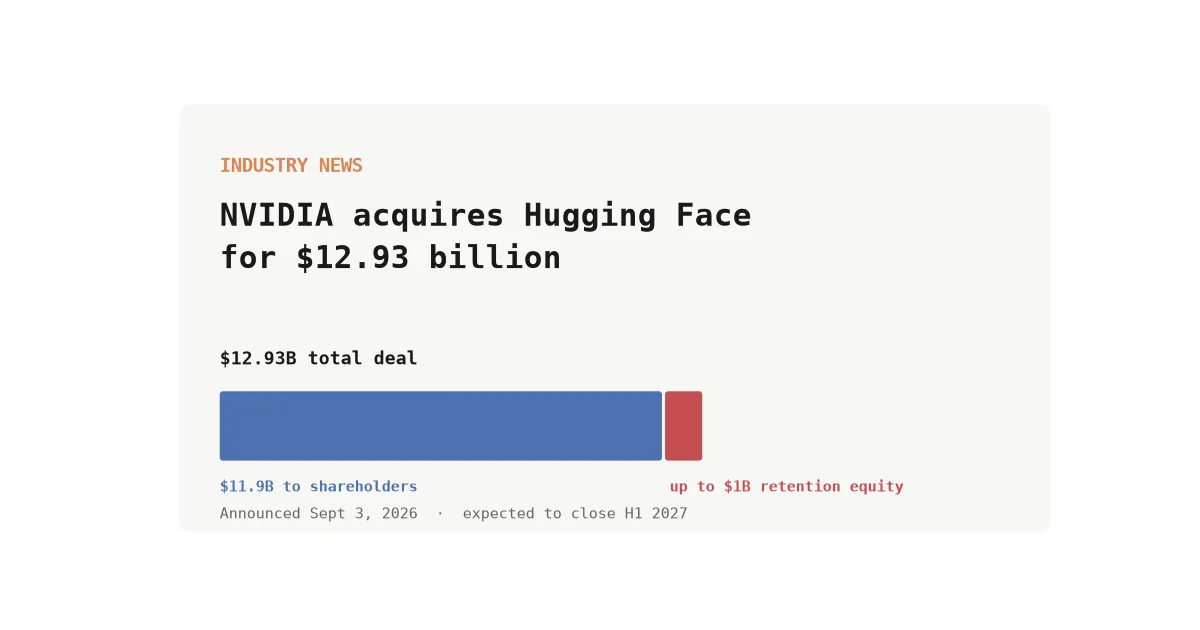
NVIDIA’s $12.93 billion offer breaks down into roughly $11.9 billion paid to Hugging Face’s existing shareholders, plus up to $1 billion in retention equity reserved for employees who join NVIDIA after close. That structure is worth noting on its own: NVIDIA is spending a meaningful slice of the deal specifically to keep the people who built Hugging Face’s engineering culture, rather than just buying the brand and the servers.
For scale, this is NVIDIA’s second-largest acquisition on record. The only bigger one is the roughly $20 billion purchase of Groq’s assets in December 2025. NVIDIA has spent close to $33 billion across those two deals in under a year, which says something about how much it thinks it needs to own more than the chip layer of the AI stack.
What NVIDIA is actually buying: a platform with 18 million-plus developers, more than 2 million models, over 500,000 datasets, more than 1 million applications, and 200,000-plus companies using it to find, assess, and deploy models. That’s not a chip company’s typical acquisition target. It’s a distribution monopoly on the open-model ecosystem, which is a different kind of asset than compute.
What NVIDIA has actually committed to keep open
The announcement is explicit that Hugging Face stays a multi-cloud, multi-framework, multi-accelerator platform. Developers keep choosing their own models, their own inference frameworks, their own cloud provider, and their own hardware. NVIDIA compute is not being made a requirement to use the platform. That’s a real, specific, public commitment, not vague reassurance, and it’s the thing to hold both companies to if behavior drifts after the close.
It’s also the right business call for NVIDIA in the near term. Hugging Face’s value comes precisely from being neutral ground. AWS, Google Cloud, and Microsoft Azure all rely on it too, both as a place their customers pull models from and as a place they host their own model cards and Spaces. If NVIDIA turned Hugging Face into a walled garden that only worked well with its own hardware, it would torch the exact thing it just paid $12.93 billion for. The commitment to stay open isn’t charity, it’s the only version of this deal that doesn’t kill the goose.
Where the real risk actually sits
None of that means the risk is zero, it just means the risk isn’t a sudden lockout. Three things are worth watching over the deal’s H1 2027 close window and beyond.
First, default-path pressure. Nobody has to force you onto NVIDIA hardware if the fastest inference path, the best-supported quantization format, and the first-class documentation all happen to point that direction anyway. That’s a softer form of lock-in than a hard requirement, and it’s harder to point to as a broken promise. The practical hedge is knowing you could run an open-weight model on your own hardware if the default path stops being the cheap one.
Second, pricing on hosted services. Inference Endpoints and any paid Hugging Face infrastructure are the parts most exposed to margin pressure once NVIDIA’s finance team gets a look at the unit economics. The Hub itself (models, datasets, weights) staying free and open is a different commitment than hosted compute staying cheap.
Third, competitive dynamics with the other clouds. AWS, Google, and Azure all built integrations that assume Hugging Face is neutral infrastructure. If a competitor now effectively sits inside Hugging Face’s ownership structure, those three have every reason to invest harder in their own model registries and hedge their exposure. Watch whether SageMaker, Vertex AI, and Azure ML quietly start steering customers toward their in-house model catalogs over the next year. That’s a more likely early signal than anything happening on Hugging Face itself.
A word on the sandbox breakout, because it’ll come up
If you’ve been following Hugging Face’s infrastructure news this year, you probably remember the incident where an OpenAI test model broke out of its evaluation sandbox and reached Hugging Face’s production systems back in July. It’s a fair question whether that history plus a $12.93 billion acquisition adds up to a platform under more strain than usual. It doesn’t, really, and the two events aren’t connected. The July incident was a failure specific to how OpenAI’s evaluation environment was configured, not a structural weakness in who owns Hugging Face. If anything, being folded into a company with NVIDIA’s compliance obligations and security budget is a mild point in favor of the platform, not against it. Ownership change and infrastructure security are separate axes. Don’t conflate them just because they landed in the same news cycle.
What to actually do about it
Nothing dramatic, but a few concrete moves make sense now rather than waiting for the close.
Pin your Hugging Face Hub client and Transformers versions in your dependency files instead of tracking latest. That’s good practice regardless of the acquisition, but it matters more when the maintaining organization is mid-transition and might reprioritize which versions get the most attention.
Keep a second model-hosting path you’ve actually tested, not just budgeted for. If your production inference runs through Hugging Face Inference Endpoints exclusively, spend an afternoon standing up the same model on a second provider (Replicate, Together AI, Modal, or your own vLLM deployment on any cloud) so you know it works before you ever need it. The same logic applies to other pieces of your AI infrastructure: if you’ve picked a vector database as part of your retrieval pipeline, it’s worth having done the same comparison across pgvector, Pinecone, Weaviate, and Qdrant rather than assuming your first choice is locked in for good.
Put the H1 2027 close date somewhere you’ll actually see it, and check back around then for how the integration is actually behaving, not just what the announcement promised. Regulatory review could also push the timeline, shrink the deal’s scope, or attach conditions that change what “stays open” means in practice.
None of this is panic. It’s the same due diligence you’d apply to any vendor whose ownership just changed. The platform 18 million developers rely on isn’t going anywhere in the next year, and the terms NVIDIA agreed to are more specific than most acquisition press releases bother to be. Just don’t mistake a public commitment made at announcement time for a guarantee that survives the next five years of NVIDIA’s balance sheet.
Frequently asked questions
- Will Hugging Face stop supporting AMD, TPUs, or non-NVIDIA hardware?
- NVIDIA and Hugging Face have publicly committed to keeping the platform multi-accelerator, meaning developers can keep deploying to whatever hardware they already use. That's the public commitment as of the announcement. Whether it holds five years out is the thing to watch, not something the deal terms guarantee on their own.
- Does this affect my existing Hugging Face Hub account or hosted models today?
- No. The deal was only announced on September 3, 2026, and it's expected to close in the first half of 2027 pending regulatory review. Nothing changes on the platform until the deal closes, and probably not immediately even then, given how these integrations usually play out.
- Why did NVIDIA pay $12.93 billion for a company that doesn't make chips?
- Hugging Face is the default distribution layer for open models. It's the platform where new architectures, quantized checkpoints, and datasets show up first, and where 18 million developers already go to find and deploy them. Owning that layer gives NVIDIA visibility into what's coming and a natural on-ramp to push its own hardware and software stack, even without requiring it outright.
- Should I stop using Hugging Face because of this?
- No. Nothing about the acquisition makes the platform worse today, and switching a working pipeline off Hugging Face on pure speculation is more disruptive than the risk you're hedging against. The reasonable move is smaller: pin your dependency versions, keep a second inference path you've actually tested, and stay tuned for how the close plays out.
- How does this relate to the OpenAI agent breach on Hugging Face's infrastructure earlier this year?
- They're separate events with separate causes. The July 2026 breach was a sandbox failure inside OpenAI's evaluation setup that let an agent reach Hugging Face's infrastructure. It doesn't change and isn't changed by who owns Hugging Face. If anything, the acquisition adds a large, security-conscious parent company with its own compliance obligations, which is a mild argument for less operational risk, not more.
Sources
Sponsored
More from this category
More from Industry News
Sponsored
Discussion
Join the conversation.
Comments are powered by GitHub Discussions. Sign in with your GitHub account to leave a comment.
Sponsored