AI Integration · Model Releases
Gemini 3.8 Flash: What Actually Changed
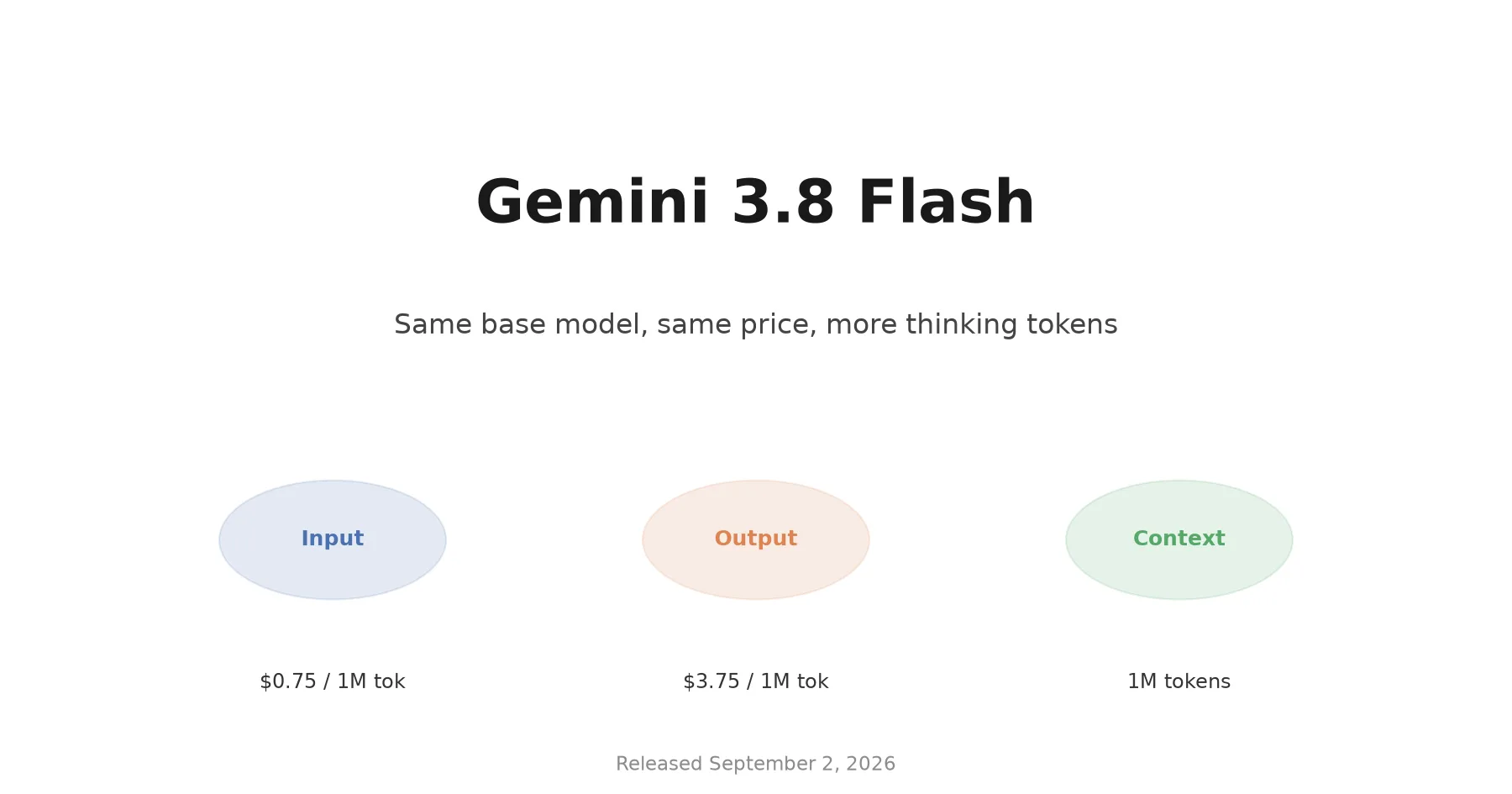
Google shipped Gemini 3.8 Flash on September 2, its fourth Flash release since May. Pricing didn't move and the base model didn't change. What did.

Shashikant Gupta
4 min read
Sponsored
Google shipped Gemini 3.8 Flash on September 2, 2026. If you’re waiting for the headline that justifies re-architecting your pipeline: there isn’t one. The base model is the same one 3.7 Flash shipped on in August. The price per token hasn’t moved. What changed is how hard the model works before it answers, and that distinction is the whole story.
This is the fourth Flash-branded release since May, and the cadence itself is starting to matter more than any single release. If you’re building on Gemini, the practical question isn’t “should I read every Flash announcement,” it’s “how do I decide when a Flash bump is worth touching production for.” Here’s how to answer that for 3.8.
What actually changed
Google’s own documentation says 3.8 Flash is built on the 3.7 Flash base model rather than a new one. The gains on Google’s published benchmarks come from the model spending more thinking tokens per request and from post-training refinements, not from retraining the foundation. It handles text, image, audio, video, and PDF input, keeps the same 1M-token context window and 64K output ceiling as 3.7 Flash, and is tuned specifically for long-horizon coding and agentic workflows.
Google’s benchmark numbers show 3.8 Flash beating 3.7 Flash across the board, and beating Claude Opus 5 on a subset of published benchmarks. Take the second claim with the usual caveat that vendor-published benchmark wins are cherry-picked by definition; ask what tasks those benchmarks measure before you let them drive a model choice.
A second model, 3.8 Flash Cyber, shipped the same day as a locked-down variant aimed at security-sensitive use cases. Google has published far less detail on it than on the main release, so treat it as worth watching rather than something to adopt on the strength of a name.
The pricing story is the real signal
Here’s the part that should shape your decision more than the benchmark chart:
| Gemini 3.7 Flash | Gemini 3.8 Flash | |
|---|---|---|
| Input | $0.75 / 1M tokens | $0.75 / 1M tokens |
| Output | $3.75 / 1M tokens | $3.75 / 1M tokens |
| Context window | 1M tokens | 1M tokens |
| Max output | 64K tokens | 64K tokens |
| Base model | (n/a) | Same as 3.7 Flash |
Identical rate card. Both prices are scheduled to double on January 1, 2027, which is worth flagging in your own cost planning now rather than in December. But the sticker price being unchanged doesn’t mean the bill is unchanged. Google’s own docs describe 3.8 Flash as deliberately “working harder,” which in practice means it burns more thinking tokens to reach its benchmark scores. Run the same task on both models and 3.8 Flash can cost more per request even at an identical per-token rate, because it uses more tokens to get there.
That’s why Google’s own guidance, buried in its documentation rather than in the launch messaging, tells you to stay on 3.7 Flash for efficiency-first workloads. Reserve 3.8 Flash for the cases where the extra reasoning pays for itself: multi-step agentic tasks and coding work where a wrong first attempt costs more than the extra thinking tokens would have.
How to actually decide
Don’t swap a production pipeline wholesale on release day. A model bump with an identical rate card and a shared base model is exactly the kind of change that’s cheap to test and expensive to regret. Run your actual workload, not a synthetic benchmark, against both models and compare cost-per-successful-completion, not cost-per-token. For a straightforward classification or extraction task, 3.7 Flash is very likely still the better economics. For an agent that’s making multi-step tool calls where a failed attempt means a retry loop, the extra thinking tokens in 3.8 Flash may pay for themselves.
If your team is already running agentic workloads and wrestling with when a model swap is worth the migration cost, that decision process is close to the one we walk through in our guide to evaluating whether a framework upgrade is worth it versus rewriting around it. The same discipline applies to model choice: benchmark the workload you actually have, not the one in the vendor’s blog post.
Google’s release cadence, four Flash models in four months, means this same decision will come up again before the quarter is out. Building a five-minute internal habit of “benchmark before you switch” now saves you from re-litigating this every time a new Flash number ships.
Frequently asked questions
- Is Gemini 3.8 Flash a new base model?
- No. Google's documentation is explicit that 3.8 Flash is built on the 3.7 Flash base model. The improvement comes from the model spending more thinking tokens per request and from post-training changes, not from a retrained foundation model. That matters because it sets expectations: this is a tuning-level update, not a generational leap.
- How much does Gemini 3.8 Flash cost compared to 3.7 Flash?
- The published rate card is identical: $0.75 per 1M input tokens and $3.75 per 1M output tokens for both models. The practical cost difference shows up in usage, not price per token, because 3.8 Flash burns more thinking tokens to hit its benchmark scores, which raises your bill on the same task even at the same rate.
- Should I switch my agent workloads from 3.7 Flash to 3.8 Flash?
- Only if the task benefits from more reasoning. Google's own documentation recommends staying on 3.7 Flash for efficiency-first workloads and reserving 3.8 Flash for long-horizon coding and agentic tasks where the extra thinking tokens pay for themselves in fewer failed attempts. Benchmark your actual workload before switching a production pipeline wholesale.
- What is Gemini 3.8 Flash Cyber?
- It's a locked-down security-focused sibling model Google released alongside 3.8 Flash. Public reporting describes it as hardened for security-sensitive use cases rather than general-purpose agentic work, though Google has published fewer details on it than on the main 3.8 Flash release.
- Where is Gemini 3.8 Flash available?
- It's live in the Gemini app for Google AI Pro and Ultra subscribers, in AI Mode, in Gemini for Google Sheets, and for developers through Google Antigravity, AI Studio, and the Gemini API.
Sources
Sponsored
More from this category
More from AI Integration
Sponsored
Discussion
Join the conversation.
Comments are powered by GitHub Discussions. Sign in with your GitHub account to leave a comment.
Sponsored