AI Integration · AI Models
Meituan's LongCat-2.0 Is Now Open Source
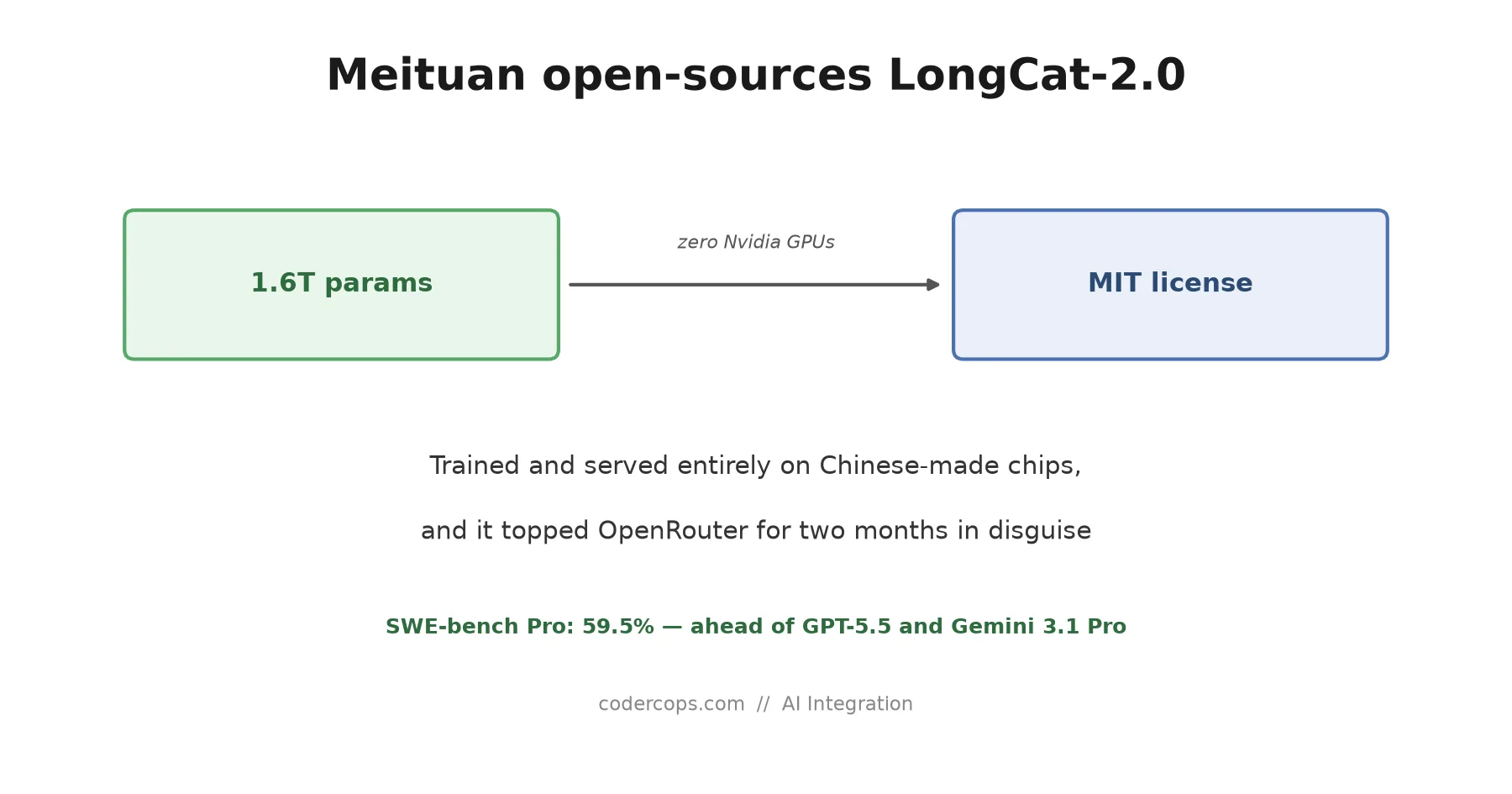
LongCat-2.0 is a 1.6T-parameter coding model Meituan trained on Chinese-made chips, ran anonymously on OpenRouter, then open-sourced under MIT.

Shashikant Gupta
5 min read
Sponsored
For two months, a mystery model called “Owl Alpha” sat near the top of OpenRouter’s leaderboards, and nobody outside Meituan knew who built it. On June 30, 2026, Meituan came forward: Owl Alpha was LongCat-2.0, a 1.6-trillion-parameter coding model, and the company open-sourced the whole thing under an MIT license the same day. The bigger claim buried in the announcement is the one that matters more for the AI industry’s supply chain: Meituan says it trained and serves this model entirely on Chinese-made chips, with no Nvidia or AMD hardware anywhere in the pipeline.
The stealth launch
Before anyone knew what Owl Alpha was, it was already competing. On OpenRouter, a service that routes requests across dozens of AI providers so developers can compare and switch between them, the anonymous model had climbed to first place on the Hermes Agent workspace leaderboard and second place on the Claude Code leaderboard. That’s an unusual way to launch a model: most labs announce first and let the benchmarks follow. Meituan let the benchmarks speak before attaching a name to them, which is either confidence or a very effective marketing trick, and probably both.
What’s actually under the hood
LongCat-2.0 is a Mixture-of-Experts model: 1.6 trillion total parameters, but only an average of about 48 billion are active for any given token, which is what makes a model this large computationally feasible to run at all. It ships with a native 1-million-token context window, built on what Meituan calls LongCat Sparse Attention, aimed at reasoning over large codebases without the context getting truncated or summarized away.
On the benchmarks that matter for a coding model:
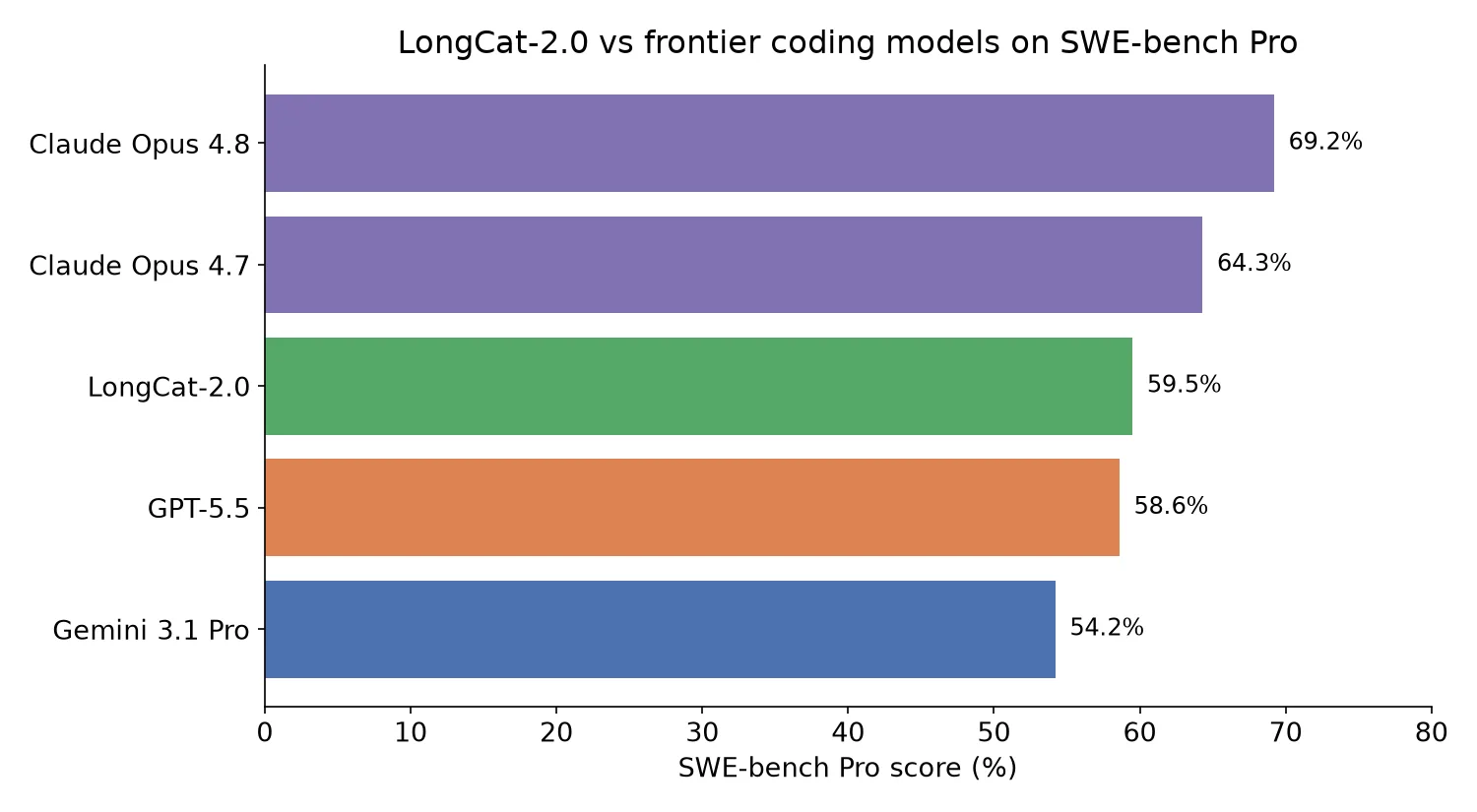
LongCat-2.0 lands at 59.5% on SWE-bench Pro, ahead of GPT-5.5 (58.6%) and Gemini 3.1 Pro (54.2%), but still behind Claude Opus 4.7 (64.3%) and Opus 4.8 (69.2%). It also posts 70.8 on Terminal-Bench 2.1 and 77.3 on SWE-bench Multilingual. That’s not a model that tops every leaderboard. It’s a model that’s genuinely competitive with most of the field while trailing only the current frontier leader, which is a very different story than the open-source-model-as-afterthought narrative from a couple of years ago.
The part that matters beyond the benchmark table
The benchmark numbers are good, but they’re not the most consequential detail in the announcement. Meituan says LongCat-2.0 was trained on a roughly 50,000-card domestic compute cluster, using chips manufactured in China, with zero reliance on Nvidia A100s, H100s, or AMD’s MI300-class accelerators anywhere in training or inference. If that holds up to scrutiny, it’s the first reported case of a trillion-parameter-scale model built and served end-to-end without the specific hardware that export controls have spent years trying to keep out of reach.
That matters beyond the geopolitics angle. It’s evidence that the ceiling on frontier-scale AI training isn’t as hard-gated by a single hardware supply chain as the last few years of export-control policy assumed. Whether that’s read as a policy failure or an inevitability depends on who you ask, but either way, it changes the planning assumptions for anyone betting on chip scarcity as a durable constraint on who can build frontier models.
What this means if you’re choosing a coding model
Most teams evaluating AI coding tools right now are picking between a small number of proprietary APIs, weighing benchmark scores against pricing and data-handling terms. LongCat-2.0 adds a genuinely different option to that list: an MIT-licensed, self-hostable model that’s competitive with, though not ahead of, the frontier proprietary systems.
That matters most for two kinds of teams. First, anyone with data residency or compliance constraints that make sending proprietary code to a third-party API a hard no, rather than a preference, now has a model worth evaluating that they can run on infrastructure they control. Second, anyone doing high-volume agentic coding work, where API costs scale with usage, has a credible self-hosted alternative to weigh against per-token API pricing, assuming they have the infrastructure to serve a trillion-parameter model at reasonable latency, which is itself a nontrivial undertaking.
It doesn’t replace the case for frontier proprietary models if your priority is the single best score on every benchmark. Claude Opus 4.8 still leads SWE-bench Pro by a wide margin. But “wide margin behind the leader” and “not a viable option” are different claims, and LongCat-2.0’s numbers put it firmly in the first category, not the second.
If you’re mapping out which coding tools and models actually fit your team’s workflow rather than just chasing the top benchmark score, our guide to the best AI coding tools walks through that evaluation from the tooling side, and pairs well with treating a model choice like LongCat-2.0 as one more input to that decision rather than a headline to react to.
The takeaway
LongCat-2.0 isn’t the best coding model available today, and Meituan isn’t claiming it is. What it demonstrates is that a credible, open-weight alternative to the usual handful of frontier vendors now exists, built on infrastructure nobody expected to be capable of it two years ago. For teams with real constraints on where their code and API calls can go, that’s a more useful development than another leaderboard headline.
Frequently asked questions
- What is LongCat-2.0?
- It's a large language model built by Meituan, the Chinese delivery-and-services company, specifically tuned for agentic coding tasks: writing code, running terminal commands, and working across large codebases. It uses a Mixture-of-Experts architecture with 1.6 trillion total parameters, of which an average of about 48 billion are active per token, plus a native 1-million-token context window.
- What does 'trained entirely on Chinese-made chips' actually mean?
- Meituan says the model was trained and is served in production using a domestic compute cluster of roughly 50,000 accelerator cards, all manufactured in China, with no Nvidia A100s, H100s, or AMD MI300-class GPUs anywhere in the pipeline. If accurate, that makes it the first trillion-parameter-scale model trained and served end-to-end without relying on the GPU hardware that export controls have targeted.
- How does it actually perform compared to Claude, GPT, and Gemini?
- On SWE-bench Pro, a benchmark measuring real-world software engineering task completion, LongCat-2.0 scores 59.5%, ahead of GPT-5.5's 58.6% and Gemini 3.1 Pro's 54.2%, but behind Claude Opus 4.7's 64.3% and Opus 4.8's 69.2%. It also scores 70.8 on Terminal-Bench 2.1 and 77.3 on SWE-bench Multilingual. It's not the top model on any major coding benchmark, but it's close enough to frontier proprietary systems to be a genuine option, not a curiosity.
- What was the 'Owl Alpha' stealth launch about?
- For roughly two months before Meituan confirmed authorship, an unlabeled model called Owl Alpha was quietly available on OpenRouter, a service that lets developers route requests across many different AI providers. During that anonymous window, Owl Alpha had already climbed to first place on the Hermes Agent workspace leaderboard and second place on the Claude Code leaderboard. Only after Meituan came forward did it become clear Owl Alpha and LongCat-2.0 were the same model.
- Is LongCat-2.0 something a typical engineering team can actually run?
- Running the full 1.6-trillion-parameter model yourself requires serious infrastructure, this isn't a model you run on a laptop. But because it's MIT-licensed and the weights are public on Hugging Face, teams can self-host it on their own infrastructure or through any inference provider that adds support, rather than being limited to a single vendor's API and pricing.
Sources
Sponsored
More from this category
More from AI Integration
Sponsored
Discussion
Join the conversation.
Comments are powered by GitHub Discussions. Sign in with your GitHub account to leave a comment.
Sponsored