Web Development · Backend
Message Queues vs Pub/Sub vs Event Streaming
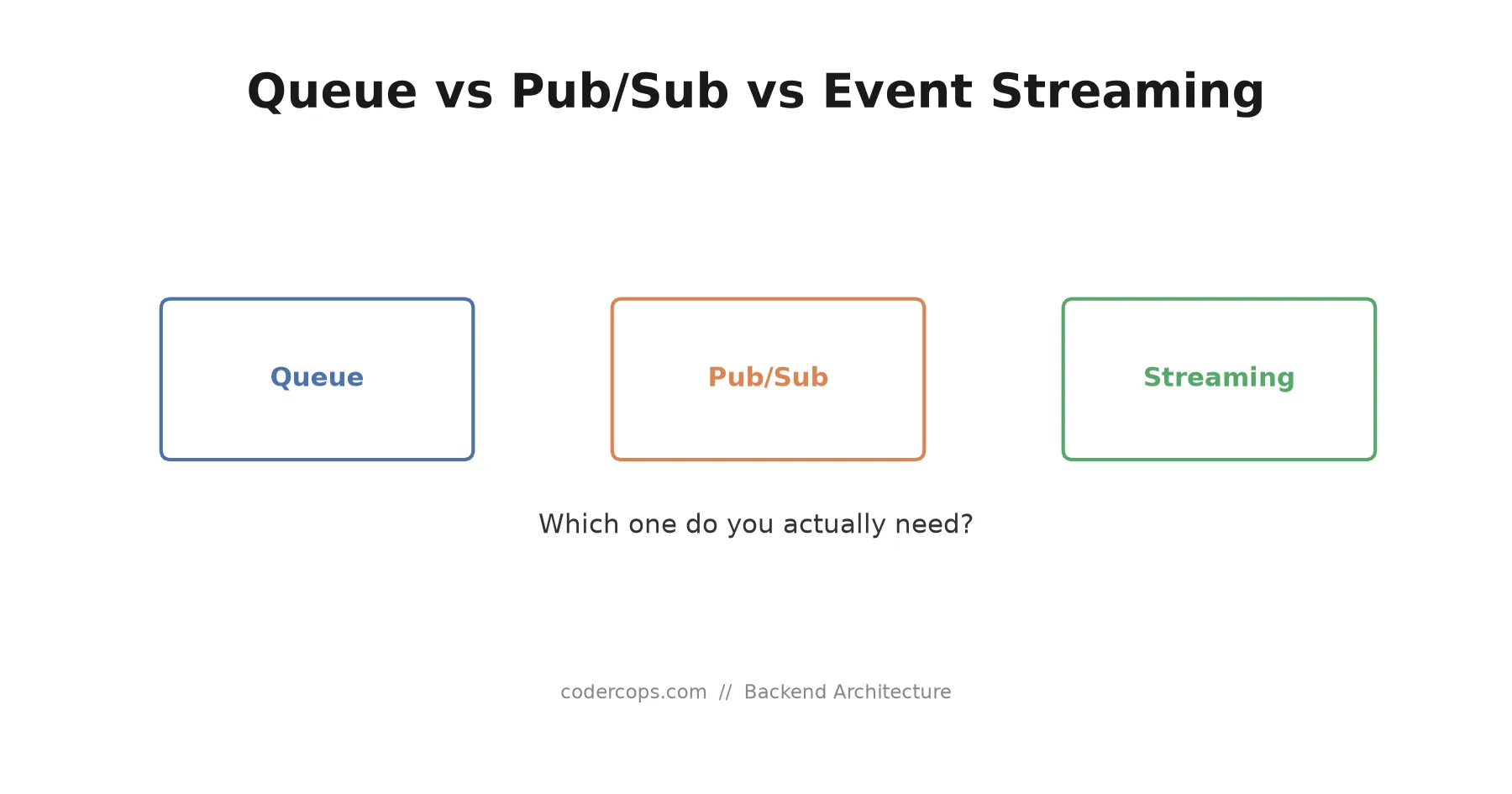
All three move messages between services, but answer different questions about delivery, replay, and who reads what. The decision, and the failure modes.

Anurag Verma
6 min read
Sponsored
Three different tools all claim to solve “get a message from one service to another,” and picking the wrong one doesn’t usually break in testing, it breaks the first time something downstream goes down or you need to fan a message out to more than one place. The distinction that actually matters isn’t throughput or vendor marketing, it’s a much narrower question: does this message need to go to exactly one consumer, to every consumer, or does it need to still exist after everyone’s read it once?
Message queues: exactly one consumer gets each message
A message queue (SQS, RabbitMQ, a Redis-backed queue) is built for distributing work across a pool of workers. Multiple workers can listen on the same queue, but each message is delivered to exactly one of them.
// Producer: enqueue a job
await queue.send('process-image', { imageId: '4821', size: 'thumbnail' });

// Consumer: any one of N workers picks this up, not all of them
queue.consume('process-image', async (job) => {
  await resizeImage(job.imageId, job.size);
  await job.ack(); // remove from queue once processed
});
Add a second worker process listening on process-image, and jobs get split between the two, not duplicated to both. That’s the entire point: a queue is a load-balancing mechanism for work, not a broadcast mechanism for notifications. Once a job is acknowledged, it’s gone from the queue. There’s no replay, no second reader coming along later to see what happened.
This is the right tool when you have a pool of interchangeable workers processing a stream of independent jobs: image resizing, sending emails, generating PDFs. Nobody else needs to know that job happened; it just needs to happen exactly once, by exactly one worker.
Pub/sub: every subscriber gets its own copy
Publish/subscribe (SNS, Google Pub/Sub, a Redis pub/sub channel) inverts that guarantee. Every subscriber to a topic receives every message published to it, independently of every other subscriber.
// Producer: publish an event, doesn't know or care who's listening
await pubsub.publish('order.created', { orderId: '9910', total: 84.50 });

// Three independent subscribers, all three receive every event
pubsub.subscribe('order.created', 'shipping-service', handleShipping);
pubsub.subscribe('order.created', 'analytics-service', handleAnalytics);
pubsub.subscribe('order.created', 'email-service', handleConfirmationEmail);
Add a fourth subscriber tomorrow, and it starts receiving its own copy of every future event without touching the other three. That’s fan-out, and it’s the reason pub/sub fits domain events, “an order was created,” “a user signed up”, where an unknown or growing number of independent parts of the system need to react without being coupled to each other.
The tradeoff: most pub/sub systems don’t retain messages after delivery. If analytics-service is down when an event publishes, that specific event is typically lost for that subscriber once its retry window (if any) expires. Pub/sub answers “who needs to know right now,” not “what happened, and can I look at it again later.”
Event streaming: a durable, replayable log
Event streaming platforms (Kafka, Redpanda, AWS Kinesis) solve a different problem again: an ordered, durable log of events that multiple independent consumer groups can read at their own pace, including replaying from an earlier point.
// Producer: append to the log, partitioned by key for ordering
await kafka.produce('order-events', {
  key: order.id,
  value: { type: 'OrderCreated', orderId: order.id, total: order.total },
});

// Consumer group A processes from wherever it left off
const consumerA = kafka.consumer({ groupId: 'shipping-service' });
await consumerA.subscribe({ topic: 'order-events' });

// Consumer group B, added six months later, can replay from the beginning
const consumerB = kafka.consumer({ groupId: 'fraud-analysis-v2' });
await consumerB.subscribe({ topic: 'order-events', fromBeginning: true });
That fromBeginning: true is the capability neither a queue nor pub/sub gives you by default. Events aren’t deleted when a consumer reads them, they’re retained per the topic’s configured retention period (hours, days, or indefinitely), and each consumer group tracks its own read position independently. If fraud-analysis-v2 gets added as a new service next quarter, it can process the entire history of order events from day one, not just events published after it started listening.
That capability isn’t free. Running a streaming platform well means operating partitioned, ordered logs, managing consumer group offsets, and thinking about retention and storage costs at a different scale than a queue or pub/sub topic requires. It’s also frequently the transport underneath event-driven architectures built on Kafka or Redis Streams, and pairs naturally with the outbox pattern for guaranteeing an event actually gets published once your database write commits.
The decision, side by side
| Message queue | Pub/sub | Event streaming | |
|---|---|---|---|
| Delivery | Exactly one consumer per message | Every subscriber, independently | Every consumer group, independently |
| Message lifetime | Removed after ack | Gone after delivery (usually) | Retained per topic config, replayable |
| Best fit | Distributing work across a worker pool | Broadcasting domain events to unknown/growing subscribers | Audit trails, replay, multiple consumers reading history at different rates |
| Adding a new consumer later | Splits existing work, doesn’t duplicate it | Starts receiving new events only | Can replay from the beginning of retained history |
| Operational complexity | Low to moderate | Low to moderate | Higher: partitioning, offsets, retention |
Getting it wrong is a production problem, not a testing one
The failure modes here rarely show up until real conditions hit. A queue used where fan-out was actually needed looks fine until someone adds a second consumer and discovers jobs are being split, not duplicated, meaning half of what was supposed to happen silently isn’t. Pub/sub used where replay was needed looks fine until a downstream service has an outage and comes back up with a permanent gap in what it processed, with no way to recover the missed events short of manually reconstructing them from somewhere else.
Before reaching for infrastructure, answer one question honestly: does this specific piece of work need to happen exactly once by exactly one worker, does it need to notify everyone who currently cares, or does something later need to be able to replay what happened from the start? That answer picks the category. Vendor benchmarks and throughput numbers matter after that, not before it. If you’re scoping this decision as part of a larger architecture review, it’s worth pairing with our technical due diligence framework so the messaging layer gets evaluated alongside the rest of the system, not in isolation.
Frequently asked questions
- What's the core difference between a queue and pub/sub?
- A queue delivers each message to exactly one consumer, even if multiple consumers are listening; whichever one picks it up first processes it, and it's typically removed from the queue afterward. Pub/sub delivers each message to every subscriber independently; if three services subscribe to a topic, all three get their own copy. Queues are for distributing work across a pool of workers. Pub/sub is for notifying multiple independent parts of a system that something happened.
- How is event streaming different from both of those?
- An event streaming platform like Kafka keeps messages in a durable, ordered log rather than removing them once consumed. Multiple consumer groups can read the same log independently, each tracking its own position, and any consumer can rewind and replay from an earlier point in the log. Neither a traditional queue nor pub/sub gives you replay by default; once a queue message is consumed or a pub/sub message is delivered, it's typically gone.
- Can I use a queue for fan-out by just adding more consumers?
- Not directly. Adding more consumers to a queue splits the work between them, it doesn't give each consumer its own copy of every message. If you need three different services to each independently react to the same event, a plain queue will only let one of them process any given message unless you build a fan-out layer on top, which is effectively rebuilding pub/sub semantics on infrastructure that wasn't designed for it.
- Do I need Kafka, or is a simpler tool enough?
- Only reach for a streaming platform if you actually need replay, multiple independent consumer groups reading the same events at different paces, or a durable audit log of everything that happened. If you just need reliable one-to-one work distribution, a managed queue like SQS or a Redis-backed queue is simpler to operate and easier to reason about. Running Kafka for a workload that only ever needed a queue is added operational cost with no corresponding benefit.
- What happens if I pick the wrong one?
- Using a queue where you needed fan-out means only one of the services that should have reacted to an event actually did, and the gap is easy to miss until a customer reports a step that silently never happened. Using pub/sub where you needed replay means that if a consumer is down when an event fires, or you need to reprocess history after fixing a bug, the data is simply gone. Both failures tend to surface in production, not in testing, because the missing behavior only shows up under real failure conditions.
Sponsored
More from this category
More from Web Development
Sponsored
Discussion
Join the conversation.
Comments are powered by GitHub Discussions. Sign in with your GitHub account to leave a comment.
Sponsored