AI Integration · Local AI
Ollama Raised $65M and Hit 9M Developers
Ollama closed a $65M Series B on July 9, taking total funding to $88M with nearly 9M developers. What the raise signals for local versus hosted inference.

Prathviraj Singh
4 min read
Sponsored
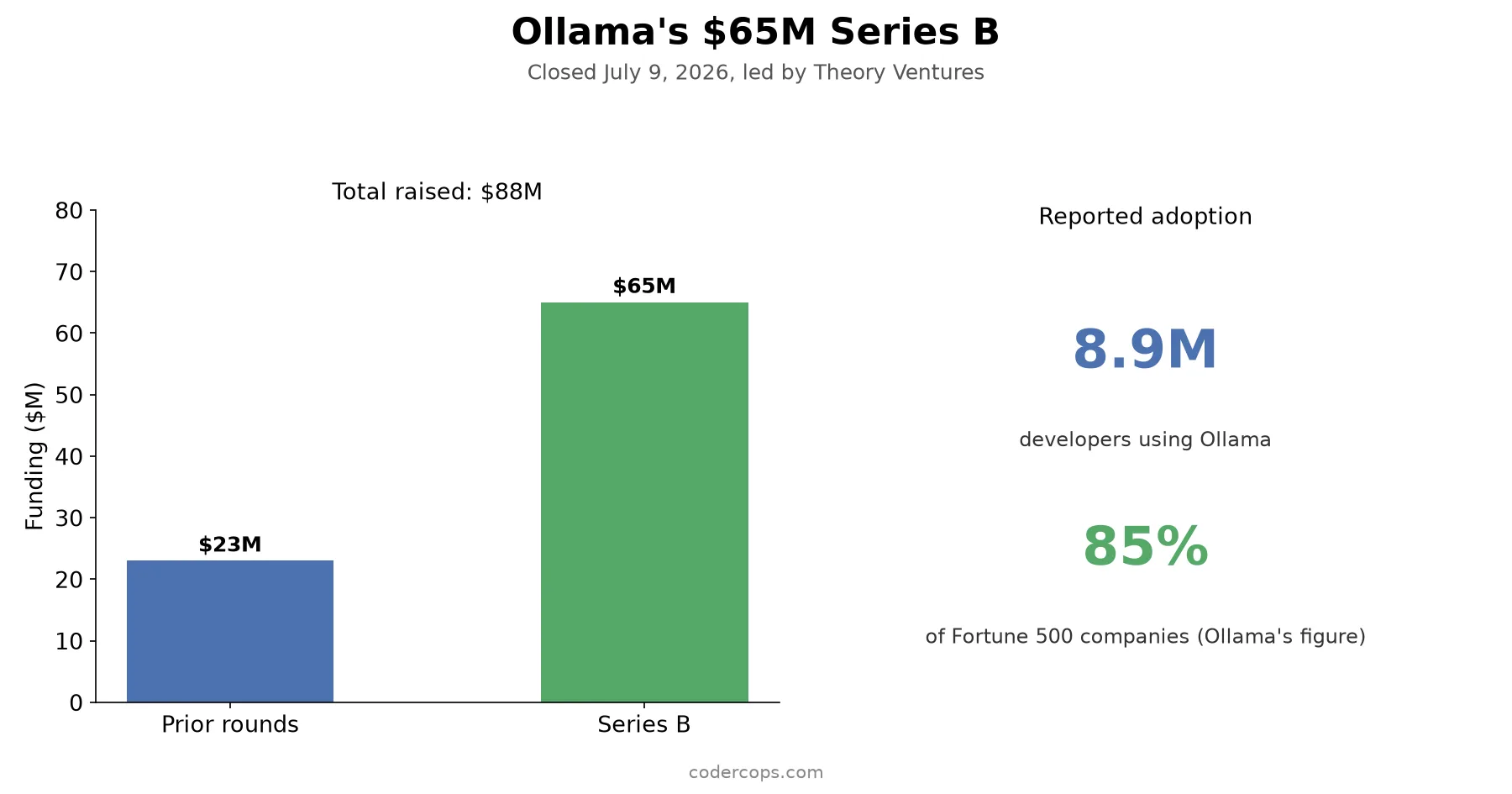
Ollama closed a $65 million Series B on July 9, 2026, led by Theory Ventures with Benchmark, 8VC, and Y Combinator among the participants. That takes total funding to $88 million and comes alongside a growth number worth pausing on: nearly 9 million developers now use the tool, and Ollama says 85% of Fortune 500 companies have some internal adoption. A year ago this was a convenient way to run Llama on your laptop. Now it’s a company with real venture backing and enterprise-scale usage claims.
What Ollama actually does
For anyone who hasn’t touched it, Ollama is a local model runner: it lets you pull open-weight models like Llama, Mistral, or Qwen and run them on your own machine or server with a single command, no API key, no per-token bill, no data leaving your infrastructure. We’ve covered the practical side of running it before. The funding news is a different story: it’s a signal about where local inference sits in the broader AI infrastructure market right now.
Where the money is going
The announcement names three priorities: hybrid inference, expanded model onboarding, and cloud expansion. The first one is the detail worth sitting with. “Hybrid inference” means Ollama isn’t positioning itself as a purely local tool anymore, it’s building toward deciding where a given inference call should run, local or cloud, based on the workload. That’s a meaningfully bigger ambition than “run models on your laptop.” It puts Ollama in more direct competition with the routing and orchestration layer that hosted API providers and inference platforms already compete on, not just the local-runner niche it built its name in.
Expanded model onboarding is the less flashy but more immediately useful piece: faster support for new open-weight releases as they ship, which matters given how quickly the open-weight landscape has been moving through 2026.
What this actually changes for a team deciding where to run inference
The raise itself doesn’t change the technical tradeoffs. What it changes is confidence: a well-funded company actively building the local/hybrid tooling layer is a different risk profile than a community project maintained by volunteers. For a team weighing whether to invest engineering time in local inference infrastructure, that matters.
The cases where local inference earns its complexity haven’t changed:
| Situation | Local inference makes sense | Hosted API makes more sense |
|---|---|---|
| Volume is high and predictable | Yes, cost compounds fast on hosted APIs | Costs scale linearly with usage |
| Data can’t leave your infrastructure | Yes, for compliance or contract reasons | Requires vendor data agreements |
| You need frontier-tier reasoning | Rarely, open-weight models still trail top hosted models | Yes, for the hardest tasks |
| Traffic is bursty or unpredictable | Provisioning hardware for peak load is wasteful | Pay-per-token scales down naturally |
| You need offline or air-gapped operation | Yes, this is the clearest case | Not possible by definition |
None of that math changed on July 9. What changed is that the tool making local inference practical now has the funding to keep improving the parts that are still rough, primarily onboarding new models quickly and handling the local/cloud handoff for you instead of leaving it as something you build yourself.
The bigger signal
Enterprise adoption claims from a company’s own funding announcement deserve some skepticism, “85% of Fortune 500 companies” almost certainly means “someone at that company ran ollama pull at least once,” not “this is core infrastructure.” But even discounted, a $65M round at this growth stage is a real vote that the market for local and hybrid inference tooling is big enough to justify serious investment, not a niche that stays hobbyist-scale forever.
For agencies and teams building AI features, the practical takeaway isn’t “go local now.” It’s that the local option is becoming a genuinely competitive default for a specific slice of workloads, cost-sensitive, compliance-bound, or high-volume, and worth evaluating on its own merits rather than dismissing as a hobbyist alternative to the API providers. If you’re not sure which category your workload falls into, that’s a question worth working through with someone who’s made the call before rather than guessing and re-architecting later.
Frequently asked questions
- How much did Ollama raise and who led the round?
- Ollama closed a $65 million Series B on July 9, 2026, led by Theory Ventures, with participation from Benchmark, 8VC, Y Combinator, and several smaller funds. That brings the company's total funding to $88 million. Ollama has not disclosed a post-money valuation for the round.
- How many people actually use Ollama?
- Ollama reports close to 9 million developers using the tool, up from a much smaller base a year earlier, and says 85% of Fortune 500 companies have some adoption of it internally. Those are Ollama's own figures; independent verification of enterprise adoption at that scale isn't publicly available, but the developer count is corroborated by npm and GitHub download trends across multiple outlets covering the raise.
- What is Ollama actually going to spend the money on?
- Three things, per the announcement: hybrid inference (mixing local and cloud execution depending on workload), expanded model onboarding (making it faster to get new open-weight releases running locally), and cloud expansion. The hybrid-inference focus is the most telling detail, it suggests Ollama's bet isn't 'local-only forever,' it's becoming the layer that decides where inference runs, not just a tool that runs it locally.
- Does this mean we should switch from hosted APIs to local models?
- Not universally, no. Local inference makes the most sense for a specific set of situations: predictable, high-volume workloads where API costs compound, data that can't leave your infrastructure for compliance or contractual reasons, and offline or air-gapped environments. It makes less sense when you need frontier-tier reasoning quality, or when your traffic is bursty enough that provisioning your own hardware costs more than paying per token. The right call is workload-by-workload, not a blanket migration.
- What does Ollama's growth signal for the broader open-weight model ecosystem?
- That the tooling layer around open-weight models has matured enough for real investment, not just hobbyist interest. A $65M round at this stage, with enterprise adoption numbers Ollama is willing to publish, is a sign that running open-weight models locally has become a legitimate infrastructure decision for engineering teams, not a workaround for people who can't afford API access.
Sources
Sponsored
More from this category
More from AI Integration
Sponsored
Discussion
Join the conversation.
Comments are powered by GitHub Discussions. Sign in with your GitHub account to leave a comment.
Sponsored