Cybersecurity · Vulnerability Management
CVE-2026-82078: PaperCut's Pre-Auth RCE Chain
Two chained PaperCut NG/MF flaws let an attacker with no credentials run code on your print server. PaperCut needed two emergency patches to close it.

Prathviraj Singh
5 min read
Sponsored
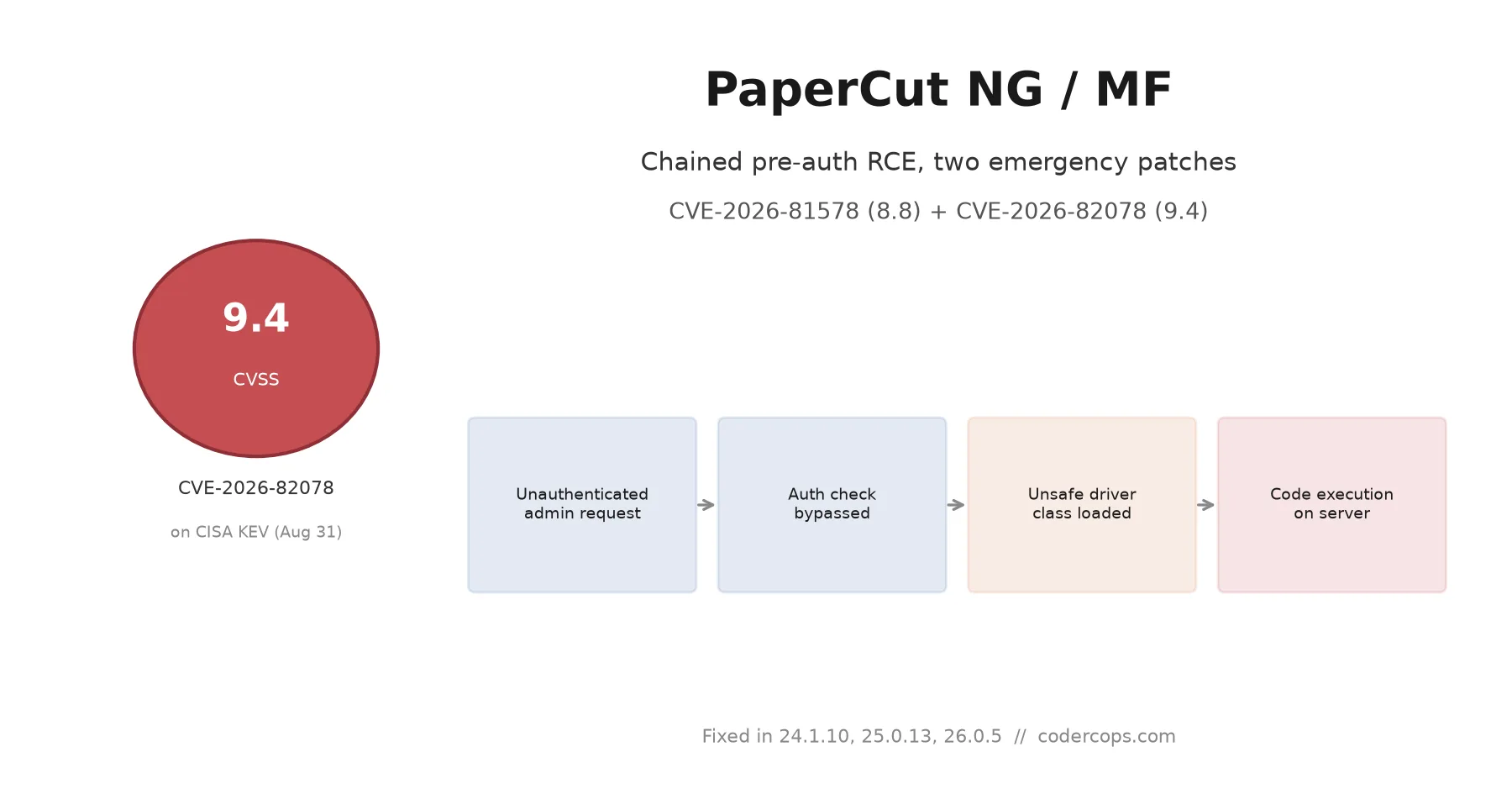
If you run PaperCut NG or MF and haven’t patched since August 28, you’re not done. PaperCut’s first emergency patch that day didn’t actually close the hole; researchers found a bypass within hours, and a second emergency release followed before the weekend. Two chained CVEs, tracked as CVE-2026-82078 (CVSS 9.4) and CVE-2026-81578 (CVSS 8.8), let an attacker with no account and no prior access run code on your print management server. CISA added both to its Known Exploited Vulnerabilities catalog on August 31, and reporting since then shows unpatched, already-compromised servers now being used for data theft.
What the two bugs actually do
PaperCut NG and MF sit in an unusual spot in a lot of networks: they’re print management software, which sounds low-stakes, but they typically hold live database credentials, run with elevated system privileges to talk to print queues across a building or campus, and are reachable from ordinary user VLANs because every desk needs to print. That combination is exactly what makes this chain dangerous.
CVE-2026-81578 is an authentication bypass in the web management interface. Under specific conditions, an unauthenticated request aimed at an administrative function triggers the backend action before the server finishes checking whether the requester is allowed to make it. In plain terms: the door is supposed to check your badge before it opens, and this bug lets the door open first and check the badge after, if it checks at all.
CVE-2026-82078 is the more severe of the two. PaperCut’s database connection utilities instantiate a database driver class based on a configurable driver name, and that name isn’t validated against a list of approved drivers before the server loads and runs it. If an attacker can influence that configuration value, which the authentication bypass hands them a path to do, they can point the server at a class of their choosing and get arbitrary Java bytecode executing under the security context of the PaperCut server process. That’s remote code execution, no credentials required, before authentication has meaningfully happened at all.
Chained together, the two bugs turn an anonymous network request into a shell on the PaperCut Application Server.
Why the first patch wasn’t the end of it
PaperCut published a security bulletin on August 27 and shipped its first emergency patch the next day, covering versions 25 and 26. That’s a fast turnaround for a vendor, and normally the story would end there. It didn’t: researchers at watchTowr and Huntress found ways to route around the initial fix within the same day, and PaperCut shipped a second emergency patch, Emergency Patch Release 2, before the week was out. That second release also extended coverage to version 24, which the first patch hadn’t touched.
The practical lesson isn’t a knock on PaperCut specifically; incomplete first patches on a fast-moving zero-day aren’t rare. It’s that “we patched last week” isn’t the same claim as “we’re on the version that’s actually safe.” If your change log shows you applied the August 28 update and stopped there, check the exact build number against the table below before you consider this closed.
Who’s affected, and what’s fixed
| PaperCut line | Status | Fixed version |
|---|---|---|
| 24.x | Affected (all releases before the fix) | 24.1.10 |
| 25.x | Affected (all releases before the fix) | 25.0.13 |
| 26.x | Affected (all releases before the fix) | 26.0.5 |
Both NG and MF are in scope, self-hosted and on-prem deployments alike. PaperCut says the vulnerable code path touches every current release line, which is unusually broad; there’s no “you’re on an old enough version to be safe” carve-out here the way there sometimes is with a bug introduced in a specific release.
How to patch it
- Update to 24.1.10, 25.0.13, or 26.0.5, matching your current major line. If you’re running anything earlier than that on the same line, this is the version to land on, not an intermediate one.
- Confirm the build number, not just that an update ran. If your last patch predates the second emergency release, you applied a fix that researchers demonstrated a bypass for. Re-patch.
- Check PaperCut’s published indicators of compromise against your logs, particularly around the disclosure window (roughly August 25 through 28), before you assume a pre-patch server was untouched.
- Rotate credentials the PaperCut server held, especially any database connection strings, if you can’t rule out compromise during the exposure window. Code execution under the server’s process context means an attacker had access to whatever that process could reach, not just PaperCut’s own data.
- Review network exposure. PaperCut Application Servers reachable from general user networks (which is common, since it’s how desktop clients submit print jobs) have a larger practical attack surface than ones restricted to admin subnets, even though the vulnerability itself doesn’t require special network positioning to exploit.
The broader pattern worth remembering
This is the second time this year an internal, unauthenticated-by-necessity interface (a password reset flow, an admin bootstrap check, a driver-loading utility) has turned into a full compromise path, and it won’t be the last. Any component that has to accept some requests before full authentication is complete, because that’s how account recovery or admin management works, deserves the kind of scrutiny that “it’s just an internal print server” doesn’t usually get. If your organization runs self-hosted infrastructure tools that fit that description and haven’t had a focused security review recently, that gap is worth closing before a CVE forces the conversation. We help teams audit exactly this class of exposure in self-hosted admin and management interfaces before it becomes an incident.
Patch to 24.1.10, 25.0.13, or 26.0.5 if you haven’t already confirmed the exact build, and don’t treat “we patched in August” as sufficient without checking which patch.
Frequently asked questions
- What is CVE-2026-82078?
- A critical unsafe dynamic class-loading vulnerability (CVSS 9.4) in PaperCut NG and MF's database connection utilities. The application instantiates database driver classes based on a configurable driver name without checking it against an allowlist. An attacker who can influence that configuration value can get the server to load and execute arbitrary Java bytecode under the PaperCut server process.
- What is CVE-2026-81578?
- A high-severity authentication bypass (CVSS 8.8) in the PaperCut web management interface. Under specific conditions, an unauthenticated request targeting an administrative function can trigger the backend action before the server finishes validating that the requester is allowed to make it.
- Do I need both CVEs present to be at risk?
- The two are meant to be chained: CVE-2026-81578 gets an unauthenticated request past the access check that would normally block it, and CVE-2026-82078 turns that access into arbitrary code execution. Patching either one breaks the chain, but PaperCut fixed both in the same emergency releases, so there's no reason to patch only one.
- Which PaperCut versions are safe?
- 24.1.10, 25.0.13, and 26.0.5, released as PaperCut's second emergency patch. If you applied only the first emergency patch from August 28 and haven't updated again since, treat your server as still exposed; researchers found ways around that first fix within days.
- Is this actually being exploited, or just theoretical?
- It's active. PaperCut confirmed customer incidents before it published a security bulletin, CISA added both CVEs to its Known Exploited Vulnerabilities catalog on August 31, and reporting since then describes already-compromised, unpatched servers being used for data theft, not just proof-of-concept access.
Sources
Sponsored
More from this category
More from Cybersecurity
Sponsored
Discussion
Join the conversation.
Comments are powered by GitHub Discussions. Sign in with your GitHub account to leave a comment.
Sponsored