Cybersecurity · Vulnerability Management
Cl0p Breached 40+ Firms Through PTC Windchill
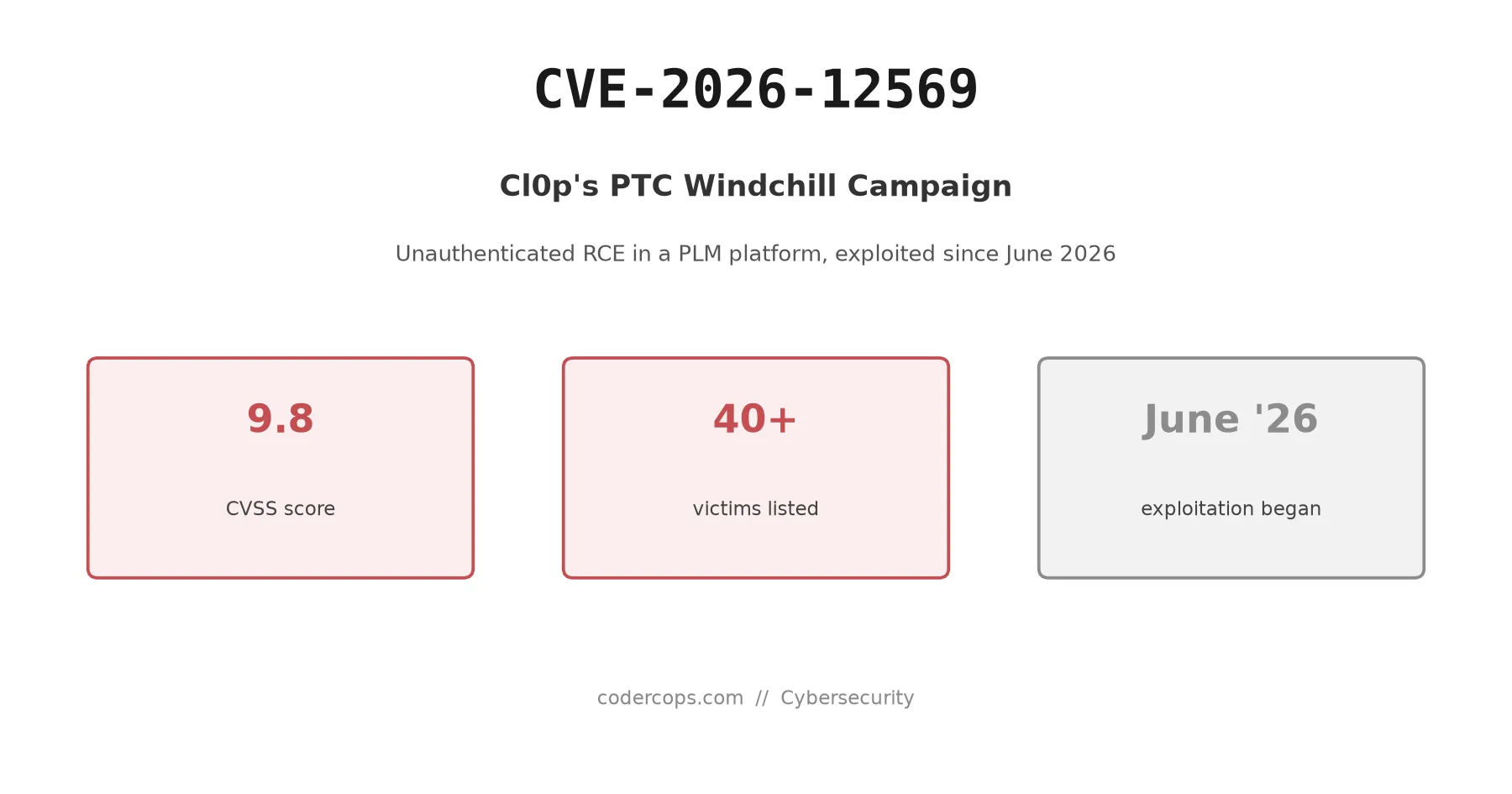
One unauthenticated RCE in PTC Windchill and FlexPLM let Cl0p quietly take data from Shell, Philips, and GE. How CVE-2026-12569 works, and what to check.

Prathviraj Singh
5 min read
Sponsored
If you’d never heard of PTC Windchill before this month, you’re not alone, and that’s exactly the problem. Windchill and its sibling FlexPLM are product lifecycle management platforms: the systems that manufacturers, aerospace suppliers, and industrial companies use to manage engineering drawings, bill-of-materials data, and supplier specifications. They’re not the kind of software that shows up in a typical security review, because they’re not customer-facing and they don’t hold anything that looks like a credit card number. That obscurity is exactly why Cl0p picked them.
By August 19, 2026, the extortion group had listed more than 40 organizations on its leak site, among them Shell, Philips, General Electric, Fiserv, Zebra, and Largan Precision. The vulnerability behind it, CVE-2026-12569, is a CVSS 9.8 flaw that needed no credentials, no phishing email, and no insider. Just a network path to a vulnerable Windchill instance.
What’s actually broken
CVE-2026-12569 is an improper input validation issue: a specially crafted request to a vulnerable Windchill or FlexPLM server triggers arbitrary code execution, with no authentication required. That combination, unauthenticated plus remote code execution plus a near-perfect severity score, is the same shape as the MOVEit Transfer flaw Cl0p used in 2023, and it’s not a coincidence that the same group found this one too. Cl0p has spent years specializing in exactly this kind of target: widely deployed enterprise file-transfer and data-management software with a security posture that lags behind the amount of sensitive data flowing through it.
Once inside, attackers deployed web shells that gave them the ability to read application files, query the underlying database directly, decrypt stored secrets, and pull administrative credentials, the kind of access that controls not just the Windchill instance itself but often the broader identity infrastructure it’s connected to.
Why this ran quiet for so long
The exploitation pattern points to Cl0p using CVE-2026-12569 as a zero-day starting in early June 2026, with the security community only picking up on exploitation in late July. CISA didn’t add it to the Known Exploited Vulnerabilities catalog until well after that pattern was already visible in the wild.
That gap matters because Cl0p’s entire model depends on it. The group doesn’t encrypt files or drop a ransom note the moment it gets in, the way most ransomware operators do. It exfiltrates data quietly, sits on it, and only surfaces once it’s ready to extort victims by threatening publication. There’s no crashed server or locked file share to force an immediate incident response. The first sign a victim organization gets is often its own name showing up on a leak site, weeks or months after the actual theft happened. This is the exact structure that made MOVEit so damaging in 2023: thousands of organizations found out they’d been breached only after their data was already being sold or published.
Why a PLM platform is a good target
Security programs are built around where sensitive data is assumed to live: customer databases, payment systems, HR platforms. A product lifecycle management system doesn’t fit that mental model, even though it routinely holds engineering drawings, unreleased product specifications, supplier contracts, and pricing data, the kind of information a competitor or a nation-state actor would pay well for, and the kind of information that rarely gets the same monitoring, patch cadence, or access review as anything labeled “customer data.”
That’s the pattern worth internalizing here, independent of whether your organization runs Windchill specifically. Attackers are increasingly good at finding the enterprise software that holds real value but sits outside the systems everyone remembers to secure first. We wrote about the same dynamic after the Ceva Logistics breach, where the exposure came through a vendor’s vendor rather than a direct target. A PLM platform is the same category of blind spot: important enough to run, obscure enough to skip the review.
What to do right now
If you run Windchill or FlexPLM anywhere reachable from the internet:
- Confirm your version against PTC’s advisory and apply the patch immediately if you haven’t. Treat any internet-facing instance as compromised until you’ve actively ruled it out, not just patched it.
- Check for web shells and unexpected files in the Windchill installation directory, and review process activity on the host for anything that shouldn’t be running an application server.
- Audit outbound traffic logs from around June and July 2026 for large or unusual data transfers, since that’s the likely window for silent exfiltration before the leak site listings began.
- Rotate credentials that were accessible from the Windchill host, including any service accounts or database credentials the application had access to, since a web shell of this depth typically means those secrets were reachable.
- If you’re a supplier or partner of a company that runs Windchill, ask directly whether they’ve checked their exposure. PLM data commonly spans an entire supply chain, not just the company that licensed the software.
A patch closes the door. It doesn’t tell you what already walked through it while it was open, and with a campaign like this one, that window was measured in months, not hours. If your organization runs enterprise software that nobody’s reviewed specifically for exposure like this, a focused audit is a lot cheaper before your name shows up on a leak site than after. Our security-focused engineering work starts with exactly that kind of inventory: not just what’s patched, but what’s actually exposed and what it’s connected to.
Frequently asked questions
- What is CVE-2026-12569?
- An improper input validation vulnerability in PTC's Windchill and FlexPLM product lifecycle management software. It scores 9.8 out of 10 on CVSS and lets a remote, unauthenticated attacker execute arbitrary code by sending a specially crafted request to a vulnerable server. No login, no prior access, and no user interaction required.
- Is this the same group behind the MOVEit breaches?
- Yes. Cl0p is the extortion group that ran the 2023 MOVEit Transfer campaign, which eventually affected thousands of downstream organizations. The Windchill campaign follows the same playbook: find one widely deployed enterprise platform with an unauthenticated RCE, exploit it quietly across as many exposed instances as possible, exfiltrate data, then extort victims by threatening to publish it rather than encrypting anything.
- How do I know if my organization is affected?
- If you run PTC Windchill or FlexPLM on infrastructure reachable from the internet, treat yourself as a candidate for compromise until you've confirmed otherwise. Check your version against PTC's advisory, look for unfamiliar web shells or unexpected files in your Windchill installation directory, and review outbound traffic logs from the host for unusual data transfers around June and July 2026, the window when exploitation is believed to have started.
- Why did it take so long for this to become public?
- Cl0p ran this as a silent data-theft operation, not a ransomware deployment. There was no encrypted file share or ransom note forcing an immediate incident response. Data was quietly exfiltrated for weeks before the group began listing victims on its leak site in mid-August, which is the same delayed-disclosure pattern that made MOVEit so damaging: the breach was already old news to the attacker by the time defenders found out.
- What should we do if we don't use Windchill ourselves but work with companies that do?
- Ask. PLM platforms typically hold supplier specifications, CAD files, and contract details shared across a manufacturing or engineering supply chain, which means a Windchill compromise at one company can expose data belonging to its partners and suppliers too. If a vendor or partner runs Windchill, it's a reasonable question to ask them directly whether they've checked their exposure to CVE-2026-12569.
Sources
Sponsored
More from this category
More from Cybersecurity
Sponsored
Discussion
Join the conversation.
Comments are powered by GitHub Discussions. Sign in with your GitHub account to leave a comment.
Sponsored