Cybersecurity · Vulnerability Advisories
ShieldBreak: The Windows Defender Zero-Day, Unpatched
A public proof-of-concept for a Windows Defender privilege-escalation flaw has circulated since August 12 with no fix shipped. What to do about it now.

Prathviraj Singh
4 min read
Sponsored
A working proof-of-concept for a Windows Defender privilege-escalation flaw has been public since August 12. Microsoft assigned it a CVE two days later. As of this week, there’s still no patch. That combination, a public exploit and an open vulnerability window measured in weeks, is exactly the scenario security teams plan tabletop exercises around. Here it’s not a tabletop exercise.
The flaw is being tracked as ShieldBreak, disclosed by a researcher going by “Nightmare Eclipse,” and formally cataloged as CVE-2026-69414.
What it is
ShieldBreak is an elevation-of-privilege vulnerability in the Microsoft Malware Protection Engine, the scanning component behind Windows Defender. It lets a low-privileged local attacker escalate to SYSTEM. The technical path runs through how Defender handles cloud-file hydration: the exploit uses a user-mode callback to interfere with the file data Defender scans through the Cloud Filter API, combined with Windows filesystem and Object Manager tricks that influence which file actually gets scanned. The practical effect is that Defender ends up trusting something it shouldn’t.
It’s worth being precise about what this is not. It’s not a remote code execution bug, and it doesn’t get an attacker onto a machine that wasn’t already compromised. It’s a local privilege escalation, which means it matters most as the second stage of an attack: phishing gets initial access as a standard user, ShieldBreak turns that into full control. Treating “local” as “low priority” is the mistake that turns a contained incident into a domain-wide one.
Why the timeline is the story
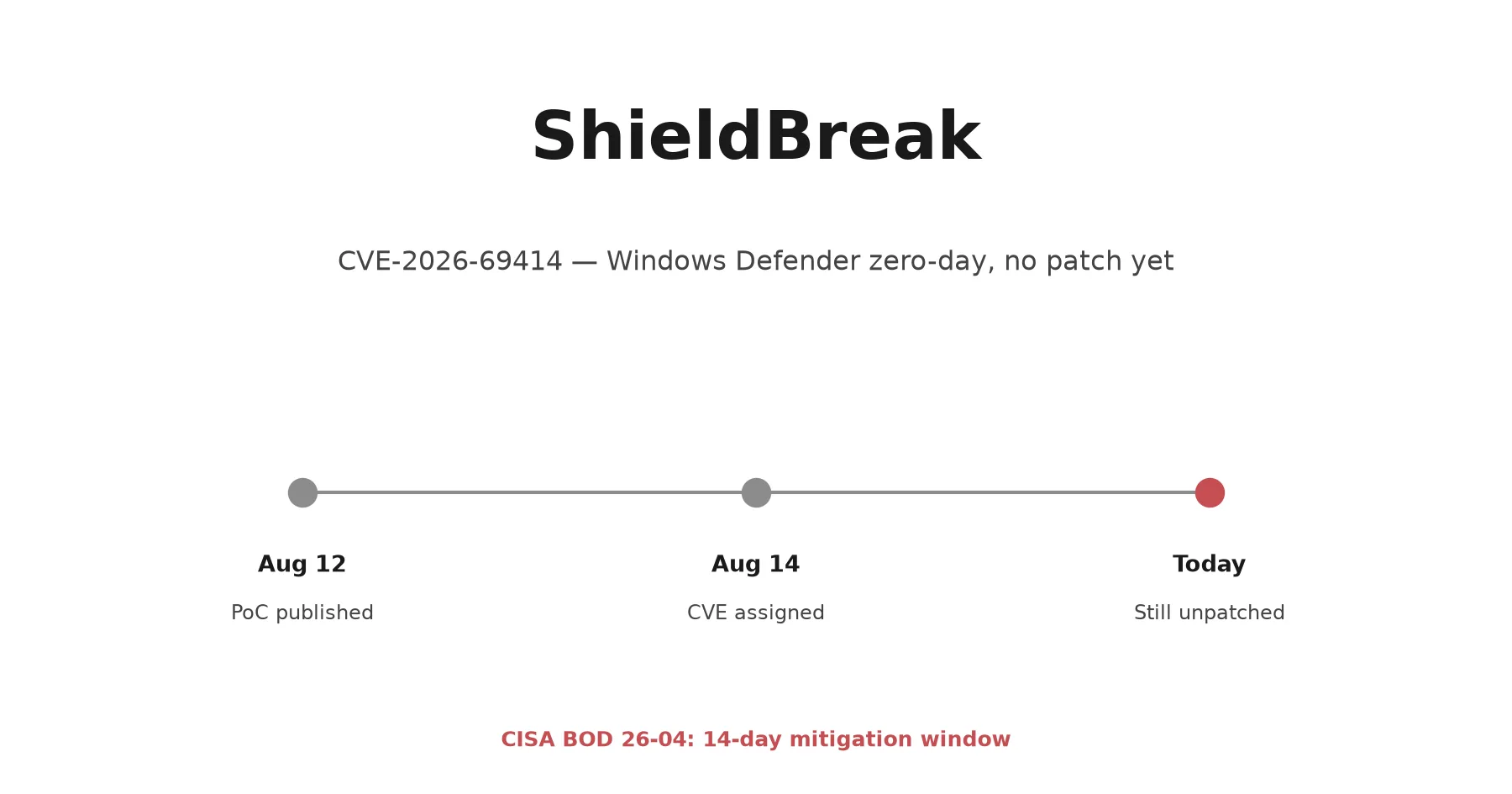
Reported publicly, this is the sequence:
- August 12, 2026: a working proof-of-concept is published, demonstrating the local-to-SYSTEM escalation.
- August 14, 2026: Microsoft assigns CVE-2026-69414.
- As of this writing: Microsoft confirms it is developing a fix but has not shipped one.
Public reporting also describes ShieldBreak as bypassing the patch Microsoft already shipped for a related Defender privilege-escalation bug, RoguePlanet (CVE-2026-50656). The two land the same outcome, an attacker reaching SYSTEM through Defender, but through different mechanisms: RoguePlanet exploited a virtual-disk race condition, while ShieldBreak uses CFAPI hooking during cloud-file hydration. Patching one path didn’t close the other, which is a useful reminder that “we already fixed the Defender privilege-escalation bug” isn’t a complete answer once a second, architecturally distinct one shows up using the same component.
What CISA’s directive means for you even if you’re not a federal agency
CISA’s Binding Operational Directive 26-04, which governs how federal civilian agencies prioritize vulnerability remediation, reportedly requires a 14-day mitigation window for ShieldBreak. The detail worth noting is that the directive accepts a mitigation action as meeting that deadline when no patch exists yet, rather than requiring a completed fix. That’s a useful model to borrow even if BOD 26-04 doesn’t bind your organization directly: set your own clock from disclosure, and define what “mitigated” means for you before a patch exists, instead of treating “no patch yet” as a reason to wait.
Confirmed affected systems are Windows 11 25H2 and Windows Server 2025. Verify your Defender-managed fleet against those two before assuming you’re out of scope.
What to actually do this week
There’s no patch to apply, so the response has to be mitigation rather than remediation:
- Tighten local privilege sprawl. ShieldBreak needs an existing low-privilege foothold to work from. Every account with unnecessary local admin or interactive-logon rights on an affected build is one fewer step an attacker needs.
- Keep Defender’s platform and intelligence updates current. Microsoft has a track record of shipping partial mitigations through Defender’s own update channel ahead of a full engine fix. That update channel is separate from a Windows security patch and worth checking specifically.
- Watch for anomalous activity around cloud-file hydration. Security teams running EDR with custom detection rules should look for the callback and Object Manager patterns described in public write-ups, since a signature-based detection won’t reliably catch a technique built specifically to interfere with what Defender scans.
- Track the CVE entry, not just the news cycle. Microsoft has said it will update the CVE record once a fix ships. That’s a more reliable signal than waiting for a headline.
This is the same posture we recommend in our guide to preventing SQL injection: assume the vulnerability window is real and act on mitigations now, rather than waiting for the patch to become the trigger for action. If your team needs help building a standing process for tracking unpatched vulnerabilities like this one against your actual fleet, that’s the kind of gap our security engineering work closes before it becomes an incident review.
Frequently asked questions
- What does ShieldBreak actually let an attacker do?
- It's a privilege escalation, not an initial-access vulnerability. An attacker who already has low-privileged local code execution on an affected machine, through phishing, a compromised account, or another vulnerability, can use ShieldBreak to escalate to SYSTEM. It doesn't get an attacker onto the machine in the first place; it lets them take it over once they're already there.
- Is there a patch for CVE-2026-69414?
- Not as of this writing. Microsoft has confirmed it's developing a security update and will update the CVE entry once it ships, but no fix is currently available. That's an unusual position for a vulnerability with a public, working proof-of-concept.
- How is ShieldBreak different from RoguePlanet?
- RoguePlanet (CVE-2026-50656) was an earlier Defender privilege-escalation flaw that Microsoft already patched. ShieldBreak reportedly reaches the same privileged outcome through a different, architecturally distinct path: it hooks the Cloud Filter API (CFAPI) during cloud-file hydration rather than using the virtual-disk race condition RoguePlanet relied on. The patch for one didn't close the other.
- What should we do if we can't patch yet?
- Since no patch exists, focus on reducing the attack surface an escalation depends on: tighten local admin and interactive-logon rights so fewer accounts can plant the low-privilege foothold this needs, keep Defender's own platform and intelligence updates current since Microsoft ships mitigations there ahead of a full fix, and watch for anomalous local process activity around cloud-file hydration paths. None of this closes the hole; it raises the cost of using it.
- Does this affect every Windows machine?
- Public reporting ties confirmed exploitation specifically to Windows 11 25H2 and Windows Server 2025. If you're not running one of those, verify your own build against Microsoft's advisory once it's published rather than assuming you're out of scope, since affected-version details for Defender engine flaws are sometimes broadened after initial disclosure.
Sources
Sponsored
More from this category
More from Cybersecurity
Sponsored
Discussion
Join the conversation.
Comments are powered by GitHub Discussions. Sign in with your GitHub account to leave a comment.
Sponsored