Industry News · Acquisitions
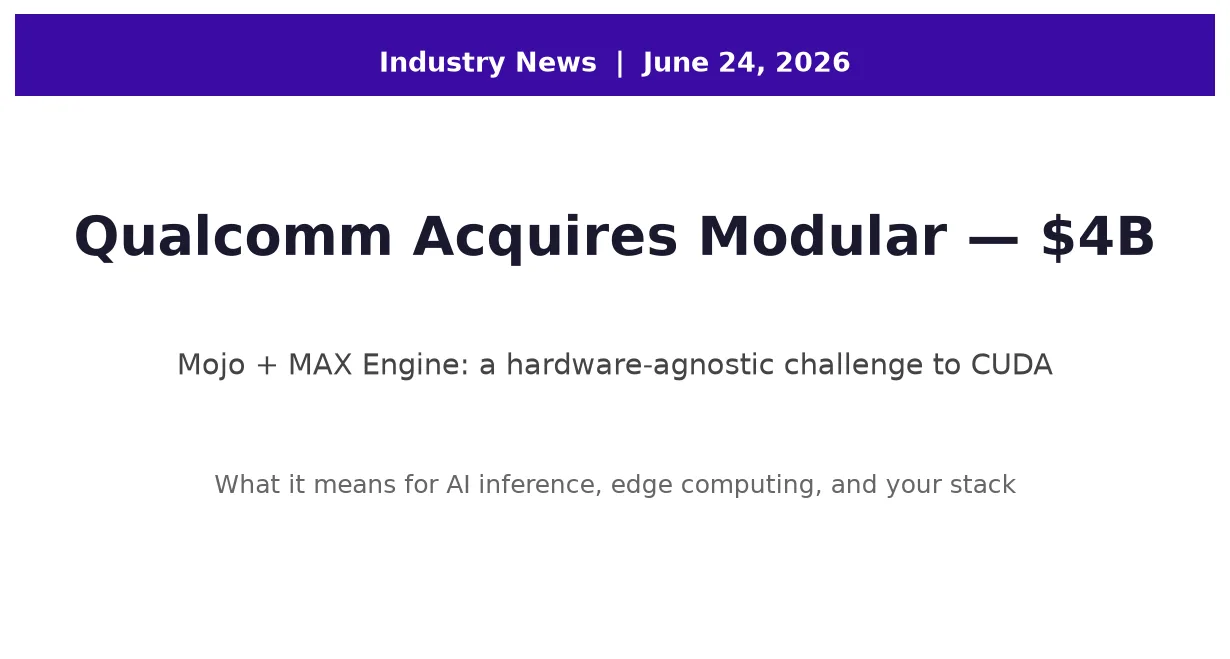
Qualcomm Buys Modular for $4B: The CUDA Challenge
Qualcomm's $3.92B all-stock deal for Modular, behind Mojo and MAX, bets on a hardware-agnostic path around NVIDIA's CUDA lock-in. What actually changes.

Anurag Verma
7 min read
Sponsored
NVIDIA’s grip on AI compute has always rested on two things: hardware that is genuinely good, and software that makes it genuinely hard to leave. CUDA, the parallel computing platform NVIDIA launched in 2007, is the second part. After 19 years of developer investment, CUDA knowledge is baked into models, pipelines, libraries, and job descriptions. Switching away from NVIDIA hardware means rewriting that foundation.
Qualcomm knows this, and on June 24, 2026, it made a $3.92 billion bet on fixing it.
The company Qualcomm is buying
Modular was founded in 2022 by Chris Lattner and Tim Davis. Lattner’s resume is not subtle: he created LLVM, the compiler infrastructure that underpins every major language toolchain from Swift to Rust to Clang. He led Tesla’s Autopilot software team. At Google, he worked on the XLA ML compiler.
When Lattner decided to start Modular, he was thinking about the same problem Qualcomm is trying to solve: AI compute is fragmented across hardware that each requires its own software stack. NVIDIA has CUDA. AMD has ROCm. Google has TPUs. Apple has Neural Engine. Qualcomm has Hexagon NPUs and Adreno GPUs. A team that wants to run inference on all of them must either pick one and accept the others’ overhead, or maintain multiple codebases.
Modular’s answer is MAX (formerly known in early demos as the Modular AI Engine). MAX is an inference engine that sits between your model and the hardware, compiling to an optimized representation that runs efficiently across CPUs, GPUs, NPUs, and custom ASICs. The compile target is MLIR (Multi-Level Intermediate Representation), developed at Google and the same foundation that the XLA compiler, the LLVM ecosystem, and major ML compilers use.
The Mojo language is the developer-facing layer. It is a Python superset: valid Python runs in Mojo, but Mojo adds zero-cost abstractions, value semantics, and compile-time metaprogramming that let performance-critical paths reach near-C speeds. The intent is that ML engineers can prototype in Python, then optimize the hot path in Mojo without changing languages.
What Qualcomm gets from this
Qualcomm’s Snapdragon chips are in hundreds of millions of devices: Android phones, Windows on ARM laptops, automotive systems, industrial edge hardware. Each of those chips includes a Hexagon NPU and Adreno GPU. AI inference is a natural workload for them: running models locally on the device, without sending data to a cloud API.
The problem Qualcomm has had is not hardware. It is software. Developers write AI code for NVIDIA because the ecosystem is there. PyTorch, TensorFlow, and most inference libraries first-class support NVIDIA CUDA. Getting the same model to run well on Snapdragon has required porting work, and porting work is friction.
MAX removes that friction at the runtime level. Instead of rewriting model inference code for Hexagon or Adreno, a developer would describe their model in a MAX-compatible format (or import from ONNX, PyTorch, or another common interchange) and let MAX compile an optimized version for the target hardware. Qualcomm’s goal is for “run this model on a Snapdragon device” to require the same effort as “run this model on an NVIDIA GPU.”
That matters commercially because the edge inference market is substantial. On-device AI means lower latency (no network roundtrip), lower cost (no cloud API fees), and privacy benefits for applications that cannot or should not send data to a remote server. Qualcomm is well-positioned in that hardware market. MAX is the software layer it needed.
The CUDA challenge in context
Challenges to CUDA have been announced before. ROCm (AMD), oneAPI (Intel), and Apple Metal are all real alternatives in their respective ecosystems. None has displaced CUDA for AI training workloads, because CUDA’s lead in training is built on years of library development: cuBLAS, cuDNN, NCCL, and the rest of the stack that makes NVIDIA the default for building new models.
MAX’s angle is not training. It is inference. Running a finished model on hardware is a different optimization problem from training it. The model weights are fixed. You are optimizing for throughput, latency, and power efficiency on a specific chip. That is closer to a compilation problem than a hardware race, and compilation is exactly what MLIR was designed for.
The realistic near-term outcome is not that CUDA loses the training market. It is that MAX makes inference on non-NVIDIA hardware practical for teams that have not staffed an optimization team. A startup deploying a model on-device, an agency integrating AI inference into a client’s edge product, an enterprise running inference on heterogeneous hardware: those are the customers this stack targets.
What changes for developers in practice
If you are building AI applications today: Nothing changes immediately. The deal closes in H2 2026. MAX and Mojo are available now as Modular products, and that continues post-acquisition. If you are evaluating inference runtimes and want hardware flexibility, MAX is worth benchmarking against ONNX Runtime and TensorRT-LLM.
If you target edge or mobile: The acquisition is directly relevant. Qualcomm will invest more in MAX’s Snapdragon-specific optimizations. The path to running inference on Snapdragon without maintaining a separate stack is likely to improve.
If you write Mojo: Nothing changes negatively. Qualcomm has $14 billion in planned AI infrastructure investment (Modular plus reported Tenstorrent talks). Mojo becoming better-resourced is a reasonable expectation.
If you are currently all-in on CUDA: No immediate pressure. For training workloads, CUDA remains the default, and this acquisition does not change the training picture. For inference, it is worth keeping a tab on MAX as a porting target, particularly if clients are asking about edge deployment or cost reduction.
What this signals for the broader ecosystem
The AI chip wars have been mostly about compute: who has the fastest GPU, the most memory bandwidth, the best interconnect. This acquisition is different. Qualcomm is spending nearly $4 billion not on silicon but on a software abstraction layer.
That is a statement about where the competition is moving. Hardware differentiation matters less if the software layer can abstract it away. The moat worth defending is the developer stack: the tooling, the libraries, the compatibility surface that determines where people write code and therefore where they spend on hardware.
NVIDIA understood this in 2007 when it released CUDA for free. Qualcomm understands it now. The question for the next few years is whether MAX becomes the abstraction that makes hardware choice a runtime decision rather than a code-rewrite decision.
For teams working on AI product development, the practical advice is: keep MAX on your radar, especially if you are deploying inference at the edge or on diverse hardware. For the actual current-hardware decision (what GPU cluster to use for training), nothing about this acquisition changes the near-term calculus. The impact is a 2027 story. But it is worth starting to understand now.
For context on how AI infrastructure spending at this scale compares to what other companies are betting, the pattern of $4B-plus acquisitions targeting the AI stack has been consistent across 2025 and 2026, and it points to the same underlying dynamic: the companies that control the inference software stack will extract value from AI compute for a long time. Teams that want to remain independent of any single vendor’s stack are watching this space, and the AI infrastructure and chip landscape in 2026 gives the broader context for where Qualcomm’s move fits.
Frequently asked questions
- What is Modular and what does it build?
- Modular is an AI software company founded in 2022 by Chris Lattner and Tim Davis. It builds two main products: Mojo, a Python superset that adds Python's ease of use to MLIR-based compilation for near-C performance; and MAX, an inference engine that runs AI models on CPUs, GPUs, NPUs, and custom ASICs from a single codebase. MAX is the core of the acquisition.
- What is CUDA and why does Qualcomm want to challenge it?
- CUDA is NVIDIA's parallel computing platform and programming model. It has been the dominant way to write GPU code for ML workloads since 2007. The catch: CUDA only runs on NVIDIA hardware. If your model is written in CUDA, it runs only on NVIDIA GPUs. This is the lock-in that gives NVIDIA pricing power over AI infrastructure. Qualcomm, which makes Snapdragon chips with dedicated NPUs (neural processing units), needs a software path that lets developers target Snapdragon without rewriting CUDA code. That is what MAX provides.
- What is Mojo and is it production-ready?
- Mojo is a superset of Python built on MLIR (Multi-Level Intermediate Representation), the same compiler infrastructure that underlies LLVM and many production ML compilers. It lets you write Python-syntax code that compiles to machine code with performance approaching C or C++. It is production-usable for ML inference workloads in 2026, though the ecosystem is smaller than Python's. The acquisition does not invalidate Mojo. If anything, Qualcomm's resources should accelerate it.
- Does this affect my current AI projects?
- Not immediately. The deal closes in H2 2026. If you're writing inference code in PyTorch or TensorFlow targeting NVIDIA hardware, nothing in your stack changes for now. The medium-term implication is that Qualcomm will push MAX more aggressively as the path to running the same model on edge devices (Snapdragon PCs, phones, automotive) without a separate porting effort.
- Who is Chris Lattner and why does it matter?
- Chris Lattner created LLVM (the compiler infrastructure now used by Apple, Google, and virtually every major compiler toolchain), Apple's Swift language, and led the Autopilot software team at Tesla. He is one of the most prolific compiler engineers alive. Modular's architecture reflects that. MAX is built on MLIR, and the performance gains come from real compiler optimization, not marketing claims.
Sources
Sponsored
More from this category
More from Industry News
Sponsored
Discussion
Join the conversation.
Comments are powered by GitHub Discussions. Sign in with your GitHub account to leave a comment.
Sponsored