Cybersecurity · Vulnerability Management
pgAdmin 4 CVE-2026-12048: Patch to 9.16 Now
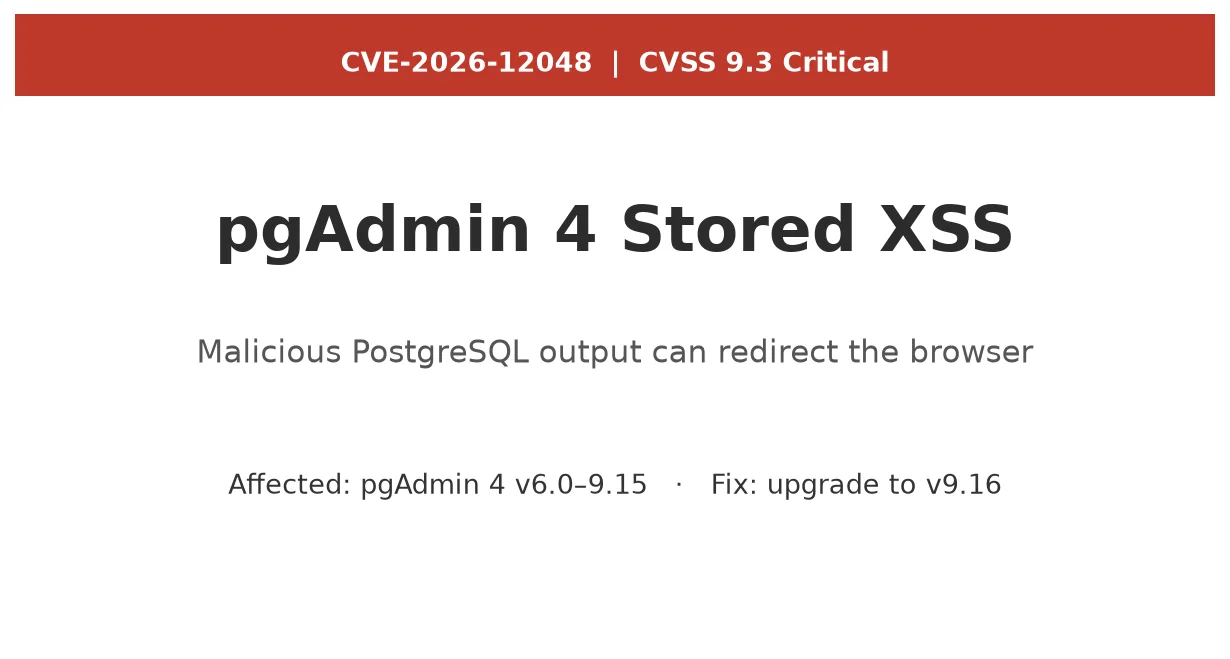
A CVSS 9.3 stored XSS lets a malicious PostgreSQL server inject JavaScript into your pgAdmin tab. Versions 6.0 to 9.15 are affected; v9.16 is the fix.

Prathviraj Singh
6 min read
Sponsored
pgAdmin 4 is the standard GUI for PostgreSQL. Most teams with a Postgres database have it running somewhere: a developer’s laptop, a bastion host, a shared ops workstation. On June 19, 2026, a disclosure landed that affects every pgAdmin 4 version from 6.0 to 9.15: a stored cross-site scripting vulnerability with a CVSS score of 9.3.
If you run pgAdmin 4, you should be on v9.16 before you read another paragraph.
What the vulnerability is
CVE-2026-12048 is a stored XSS. It does not require the user to click a malicious link or visit a crafted URL. The attack path runs through the database connection itself.
When pgAdmin displays an error from a PostgreSQL server (something like a “relation does not exist” message), it includes the relation name in the error text. That error text gets passed through html-react-parser, which is designed to render HTML strings into React elements. The problem is that pgAdmin passed unescaped server output directly to the parser without sanitizing it first.
The same issue exists in EXPLAIN plan output. Fields like Recheck Cond and Exact Heap Blocks from a query plan are also rendered via the parser.
An attacker who controls the server (or can influence what the server returns) sends back a crafted error message or plan output containing HTML and JavaScript. pgAdmin renders it. The attacker’s JavaScript now runs in the user’s browser session.
The immediate consequence: the attacker redirects the pgAdmin browser tab to a phishing page. Because pgAdmin users are typically database administrators, this is a targeted path to capturing credentials from a high-privilege user.
The attack path in concrete terms
A typical scenario with a team pgAdmin deployment:
- A developer connects pgAdmin to an internal staging database. Unknown to them, that staging database’s schema has been manipulated by an earlier intrusion. An attacker added a table with a specially crafted name.
- When pgAdmin queries for the table and receives an error referencing the table name, the crafted name is rendered by
html-react-parseras live HTML. - A JavaScript redirect fires. The pgAdmin tab navigates to a convincing fake login page.
- The developer types their real credentials to “re-authenticate.”
This does not require the attacker to have persistent access to the machine running pgAdmin. It requires only that pgAdmin connects to a database the attacker can influence at least once.
What else shipped in the June 2026 pgAdmin advisory
CVE-2026-12048 is the headline, but the v9.16 release patches a cluster of vulnerabilities:
CVE-2026-12044, AI assistant bypass (CVSS 9.0). pgAdmin 4 added an AI assistant feature in a recent version. This vulnerability allows the assistant’s restrictions to be bypassed, potentially allowing SQL queries outside the intended scope to be issued on behalf of the user.
CVE-2026-12046, SQL injection in the query tool (CVSS 8.8). The maintenance and query tools in pgAdmin pass certain parameters to the database without adequate parameterization. An attacker with pgAdmin access can inject arbitrary SQL, including commands that run outside the current user’s intended query.
CVE-2026-12045. Additional flaw patched in the same release. Check the official advisory for current details.
CVE-2026-7815, SQL injection in the Maintenance Tool, also tracked in the GitHub Advisory Database (GHSA-hp84-p2gq-6fvr). This affects the maintenance dialog specifically.
Taken together, this is one of the heavier pgAdmin patch drops in recent memory. It is not a routine update.
How to check your version and upgrade
# In pgAdmin, go to Help > About to see your version
# Or check your system package

# For pip-installed pgAdmin:
pip show pgadmin4 | grep Version

# For system packages (Debian/Ubuntu):
dpkg -l | grep pgadmin4

# For macOS with Homebrew:
brew info pgadmin4

# For Windows: check Add/Remove Programs or the pgAdmin installer version
The fix is pgAdmin 4 v9.16. Download it from the official pgAdmin site or upgrade your system package:
# pip:
pip install --upgrade pgadmin4

# Debian/Ubuntu via apt (if the pgAdmin APT repo is configured):
apt update && apt install pgadmin4

# Homebrew:
brew upgrade pgadmin4
After upgrading, confirm the version shows 9.16 or later before connecting to any external database.
Risk triage by environment
Shared team pgAdmin (highest risk). If multiple people share a pgAdmin instance or connect to databases that external parties may have influenced, treat this as urgent. The phishing and credential-harvest risk is real when the users are DBAs.
Individual developer workstation connecting to own databases (lower risk). You are unlikely to encounter a crafted server error unless your database server itself is compromised. Still, upgrade. There is no reason to stay exposed.
pgAdmin not internet-exposed but on an internal network. The attack requires a malicious server, not network access to pgAdmin. Internal positioning does not eliminate the risk if the connected databases are multi-tenant or accessible to other teams.
pgAdmin not installed. If your team uses other PostgreSQL clients (DBeaver, DataGrip, psql directly), you are not affected by this CVE. It is specific to pgAdmin 4.
No workaround, patch is the only fix
No configuration option disables the vulnerable rendering path. The fix requires the parser changes in v9.16 that properly sanitize server output before it reaches html-react-parser.
If upgrading immediately is not possible (staged rollout, packaged deployment), consider restricting pgAdmin to connections against read-only replicas or databases with tightly controlled schemas until the patch is applied. This reduces exposure but does not eliminate it.
For teams that moved their database administration to a dedicated security-reviewed tool or a bastion with strict access controls, this is a reminder that developer tools in the database access path carry real attack surface. The same thought applies to reviewing other developer-facing tools. See how teams approach layered security in DevSecOps pipelines for a broader framing.
The bottom line: upgrade to pgAdmin 4 v9.16. It patches a 9.3 CVSS stored XSS, a 9.0 AI assistant bypass, and two SQL injection vulnerabilities in a single release. All four are serious on their own. Together they are a strong reason to move fast.
Frequently asked questions
- What is CVE-2026-12048 in pgAdmin 4?
- CVE-2026-12048 is a stored cross-site scripting (XSS) vulnerability in pgAdmin 4, scored 9.3 CVSS. When pgAdmin displays error messages from a PostgreSQL server, or fields from an EXPLAIN plan output, it passes those strings through the html-react-parser library without sanitizing them first. An attacker who controls the PostgreSQL server can inject arbitrary HTML and JavaScript into the pgAdmin DOM.
- Who is affected by CVE-2026-12048?
- Any pgAdmin 4 user running version 6.0 through 9.15 is affected. That covers most installations because pgAdmin 4 v9.15 was the current release before this patch. The risk is highest in shared or team pgAdmin environments, and wherever pgAdmin connects to a database server that external parties could influence.
- What can an attacker actually do with this XSS?
- Once JavaScript runs in the pgAdmin browser context, the attacker can redirect the top-level browser tab to any URL (typically a convincing phishing page). Because pgAdmin users are database administrators, this is an effective credential-harvesting path. The attacker could also steal session cookies, modify in-page content, or exfiltrate data visible in the pgAdmin interface.
- Do I need to worry about this if I only connect to my own servers?
- If your pgAdmin connects only to servers you fully control and trust, and no one else can send queries to those servers, your practical risk is low. The vulnerability requires a server that returns crafted error messages. That said, upgrading to v9.16 is straightforward and closes the door entirely. There is no reason to stay on an affected version.
- What else was patched in pgAdmin 4 v9.16?
- The v9.16 release patches at least four CVEs: CVE-2026-12048 (stored XSS, 9.3), CVE-2026-12044 (AI assistant bypass, 9.0), CVE-2026-12046 (SQL injection in query tool, 8.8), and CVE-2026-12045. The SQL injection (8.8) is separately serious for environments where pgAdmin's query tool is accessible to less-trusted users.
Sources
Sponsored
More from this category
More from Cybersecurity
Sponsored
Discussion
Join the conversation.
Comments are powered by GitHub Discussions. Sign in with your GitHub account to leave a comment.
Sponsored