AI Integration · AI Infrastructure
Stripe Bought OpenRouter for $7B. Here's What It Means If You Route LLM Calls
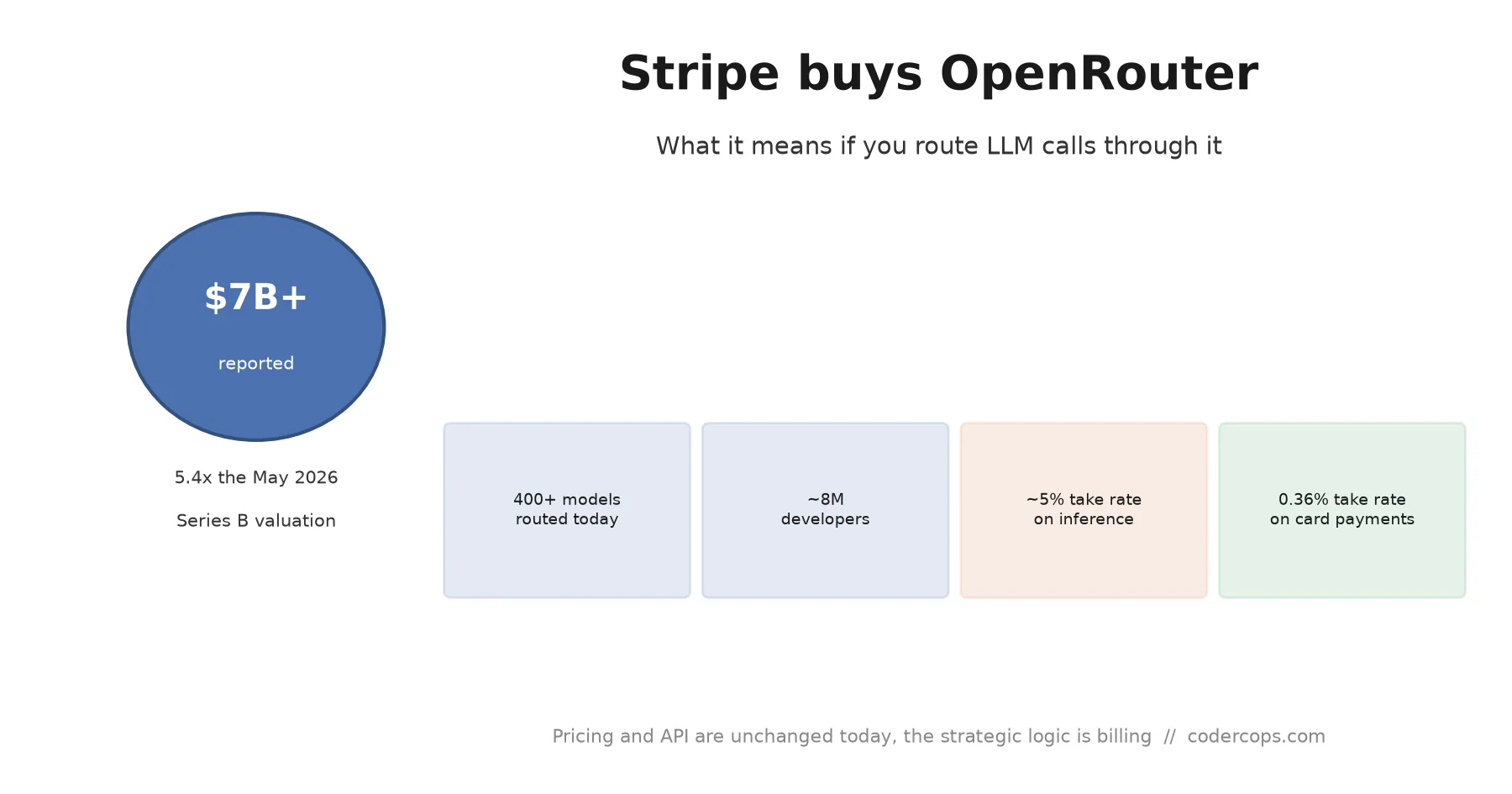
Stripe is acquiring the AI model gateway OpenRouter for more than $7 billion, roughly 50x its annualized revenue. Nothing changes in the API today, but the bet behind the price tells you where model routing and billing are headed.

Shashikant Gupta
5 min read
Sponsored
A payments company just paid more than $7 billion for a startup that doesn’t process a single payment. Stripe’s reported acquisition of OpenRouter, the gateway that routes API calls across hundreds of AI models, is a bet that model routing and billing infrastructure are actually the same problem wearing different clothes. If you route LLM calls through OpenRouter today, or you’re deciding whether to, the deal itself changes nothing yet. What it signals about where this layer of the stack is headed is worth paying attention to.
What OpenRouter is, for anyone who hasn’t touched it
OpenRouter solves a specific, common problem: calling more than one AI model provider without writing and maintaining a separate integration for each one. One API, one billing relationship, and a router that can switch between OpenAI, Anthropic, Google, Meta, DeepSeek, and dozens of smaller labs based on price, latency, or which model actually handles a given task best. It’s grown into real infrastructure, not a side project: roughly 8 million developers route something like 100 trillion tokens a month through it, and its annualized revenue reportedly hit $140 million in July 2026, up from $50 million at the end of 2025. That growth curve, tripling in about seven months, is most of why the price tag makes sense to acquirers even if it looks steep on paper.
The numbers behind the price tag
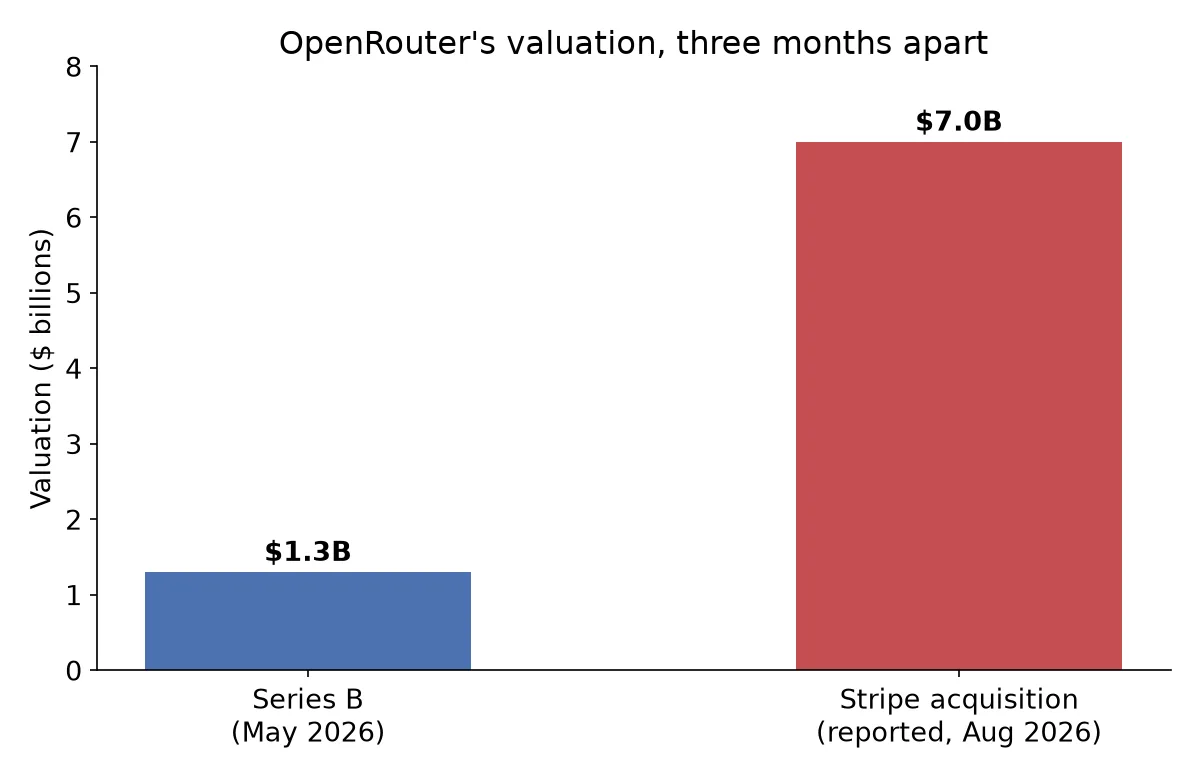
$7 billion is roughly 5.4x the $1.3 billion valuation OpenRouter set in its own Series B just three months earlier, in May 2026. It’s also close to 50 times its annualized revenue, a multiple that only makes sense if you believe the growth rate holds or accelerates, not just the current run rate.
The more interesting number for understanding why Stripe specifically wanted this isn’t the price, it’s the take rate. Stripe’s own cut on a typical card transaction is thin, reportedly around 0.36%. OpenRouter takes roughly 5% or more on the inference spend it routes. Put those side by side and the acquisition reads less like “AI is hot, buy AI thing” and more like a payments company looking at its own margins and deciding that metering AI usage is a fundamentally better business than metering card swipes.
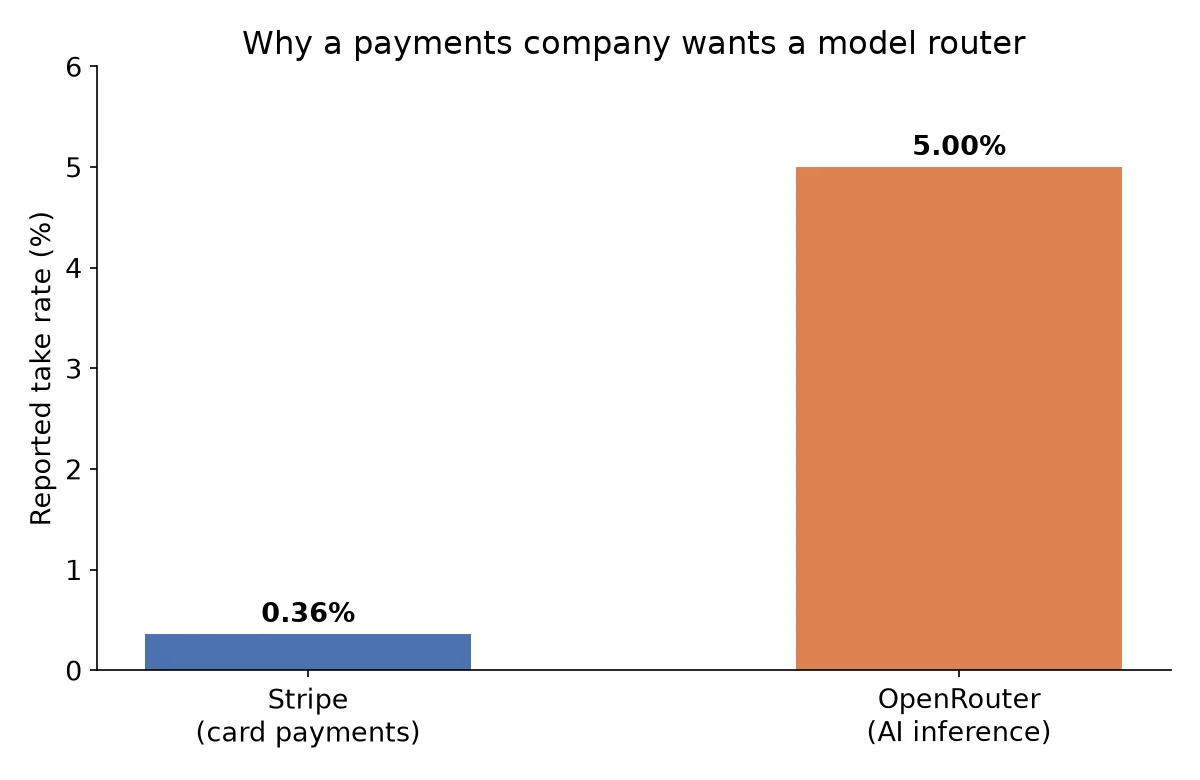
That’s the strategic logic reporters have converged on: AI inference is becoming a usage-metered cost the way cloud compute already is, and whoever owns the metering and billing layer for that spend captures a slice of a market that’s still compounding. Stripe already has the billing infrastructure half of that equation for a huge share of the internet’s SaaS and marketplace businesses. OpenRouter gives it the metering-and-routing half for AI specifically, positioned as what one analysis called “micropayments without a blockchain,” a real-time, usage-based settlement layer for tokens instead of purchases.
What actually changes for you today
As of this writing, nothing. OpenRouter’s pricing, API surface, and product are unchanged. Neither company has confirmed deal terms beyond what’s been reported, and Stripe’s public line has been the standard “we don’t comment on rumors or speculation.” If you’re routing production traffic through OpenRouter right now, there’s no button to click, no migration to plan, no contract to renegotiate this week.
What’s worth doing is distinguishing between reacting to news and managing a dependency you already have. Two things are true at once: this deal doesn’t require you to do anything today, and any time a critical piece of your stack changes hands, especially one that sits between your application and every model provider it talks to, it’s a reasonable moment to check how tightly you’re coupled to it.
# Coupling OpenRouter's API shape directly into your call sites means
# any future pricing, routing, or product change from its new owner
# touches every one of those call sites.
def call_model(prompt):
    response = openrouter_client.chat.completions.create(
        model="provider-a/model-name",
        messages=[{"role": "user", "content": prompt}],
    )
    return response.choices[0].message.content

# A thin abstraction layer keeps the gateway swappable. Same call sites,
# one place to change if OpenRouter's terms, pricing, or reliability
# shift under its new ownership.
def call_model(prompt, model="model-name"):
    return llm_gateway.complete(model=model, prompt=prompt)
That second pattern isn’t specific to this acquisition. It’s the same discipline you’d want regardless of which vendor sits behind your model calls, and our take on model routing and cost control covers the broader version of it. The acquisition is just a concrete, well-timed reminder that “the vendor behind my AI gateway” is not a fixed fact about your architecture, it’s a dependency like any other.
The consolidation risk worth actually tracking
The realistic risk isn’t a sudden price hike. It’s that the layer between your application and the model providers it calls is consolidating into fewer, larger companies, and each layer of consolidation reduces how much leverage you have if terms change later. OpenRouter’s pitch has always been provider-neutral routing: it doesn’t care whether you pick OpenAI or Anthropic or a cheaper open-weights model, it just routes. A payments company with its own margin incentives sitting on top of that neutrality is worth watching, not because there’s evidence of a problem yet, but because the incentive structure changed even though the product hasn’t.
If you’re building anything where AI inference cost is a meaningful line item, the practical move isn’t switching gateways reflexively. It’s making sure your integration is thin enough that switching is a config change if you ever need to, and keeping half an eye on how this specific deal actually gets integrated over the next two or three quarters before you decide it matters to your stack at all.
Frequently asked questions
- What does OpenRouter actually do?
- OpenRouter is a unified API that lets developers call more than 400 AI models from OpenAI, Anthropic, Google, Meta, DeepSeek, and dozens of other providers through one endpoint, switching between them by price, latency, or task. It routes roughly 100 trillion tokens a month for around 8 million developers and takes a percentage cut of the inference spend that flows through it.
- Is OpenRouter's pricing changing because of the Stripe deal?
- Not as of this writing. Reporting on the deal is consistent that OpenRouter's product and pricing are unchanged, and neither Stripe nor OpenRouter has publicly confirmed the transaction's terms or laid out integration plans. Treat this as a live risk to plan for, not a change to react to yet.
- Why would a payments company want an AI model router?
- Because Stripe's own take rate on card payments is thin, reportedly around 0.36%, while OpenRouter takes roughly 5% or more on the AI inference spend it routes. As AI usage becomes a metered, usage-based cost the way cloud compute already is, owning the layer that meters and bills for model calls is a much richer business than owning the card rail underneath a purchase.
- Should I move off OpenRouter now?
- Not on the deal alone. There's no functional or pricing change yet, and OpenRouter's core value, one API instead of a dozen provider SDKs, doesn't disappear because of who owns the company. What's worth doing now is not architectural panic: keep your provider abstraction thin enough that swapping a gateway is a config change, not a rewrite, regardless of who owns OpenRouter next year.
- What are the alternatives to OpenRouter if I want to reduce dependency risk?
- LiteLLM (self-hosted or managed) and direct multi-provider SDKs are the two most common paths, along with cloud-native routers like AWS Bedrock or Azure AI Foundry if you're already committed to one cloud. Each trades OpenRouter's breadth of 400+ models for more operational ownership, which is the right tradeoff for teams that want to own their routing layer outright rather than depend on any single vendor's roadmap.
Sources
Sponsored
More from this category
More from AI Integration
 R.01
R.01 Gemini 3.7 Flash Is Out: What Google's Coding-Focused Model Actually Changes
 R.02
R.02 Gemini 3.7 Flash Is Out: Google's Cheap, Fast Coding Model Just Got Better at Both
 R.03
R.03 Grok 4.6 Is Out: What Actually Changed Since 4.5
Sponsored
Discussion
Join the conversation.
Comments are powered by GitHub Discussions. Sign in with your GitHub account to leave a comment.
Sponsored