AI Integration · Model Releases
Gemini 3.7 Flash Is Out: What Google's Coding-Focused Model Actually Changes
Google DeepMind shipped Gemini 3.7 Flash on August 13, 2026, with a 50% introductory price cut and coding benchmark scores ahead of Claude Sonnet 5 and GPT-5.6 Terra. Here's what the numbers mean and whether it's worth switching a production pipeline.

Shashikant Gupta
5 min read
Sponsored
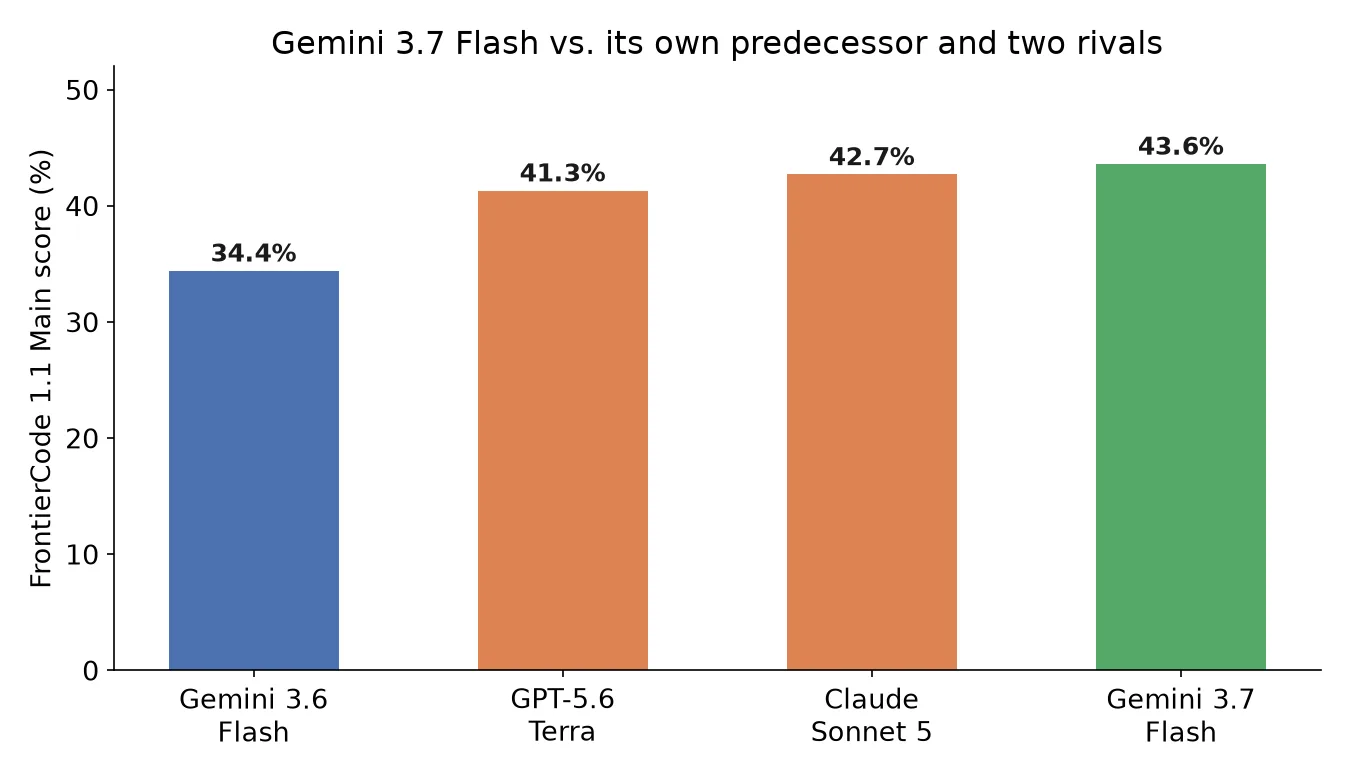
Google DeepMind shipped Gemini 3.7 Flash on August 13, three months after 3.6 Flash and with a specific target: coding, web development, and the agentic workflows that chain a model’s output into the next step without a human reading it first. The headline number is a FrontierCode 1.1 Main score of 43.6%, edging out Claude Sonnet 5 at 42.7% and GPT-5.6 Terra at 41.3%. That’s a genuinely tight three-way race, and the more useful number sits one benchmark over.
What actually shipped
Google is calling this an algorithmic improvement on 3.6 Flash, not a full retrain. That distinction matters for expectations: you’re not getting a new architecture or a step-change in general capability, you’re getting a model tuned specifically for the workloads Google thinks matter right now.
Three numbers tell the story:
| Benchmark | Gemini 3.6 Flash | Gemini 3.7 Flash | Change |
|---|---|---|---|
| FrontierCode 1.1 Main | 34.4% | 43.6% | +9.2 points |
| DeepSWE v1.1 (long-horizon) | 48.6% | 65.3% | +16.7 points |
| Code Arena web-dev Elo | 1538 | 1588 | +50 |
The FrontierCode gain is solid. The DeepSWE gain is the one worth paying attention to.
Why the long-horizon number matters more than the leaderboard win
FrontierCode tests single-pass correctness: give the model a coding task, check the output. DeepSWE v1.1 tests something closer to what an agent actually does in production, a multi-step task with intermediate decisions, where an early mistake compounds instead of just failing one test case. A 16.7-point jump there is a bigger deal than a one-point edge over Sonnet 5 on a single benchmark suite, because it’s evidence the model got better at the part of the job that’s hardest to fake: staying coherent across a long chain of actions.
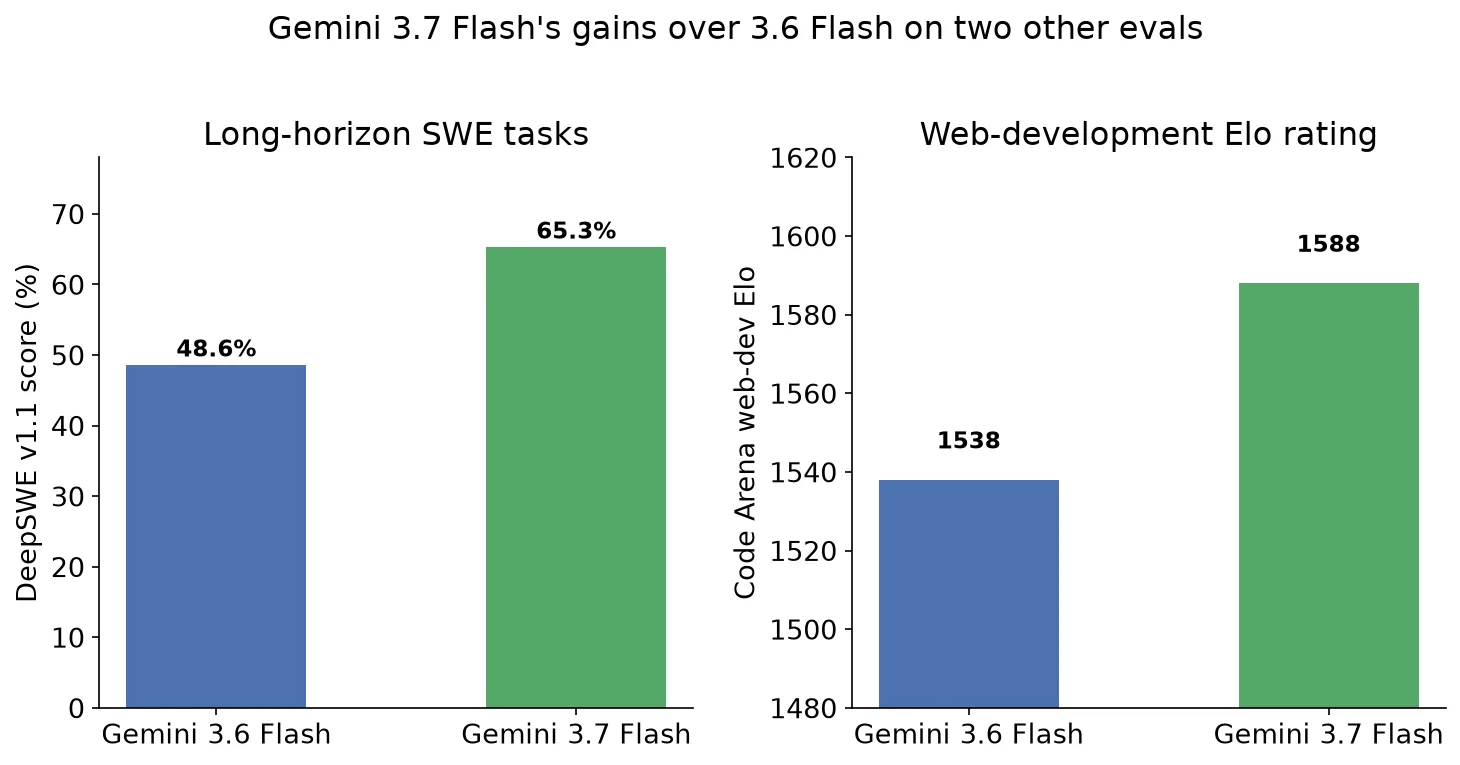
If your use of an LLM looks like autocomplete, one prompt, one answer, the FrontierCode number is more relevant to you. If you’re running an agent that plans, writes, tests, and revises across several turns without a human in the loop, DeepSWE is the number that predicts how often it goes off the rails halfway through, which matters more as more of that agent’s tool-calling moves into places like browser-native tool exposure via WebMCP.
Pricing: read the fine print before you build on it
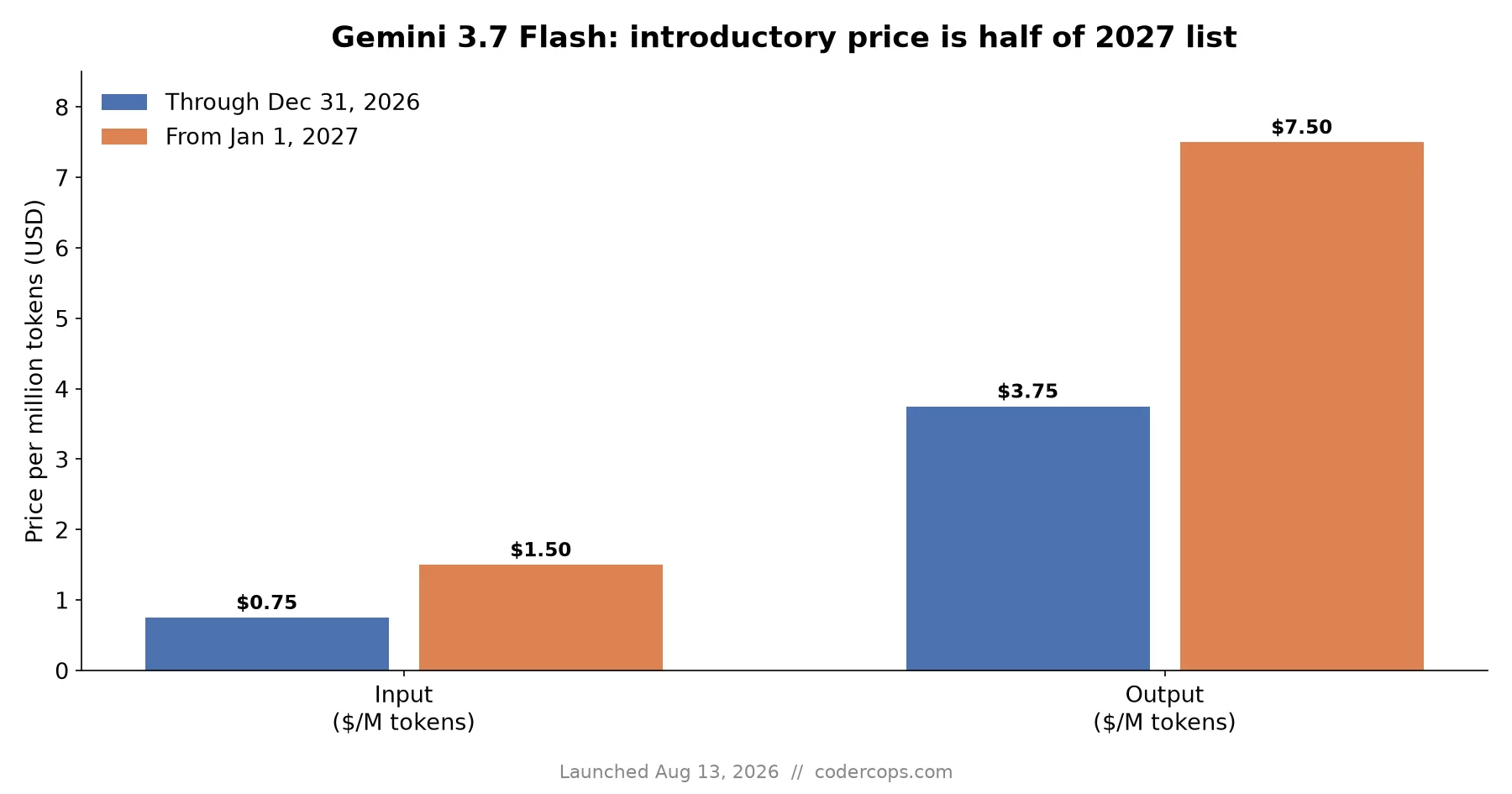
Gemini 3.7 Flash launches at $0.75 per million input tokens and $3.75 per million output tokens, about half of what the model will eventually cost. That introductory rate holds through December 31, 2026. After that, pricing doubles to $1.50 and $7.50 respectively.
That’s not a small detail if you’re doing capacity planning. A pipeline that pencils out at the intro price can look meaningfully different in Q1 2027 once the discount expires. If you’re deciding whether to build a new feature on 3.7 Flash, run the cost projection at the post-January rate, not the launch rate, before you commit to the architecture. We’ve walked clients through exactly this kind of AI feature budgeting exercise before, and the pattern repeats: teams that plan around the discounted price get an unpleasant surprise four months later.
What this doesn’t tell you
A benchmark win doesn’t mean the model is better for your specific task. FrontierCode and DeepSWE are useful signals, not a substitute for testing against your own code. Three things worth checking before you migrate anything:
- Run it against your actual prompts, not a generic coding challenge. A model that’s stronger on published benchmarks can still underperform your current model on a narrow, idiosyncratic task your prompts are already tuned for.
- Measure latency, not just accuracy. Flash-tier models trade some capability for speed. If 3.7 Flash’s improvements come with a latency hit that breaks your interactive UX, the benchmark score doesn’t matter.
- Check where the gains concentrate. The DeepSWE jump suggests this release is tuned for multi-step agentic work specifically. If your workload is short-form and single-turn, you may see a smaller real-world improvement than the leaderboard implies.
Where this fits in a crowded release cycle
Three flagship Flash-tier releases in under six months (3.5, 3.6, 3.7) is a faster cadence than most teams can realistically keep up with by re-evaluating every version. A more sustainable approach is picking a review cadence, quarterly is reasonable for most teams, and only re-testing against a new release when a change note suggests it’s relevant to your actual workload, rather than chasing every point release. If you’re weighing this against Gemini 3.5 Pro’s general availability from last month, the short version is: Pro trades speed for a much larger context window, Flash trades context for cost and latency. Pick based on which constraint you’re actually hitting, not which model shipped most recently.
The model is out, the numbers are real, and the three-way race at the top of the coding leaderboard is now close enough that picking a model on benchmark score alone stopped being a reliable strategy months ago. Test against your own workload before you switch anything.
Frequently asked questions
- When was Gemini 3.7 Flash released and what kind of update is it?
- Google DeepMind released it on August 13, 2026. It's described as an algorithmic improvement over Gemini 3.6 Flash rather than a ground-up retrain, which is consistent with how fast Google has been iterating on the Flash tier this year: three meaningful versions in under six months.
- Does Gemini 3.7 Flash actually beat Claude Sonnet 5 and GPT-5.6 Terra?
- On the specific benchmarks Google published, yes, by a narrow margin: 43.6% on FrontierCode 1.1 Main against 42.7% for Sonnet 5 and 41.3% for GPT-5.6 Terra. A one-point lead on one benchmark suite is not a categorical win. Treat it as evidence the three models are now close enough that your actual task, not the leaderboard, should decide which one you use.
- How much does Gemini 3.7 Flash cost?
- $0.75 per million input tokens and $3.75 per million output tokens through December 31, 2026. After that, standard pricing applies at $1.50 per million input and $7.50 per million output, doubling both rates. If you're building on the introductory price, budget for that increase now rather than getting surprised by it in January.
- Should I migrate an existing pipeline from 3.6 Flash or another model?
- Only after testing against your real prompts and your real codebase, not a published benchmark. The gains are genuinely large on long-horizon software engineering tasks specifically. If your workload looks like that, a A/B test is worth the afternoon. If your workload is short, simple completions, the benchmark gap matters far less than latency and your existing prompt tuning.
- What does 'FrontierCode' and 'DeepSWE' actually measure?
- FrontierCode 1.1 Main is a coding benchmark suite testing correctness across a range of programming tasks in a single pass. DeepSWE v1.1 tests long-horizon software engineering work, multi-step tasks closer to a real ticket than a single function, which is why the gap between 3.6 and 3.7 Flash is so much wider there than on FrontierCode.
Sources
Sponsored
More from this category
More from AI Integration
 R.01
R.01 Stripe Bought OpenRouter for $7B. Here's What It Means If You Route LLM Calls
 R.02
R.02 Gemini 3.7 Flash Is Out: Google's Cheap, Fast Coding Model Just Got Better at Both
 R.03
R.03 Grok 4.6 Is Out: What Actually Changed Since 4.5
Sponsored
Discussion
Join the conversation.
Comments are powered by GitHub Discussions. Sign in with your GitHub account to leave a comment.
Sponsored