AI Integration · Model Releases
Gemini 3.7 Flash Is Out: Google's Cheap, Fast Coding Model Just Got Better at Both
Gemini 3.7 Flash shipped three weeks after 3.6 Flash, with real gains on debugging and first-pass code accuracy, and pricing held at half of list through the end of 2026. Here's what changed and where it actually fits.

Shashikant Gupta
4 min read
Sponsored
Google shipped a new Gemini Flash model three weeks after the last one, which tells you something about how the release cadence has changed this year: point releases now land like software patches, not flagship launches. Gemini 3.7 Flash is out as of August 13, 2026, and Google’s own framing is narrower than usual, this one is built for coding and agents specifically, not positioned as a general-purpose upgrade across the board.
What actually changed
The headline improvements are debugging accuracy, issue resolution, and first-pass code correctness. That’s a deliberate, narrow target. In an agentic coding loop, whether that’s an IDE assistant, a CI-triggered fix-it bot, or an autonomous coding agent working through a backlog, the cost of a wrong first attempt isn’t just wasted tokens, it’s an extra round trip: generate, test, fail, diagnose, regenerate. A model that gets more attempts right the first time collapses that loop, and that’s a more useful axis to optimize than raw benchmark scores on tasks most teams aren’t running.
Google didn’t change the context window (still 1 million tokens) or the output cap (64,000 tokens), and it’s still multimodal across text, image, video, and audio input. This is a capability update within the same envelope, not a bigger model.
The pricing detail that actually matters for planning
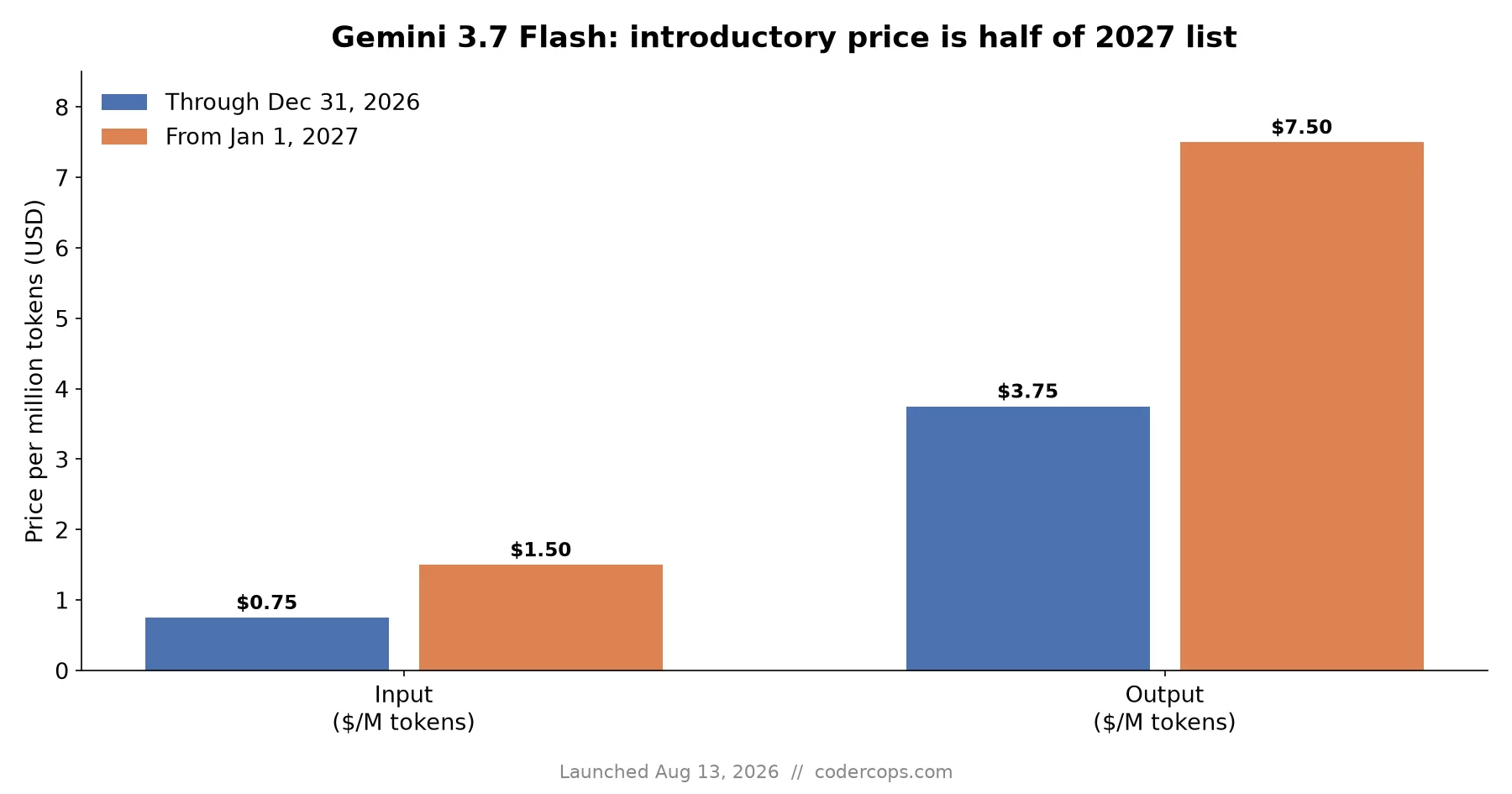
| Through Dec 31, 2026 | From Jan 1, 2027 | |
|---|---|---|
| Input | $0.75 / million tokens | $1.50 / million tokens |
| Output | $3.75 / million tokens | $7.50 / million tokens |
The halved introductory pricing is a real number to plan around, not a permanent one. If you’re scoping a project that runs a coding agent against Gemini 3.7 Flash at meaningful volume and the timeline crosses into 2027, budget for the list price doubling on January 1, not the launch price holding indefinitely. Teams that build cost projections off launch-week pricing and forget the sunset date are the ones surprised by a doubled bill in Q1.
# Rough monthly cost estimate for a coding agent workload
input_tokens_per_month = 400_000_000   # e.g. 3.7 Flash reading diffs, logs, context
output_tokens_per_month = 60_000_000   # generated patches, explanations

# 2026 introductory pricing
cost_2026 = (input_tokens_per_month / 1_000_000) * 0.75 + (output_tokens_per_month / 1_000_000) * 3.75
# 2027 list pricing
cost_2027 = (input_tokens_per_month / 1_000_000) * 1.50 + (output_tokens_per_month / 1_000_000) * 7.50

print(f"2026: ${cost_2026:,.2f}/mo   2027: ${cost_2027:,.2f}/mo")
# 2026: $525.00/mo   2027: $1,050.00/mo
Same workload, double the bill, purely from the pricing calendar. Worth putting on a finance calendar the same way you’d track a cloud reserved-instance expiration.
Why Flash shipped first, and what that means for your model routing
Gemini 3.5 Pro, the model most teams are actually waiting on for harder reasoning work, is still delayed. That’s left Flash doing double duty: it’s simultaneously the budget tier and, for three weeks now, the most current model Google has shipped. If your routing logic sends complex tasks to Pro and routine ones to Flash, there’s nothing to change yet, Flash getting better doesn’t substitute for Pro’s reasoning depth on the tasks you were routing to Pro for. What it does change is the floor: the cheap option in your routing table just got meaningfully more reliable on coding tasks specifically, which is worth revisiting if your Flash-tier accuracy was previously the reason certain tasks got escalated to a pricier model by default.
This is the same evaluation discipline that applies to any model swap in a production pipeline: don’t take a vendor’s benchmark claims as your production baseline. Run your own eval set, the actual prompts and code patterns your agent handles, against both the old and new model versions before flipping the default, and keep the eval running after the switch in case a regression shows up on a task type the vendor’s benchmarks didn’t cover.
Where this fits if you’re building agentic coding workflows
A cheap, fast model that’s gotten better at first-pass correctness is specifically useful for the high-volume, lower-stakes end of an agentic pipeline: automated test generation, routine dependency-bump PRs, changelog drafting, code review comments on style and obvious bugs. It’s a worse fit for anything where a subtly wrong answer is expensive to catch after the fact, security-sensitive logic, complex architectural changes, anything touching money or auth. The practical pattern most teams land on is tiered: Flash for volume, a stronger model gated behind either explicit escalation rules or a confidence threshold for the tasks where being wrong costs more than the token savings are worth.
If you’re evaluating where a model update like this actually earns its place in your stack rather than just swapping a config value and hoping, our team has run exactly that kind of model-routing audit for clients building production AI features.
Frequently asked questions
- What's actually new in Gemini 3.7 Flash versus 3.6 Flash?
- Google's release notes point to concrete gains in debugging and issue resolution accuracy, plus higher first-pass code correctness on software engineering and web development tasks. It's not a context window or modality change, both models handle the same input types, it's a capability jump on the specific tasks coding agents run most often: understanding an error, proposing a fix, and getting that fix right without a second attempt.
- How much does Gemini 3.7 Flash cost?
- $0.75 per million input tokens and $3.75 per million output tokens through December 31, 2026. That's half of the list price Google has set for 2027, when it rises to $1.50 and $7.50 respectively. If you're budgeting a project that spans the new year, plan for the price to double on January 1.
- Should I switch from Gemini 3.6 Flash to 3.7 Flash?
- For coding and agentic workloads, yes, the pricing is the same and the accuracy gains are specifically in that use case. For general-purpose text tasks where 3.6 Flash was already meeting your bar, there's less urgency, but there's also no cost penalty to switching since pricing didn't change between versions.
- Why did Google ship a Flash update instead of the delayed Gemini 3.5 Pro?
- Google hasn't stated a reason publicly, but the practical effect is that Flash, normally the cheaper, faster tier below a flagship Pro model, is currently the newest model in the lineup by three weeks. Teams waiting on 3.5 Pro for harder reasoning tasks are still waiting; teams that need a fast, cheap coding model got an upgrade instead.
- Is Gemini 3.7 Flash good enough to replace a more expensive model for coding agents?
- That depends on your task's error tolerance. For high-volume, lower-stakes agentic loops, code review comments, test generation, routine refactors, the combination of low cost and improved first-pass accuracy makes Flash a reasonable default. For tasks where a wrong output is expensive to catch (complex architectural changes, security-sensitive code), route through Flash for cheap early passes and reserve a stronger model for final validation.
Sources
Sponsored
More from this category
More from AI Integration
 R.01
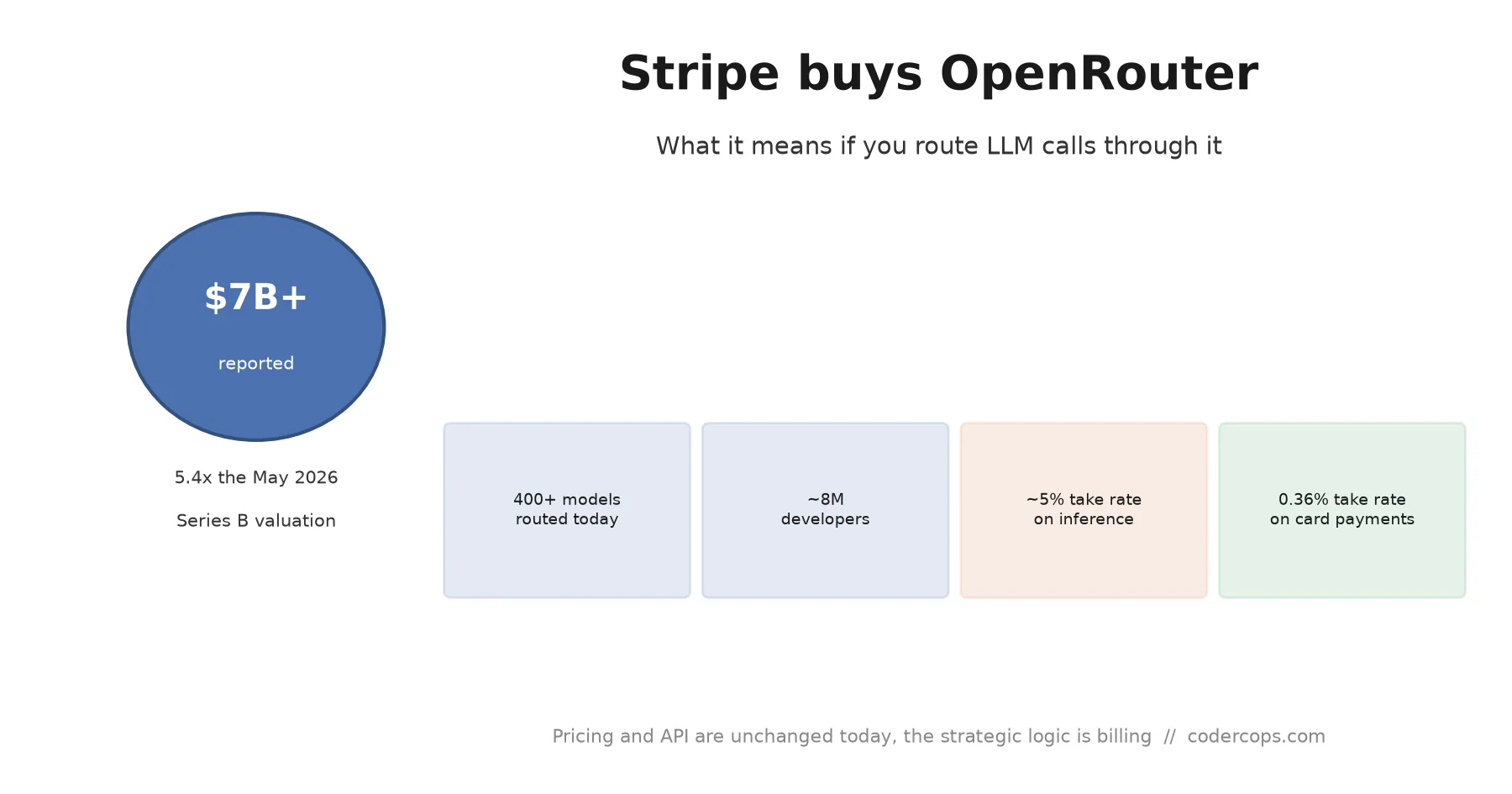
R.01 Stripe Bought OpenRouter for $7B. Here's What It Means If You Route LLM Calls
 R.02
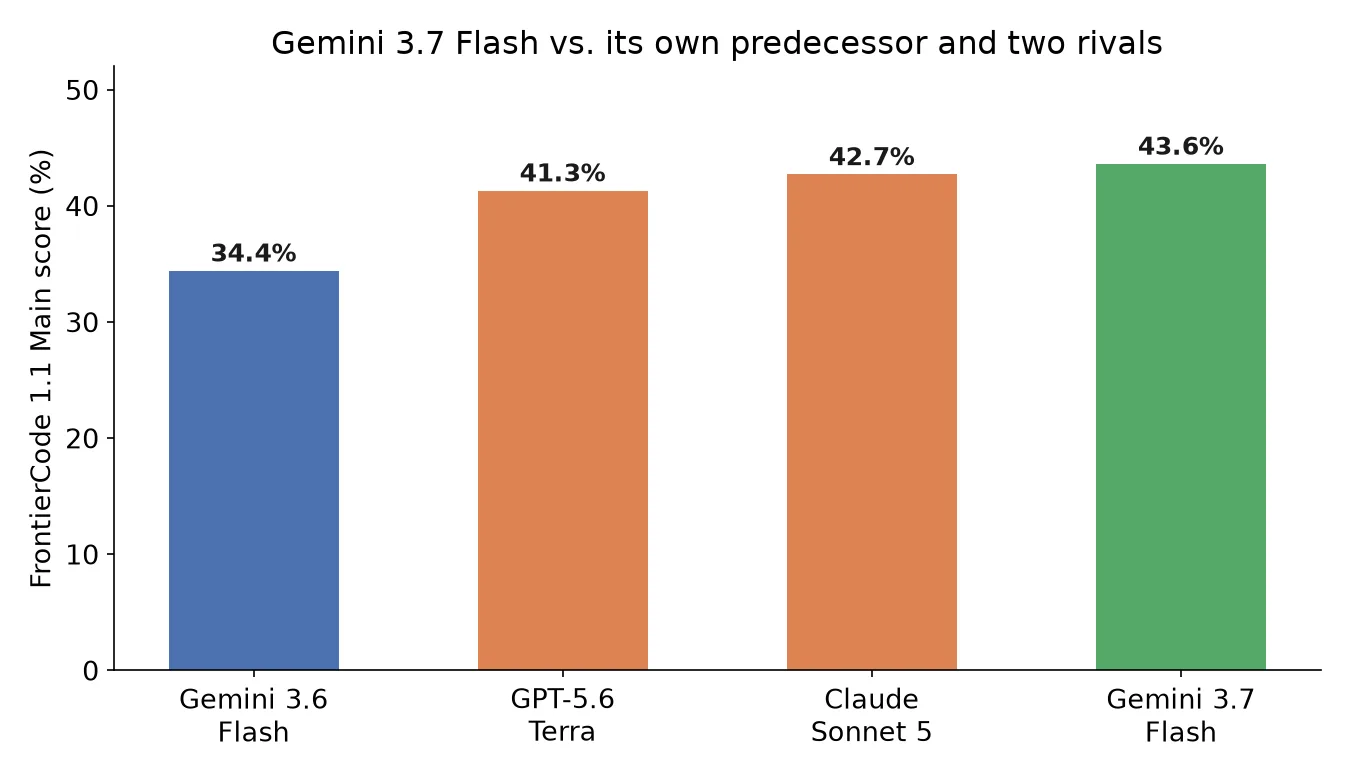
R.02 Gemini 3.7 Flash Is Out: What Google's Coding-Focused Model Actually Changes
 R.03
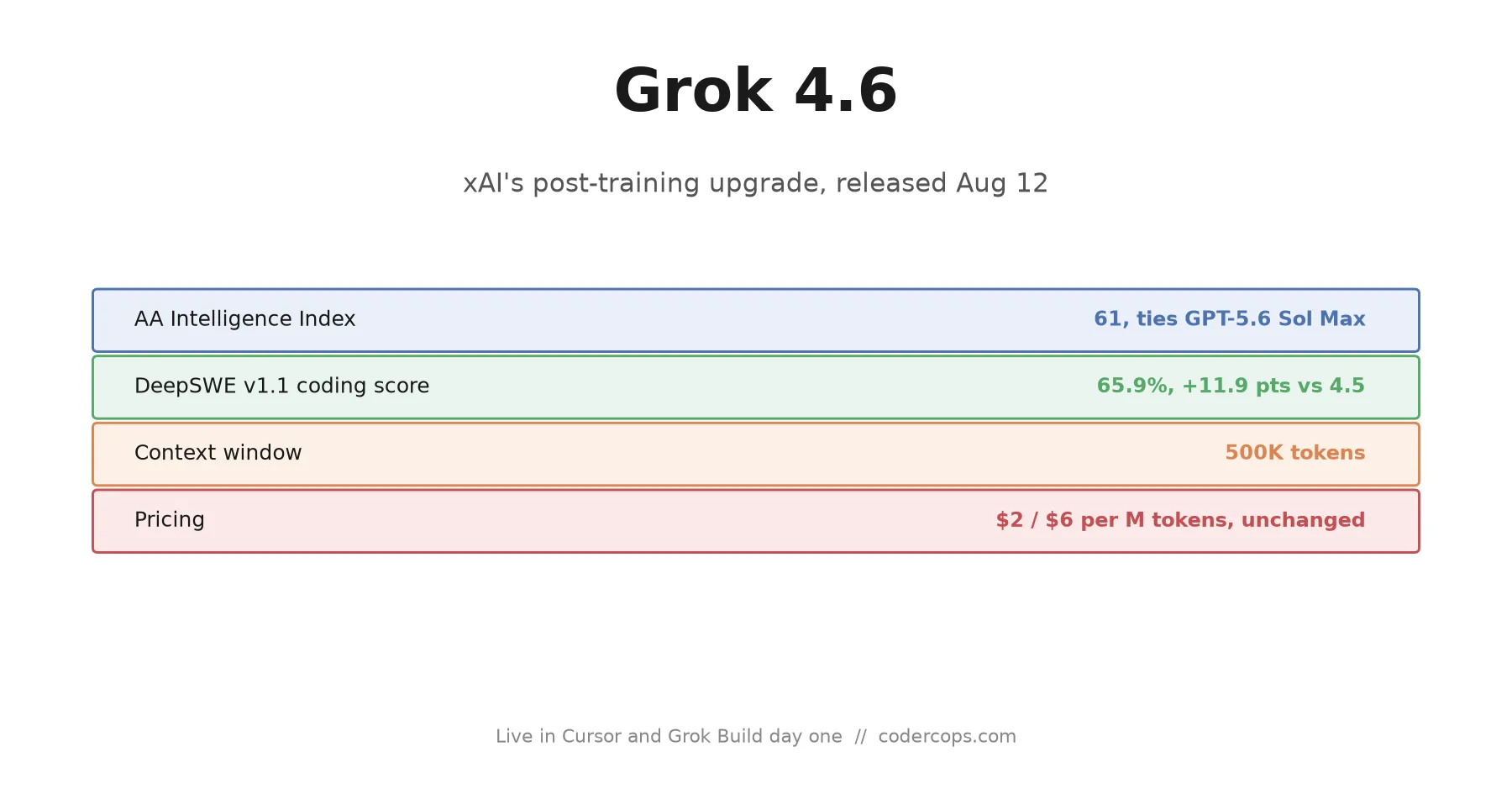
R.03 Grok 4.6 Is Out: What Actually Changed Since 4.5
Sponsored
Discussion
Join the conversation.
Comments are powered by GitHub Discussions. Sign in with your GitHub account to leave a comment.
Sponsored